
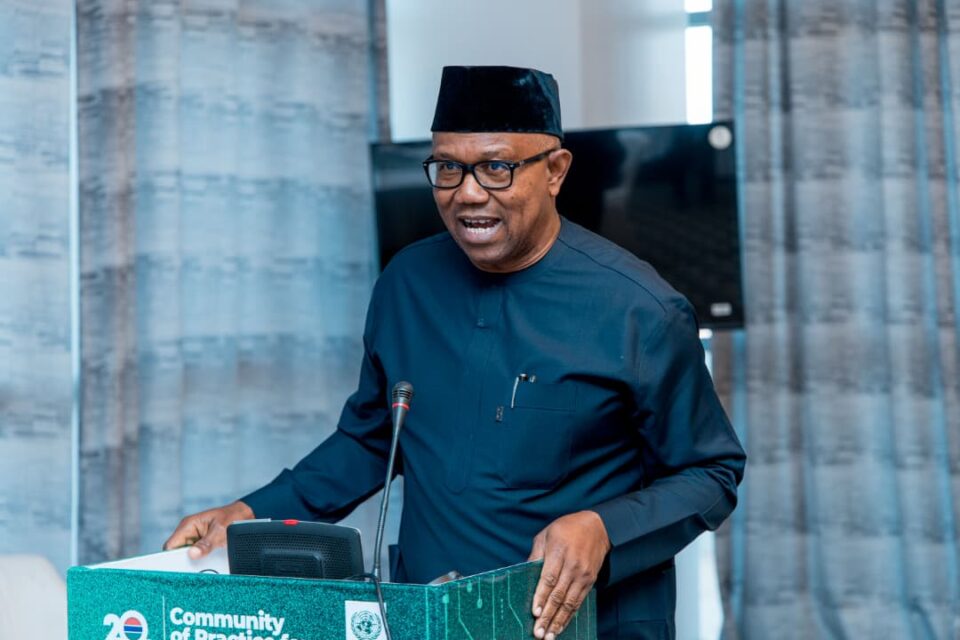
Former Anambra State Governor, Peter Obi, has urged members of the Nigeria Democratic Congress to shun litigation and internal disputes, warning that court battles could undermine efforts to build a viable political alternative ahead of the 2027 general elections.
Obi made the appeal in remarks captured in a video circulating on Sunday, shortly after he and former Kano State Governor, Rabiu Kwankwaso, were seen receiving membership cards of the party, signalling what appears to be their formal entry into the platform.
Addressing party members, Obi stressed the need for unity and discipline, noting that internal legal conflicts have historically weakened political parties in Nigeria.
“Please let there be no litigation. Party members, please don’t go to court. We want to build a party, we are not lawyers.
“We are pleading with the judiciary. Please end cases in party so we can face the job of building a new Nigeria that is possible,” he said.
Obi framed his appeal within a broader vision of national transformation, arguing that political actors must prioritise institution-building over personal interests.
“We want to build a country where a child of nobody can be somebody without knowing anybody. That is what we want to do,” he said.
The former Labour Party presidential candidate also warned against actions capable of destabilising the party at a critical stage of its formation, suggesting that discipline would be enforced where necessary.
The development comes amid intensifying political realignments among opposition figures seeking to form a united front ahead of the 2027 polls.
Obi and Kwankwaso had, hours earlier, held a closed-door meeting with leaders of the NDC at the Abuja residence of the party’s National Leader and former Bayelsa State Governor, Seriake Dickson. The meeting, held in Guzape, is believed to be part of ongoing consultations to consolidate opposition forces.
Their appearance at the event drew supporters under the Obi-Kwankwaso Movement, who chanted in solidarity as both leaders were ushered into the venue.
The move followed Obi’s recent exit from the African Democratic Congress, which he attributed to internal crises, persistent legal disputes, and what he described as a toxic political environment marked by division and distraction from national issues.
Obi had maintained that his decision to leave the ADC was not driven by personal grievances with party leaders but by systemic challenges that, in his view, hinder effective political organisation.
Despite the shifting alliances, he reiterated that his political engagement is driven by national interest rather than personal ambition.
“I am not desperate to be President, Vice President or Senate President. I am desperate to see a Nigeria where people can live in dignity, without hunger, fear, or displacement,” he had said.
His latest appeal to NDC members underscores concerns among opposition figures about the destabilising impact of intra-party litigation, as they attempt to build a cohesive platform capable of challenging the ruling party in the next general elections.
In this article