
.As GIABA holds media outreach
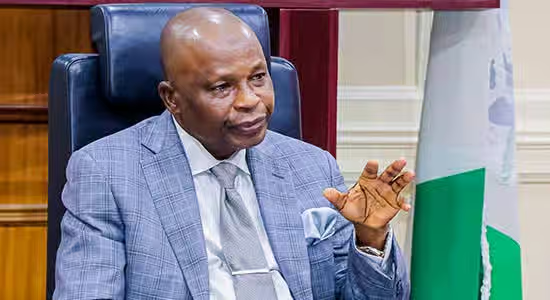
The Attorney-General of the Federation and Minister of Justice, Lateef Fagbemi (SAN), has called for a coordinated, informed and proactive response from all stakeholders against money laundering and terrorism financing.
Speaking Tuesday at a media outreach and advocacy programme organised by Inter-Governmental Action Group against Money Laundering in West Africa (GIABA), the AGF expressed worries that the crimes do not just threaten the economy of the West-African Sub-region but have also affected institutional credibility and placed citizens’ safety at stake.
According to him, the complex, transnational and constantly evolving nature of the crimes require a coordinated, informed and proactive response from all stakeholders.
Fagbemi, who declared the programme opened, said that Nigeria has over the years, strengthened its Anti-Money Laundering and Combating the Financing of Terrorism (AML/CFT) framework through legislative reforms, regional and international collaboration as well as enhanced inter-agency partnership.
He However stressed that beyond laws and enforcement mechanisms, public awareness and understanding remained indispensable in winning the fight against the crimes.
“We must collectively work to demystify technical concepts, expose illicit financial activities and promote a culture of transparency and accountability. When the public is well-informed, it becomes more difficult for criminal networks to operate undetected”, Fegbemi said.
In his welcome address, the Director General of GIABA, Mr Edwin W. Harris Jr, charged the media against compromise.
Represented by the Country Director, GIABA, Mr Timothy Melaye, the D.G noted that the anti-graft war cannot be effective without the active involvement of the media. He therefore called for deepening of narratives in identifying and exposing money laundering.
“The media must not allow itself to be used by suspected money launderers and looters of public treasury to truncate the course of justice. However, the anti-graft fight cannot be effective without the active involvement of the media, which has the dual capacity for educating the public on the menace of money laundering and directly investigating and tracking down those involved.”
He however stated that the task is not exclusive for journalists as GIABA also
interacts with and build capacity of other stakeholders, including law enforcement agencies, judiciary, financial institutions and civil society organisations.
“All hands must be on deck for us to achieve the desired outcomes”, Harris said.
In her remarks, the Chief Executive Officer, Nigerian Financial Intelligence Unit (NFIU), Hafsat Abubakar Bakari, highlighted the role of technology in facilitating money laundering.
“The funds that move quietly through illicit channels often fuel organised crime, corruption, trafficking networks and violent extremism. When these financial flows go unnoticed or unexplained, they weaken institutions, distort economies and ultimately threaten national stability.”
She noted that across West Africa, money laundering and terrorist financing are no longer abstract legal concepts but real threats with serious consequences.
“This is precisely where the media becomes indispensable. Journalists serve as society’s interpreters of complex issues. They translate technical subjects such as anti-money laundering, counter-terrorism financing and counter proliferation financing, into information that citizens can understand and act upon.
The role of responsible journalism is therefore, not simply to repeat information but to question, explain and illuminate. And in the fight against financial crime, that role is more important than ever”, she said.
With ‘Strengthening collaboration between financial intelligence institutions and
the media to deepen public awareness of the risks and consequences of money laundering and terrorist financing’, as theme of the outreach, she commended GIABA for recognising that the effectiveness of AML/CFT frameworks depends not only on laws and enforcement agencies but also on public understanding and civic vigilance.
“This understanding cannot develop without a knowledgeable and engaged media community. That is why today’s programme is about building a network of journalists, who understand financial crime issues, who can report them accurately and, who can help amplify the message that illicit finance harms societies at every level.
“A corrupt payment hidden in a contract, an unexplained transfer through shell accounts, or suspicious flows linked to extremist groups may appear technical when viewed through regulatory language but when explained clearly, citizens begin to see the broader picture, that these activities divert resources from development, weaken public institutions and undermine national security.
“In Nigeria, NFIU works closely with law enforcement, regulators and international partners to analyse financial intelligence and support investigations into these crimes. Yet our work becomes significantly more impactful when the public understands why vigilance against illicit finance matters.”
In his goodwill message, Chairman, Independent Corrupt Practices and other related Offences Commission (ICPC), Dr Musa Adamu Aliyu (SAN), described money laundering and terrorist financing as destabilising threat to economic systems, national security and democratic institutions.
This he said, erode public trust, undermine governance, distort markets and deprive citizens of the resources required for sustainable development.
“In a region as dynamic and interconnected as West Africa, the imperative to strengthen our collective response has never been more urgent and what makes this challenge particularly formidable is the fact that financial crime does not stand still, it adapts, innovates and exploits every new frontier that technology opens.
“The advent of the internet, social media and Artificial Intelligence (AI) has dramatically altered the landscape of financial crime. Criminals now launder proceeds across jurisdictions at the click of a button.
“They radicalise and fund extremist networks through anonymous online channels as well as deploy sophisticated cyber-enabled fraud schemes that target unsuspecting citizens across the length and breadth of the society.
“The speed and anonymity that digital technologies afford have made detection far more challenging and the stakes considerably higher. Yet, the same technologies in the right hands, present extraordinary opportunities for us to be several steps ahead of the crime curve.
“We do not have to be perpetually on the back foot and it is in this regard that I wish to commend NFIU for its deployment of advanced analytics, AI and real-time …transaction monitoring systems to detect suspicious financial flows with greater precision and speed. This is exactly the kind of forward-looking, technology-driven approach that must define our collective response to crime in the 21st century.
“We must not merely react to the crime curve, we must anticipate and
reshape it. It is against this backdrop that the role of the media assumes singular importance. The media is the cornerstone of democratic governance and one of the most powerful checks on the abuse of power that any society can possess.”
Stressing that the media have an unrivalled capacity to shape norms, values and attitudes across the society, he said such capacity must be deliberately and strategically harnessed.
“Content on our airwaves and digital platforms must be intentionally crafted to ingrain anti-corruption ideals and financial integrity values into the consciousness of Nigerian citizens from the earliest age.
“The ICPC in the discharge of its tripartite mandate of enforcement, prevention and public education, has long recognised that legal sanctions alone cannot eradicate corruption. Sustainable change requires a fundamental shift in societal values and the media is our most powerful partner in achieving that shift.
“Corruption and money laundering are deeply intertwined. Proceeds of corruption are routinely laundered to conceal their criminal origins and it is this very nexus that demands a whole-of-society response.
GIABA was established in the year 2000 by the ECOWAS Authority of Heads of State and Government with the mandate to protect member States’ economies from the laundering of the proceeds of crimes and combat terrorism financing (TF).
Consequently, it works to ensure that member States comply with acceptable international standards on Anti-Money Laundering (AML) and Combating the Financing of Terrorism (CFT).
In this article