
BY
UJAH ISRAEL UJAH ESQ B/Phil, LLB, BL, LLM, [Ph.D in View]
“Justice must not only be done; it must also be seen to be done.” That timeless principle has guided judicial reasoning for centuries. Yet, increasingly, one cannot help but ask whether some bail conditions being imposed by Nigerian courts are gradually departing from that philosophy.
The recent decision of the Federal High Court, Abuja, granting activist and former presidential candidate Omoyele Sowore bail in the sum of ₦200 million, with conditions requiring two sureties, one being a traditional ruler from his community and the other an owner of landed property within the Federal Capital Territory, coupled with the surrender of his international passport, has once again ignited an important conversation; not merely about Mr. Sowore, but about the philosophy of bail itself.
This article is not about whether Mr. Sowore is guilty or innocent. His guilt or innocence remains a matter for the court to determine after hearing all the evidence. Rather, it concerns whether the conditions attached to his liberty align with the constitutional and philosophical foundations upon which bail rests.
The law has always recognised one fundamental principle: bail is not a punishment. It is merely a mechanism designed to secure the attendance of an accused person at trial while preserving the constitutional presumption of innocence. Courts have repeatedly held that bail conditions should never be excessive, oppressive or impossible to satisfy. A bail condition that is practically unattainable amounts to a disguised refusal of bail.
The ordinary Nigerian understands justice less from legal textbooks than from what he sees in practice. When a court grants bail on paper but imposes conditions that appear almost impossible to fulfil, the public naturally begins to question whether justice has truly been served.
One cannot ignore a curious aspect of the Sowore ruling. The court directed him to surrender his international passport. Ordinarily, that is a familiar condition. However, reports suggest and indicate that his passport had already been seized before in connection with the proceedings. If that is indeed the case, one is compelled to ask: what additional purpose does repeating that condition serve? Judicial orders should always be meaningful and practical rather than merely symbolic. Perhaps even more troubling is the requirement that one surety must be a traditional ruler from his community. While courts possess discretion in fashioning bail conditions, such discretion ought to be exercised judicially and judiciously. The law ordinarily requires sureties capable of ensuring the defendant’s attendance in court; not persons clothed with particular traditional or social status.
Let us ask ourselves this question; is it the traditional ruler that is attending to local meetings; making efforts to sort out bandit and communal clashes between Fulani herdsmen in faraway Ondo or Oyo state that should be dragged into the liberty of Mr. Sowore? One wonders how many Nigerians could realistically satisfy such a condition. If the benchmark for liberty gradually shifts from legal sufficiency to social privilege, then justice risks becoming accessible only to those with extraordinary influence. A Wiseman once said: if you don’t want to give me the goat with its rope; then it is needless giving me the goat and holing unto its rope. It is better bail is refused out rightly than what is playing out.
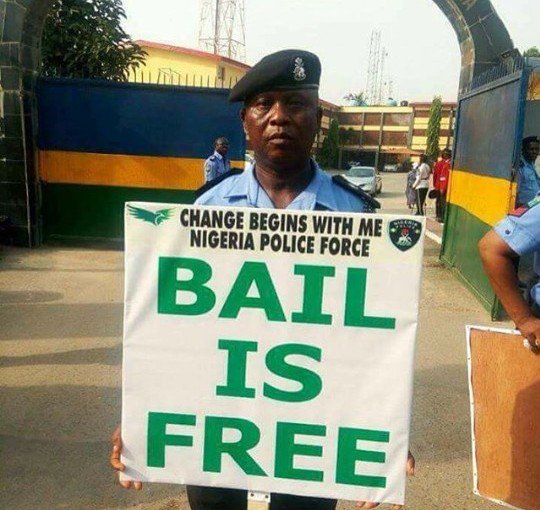
Ironically, the legal profession has consistently condemned law enforcement agencies; particularly the Police and the EFCC; whenever they impose outrageous administrative bail conditions. We have challenged demands for unreasonable sureties, excessive monetary deposits, or impractical documentation. We have approached the courts, rightly so, asking judges to intervene as guardians of constitutional liberty.
The courts have often reminded investigative agencies that administrative bail must not become an instrument of oppression. But what happens when similar concerns now arise from judicial bail itself? The question is uncomfortable, yet unavoidable.
If lawyers criticise the Police for imposing oppressive bail conditions but remain silent when courts impose similarly burdensome conditions, then our commitment is not to justice but to convenience. The judiciary occupies a unique constitutional position. It is the last refuge of the common man. Every institution of government may falter, but public confidence in the courts must remain unwavering. Once that confidence begins to erode, the very foundation of constitutional democracy becomes endangered.
Judges undoubtedly operate under enormous pressure. They must balance the rights of accused persons with societal interests, ensure attendance at trial, protect the integrity of judicial proceedings, and maintain public confidence. Those are not easy responsibilities. Yet, in pursuing justice, the judiciary must equally avoid the appearance of injustice.
There are occasions when the law requires firmness. There are equally occasions when restraint better serves justice. Judicial discretion is most admirable not when it demonstrates power, but when it demonstrates wisdom.
Nigeria today sits upon a delicate political and social landscape. Public confidence in institutions continues to diminish. In such an environment, every judicial decision carries consequences extending beyond the courtroom. Courts must therefore exercise their enormous discretionary powers with heightened sensitivity, recognising that every order contributes either to strengthening or weakening public trust.
The judiciary must guard its institutional credibility jealously. It should never place itself in a position where citizens begin to perceive judicial bail as more punitive than administrative detention. The law exists to protect liberty while ensuring accountability; not to create the illusion of liberty through conditions that defeat its very purpose.
As lawyers, we owe a duty not only to defend our clients but also to defend the integrity of the legal system itself. Constructive criticism of judicial decisions is not an attack on the judiciary; it is an indispensable feature of constitutional democracy. Courts have evolved through reasoned criticism, principled debate, and scholarly reflection.
One hopes that our courts will continue to remember that justice is measured not merely by the correctness of its decisions, but by the confidence those decisions inspire in the minds of ordinary citizens. For when the common man begins to doubt the fairness of the temple of justice, society risks losing far more than a single case; it risks losing faith in the rule of law itself.
Author’s Reflection
The issue raised by the Sowore bail decision extends beyond one individual. It presents an opportunity for sober institutional introspection. Judicial discretion remains one of the most powerful tools entrusted to the courts, but like every great power, it demands corresponding restraint. History teaches us that the strength of a judiciary is not measured by the severity of its orders but by the confidence its judgments inspire. If the courts are perceived as imposing conditions that ordinary citizens regard as excessive or unattainable, the institution itself bears the burden of that perception. In a democracy already grappling with declining public trust in institutions, the judiciary must remain the stabilising force; not the institution whose decisions inadvertently deepen public cynicism. Justice should never wear the appearance of punishment before conviction.
About the Author
Ujah Israel Ujah is a legal practitioner, public affairs commentator, and writer with a keen interest in constitutional law, judicial accountability, electoral jurisprudence, and the intersection between law and governance in Nigeria. His writings seek to simplify complex legal issues while promoting the rule of law, institutional integrity, and access to justice.
He can be reached via: monkiszrel@gmail.com
In this article