
By Tobiloba Ahmed
Sir: President Bola Ahmed Tinubu inherited a lot of challenges such as banditry, kidnapping, terrorism, armed robbery, assassination of lives, cybercrime, communal clashes, and religious violence, just to mention but a few.
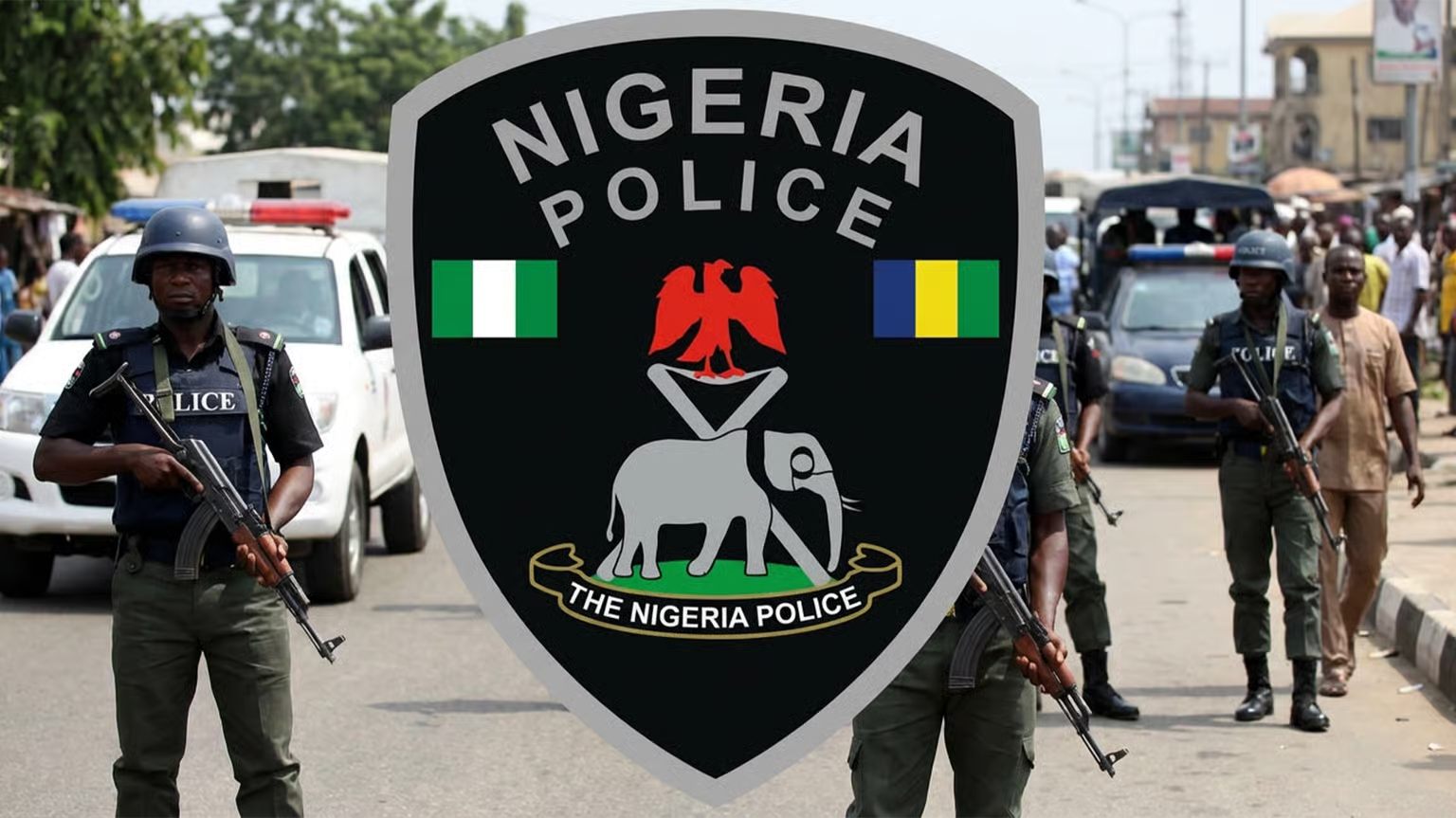
Notwithstanding, I think there is urgent need for the Senate to expedite action on the creation of state policing to help fight insecurity in our beloved country.
The recent communal violence and mass killing by gunmen in Angwan Rukuba in Jos North, where over 28 to 30 people were killed and several others injured, in addition to the Easter weekend (April 5–6, 2026) attacks at Mbalom community (Gwer West), where 17 people were killed, are clear indications of the insecurity challenges facing the nation.
Having seen that there is a serious lacuna in tackling insecurity, it behooves on us to do something very drastic to change the security architecture of the country. One of the ways to make that happen is creation of state police, whereby each state in the country will have its own police force, controlled and managed by the state government, rather than relying on the centralised Nigeria Police Force, which is controlled by the Federal Government and has been prone to several inefficiencies.
If state policing is adopted by all the 36 states, including the Federal Capital Territory, Abuja, it will help maintain law and order within each state.
Response time will be quicker and more efficient. It will help protect rural areas, which are often neglected by the Federal Police, and will also encourage collaboration with traditional rulers and community leaders within the state.
With the creation of state police, policing will be brought closer to the people at the grassroots level, whereby security becomes more accessible and response time becomes faster and we will think less about severe security threats in this country.
The benefits of state police also include:
• Better local intelligence, because officers understand the language, culture, and terrain of the communities they protect.
• It will help improve security in rural areas, as many villages currently lack police presence; state police can fill this gap.
• Reduced burden on the Federal Police, allowing the Nigeria Police Force to focus more on national security, terrorism, interstate crimes, and other major concerns.
• Accountability, as citizens can hold their state governments responsible for security, making performance easier to monitor.
In most civilised societies, such as the United States of America, state policing has proven to be effective.
Today, the U.S. operates thousands of independent police agencies, including:
• State Police (e.g., Texas Department of Public Safety), County Sheriffs and City Police Departments (like New York Police Department).
Each state controls its policing structure, funding, and operations. This decentralised system has been especially effective in addressing crime because local officers know their terrain, culture, and crime patterns better than a distant central authority.
For instance, in major cities like New York City, crime rates dropped significantly in the 1990s due to localised policing strategies such as community policing and data-driven policing. Officers worked closely with residents, gathered intelligence, and responded quickly to threats. I believe that if state policing is adopted, Nigeria can be better secured, and citizens can sleep peacefully with both eyes closed.
Tobiloba Ahmed wrote from Lagos.
In this article