
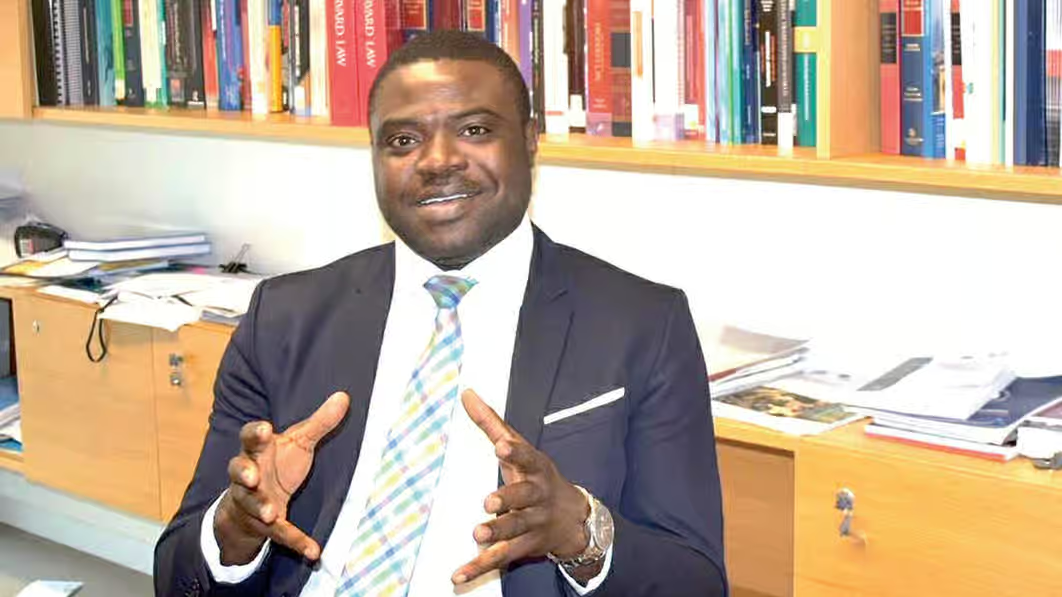
International law expert and Vice Chairperson, United Nations Working Group on Business and Human Rights, Professor Damilola S. Olawuyi (SAN), has called for greater global commitment to human rights as well as the need to address rising insecurity, conflicts and other interlocking crises.
Olawuyi, who also serves as the global Vice Chair, International Law Association, made the call during his plenary address at the 14th Annual Forum on Business and Human Rights in Geneva, Switzerland.
The Forum, established in 2011 by the UN Human Rights Council, is the world’s largest annual gathering with a focus on advancing UN Guiding Principles on Business and Human Rights (UNGPs).
It brought together governments, businesses, civil society groups, affected communities and international organisations. This year’s edition, themed ‘Accelerating Action on Business and Human Rights Amidst Crises and Transformations’, hosted about 5,000 participants and featured high-level speakers, including UN High Commissioner for Human Rights, Volker Türk; Vice-President, Human Rights Council, Ambassador Salma Rasheed and Deputy Director, UN Global Compact, Melissa Powell.
Others are Nigeria’s Minister for Women Affairs, Imaan Sulaiman-Ibrahim; Chad’s Minister of Justice and Human Rights, Dr Youssouf Tom; Virgin Group founder, Sir Richard Branson, as well as representatives of UNDP, UNICEF, the African Union and the African Commission on Human and Peoples’ Rights
Addressing the Forum, Olawuyi identified insufficient stakeholders’ engagement as a major factor behind growing conflicts and insecurity globally and urged governments, investors and businesses to integrate human rights considerations into all stages of planning and development to avert local grievances.
“In these precarious times of interlocking crises and transformations that shake the foundations of human rights, renewed solidarity and unity of purpose is urgently required.
“Economic development that neglects human rights will only result in further crises. Let us therefore continue to work together to shape a more just, accountable, and human rights-oriented global economy that leaves no one behind.”
Olawuyi stressed the need for capacity building, public awareness and human rights education, calling on states and businesses to increase financial and technical support for national human rights institutions, higher education institutions, the media, civil society organisations, indigenous groups and human rights defenders.
He also highlighted the need to train security personnel deployed in conflict-prone areas, noting that improved education and orientation can contribute to youth-led entrepreneurship and innovation.
Olawuyi also suggested a coordinated effort across sectors and the need for stakeholders to strengthen the implementation of UNGPs on Business and Human Rights.
In this article