
By GEB
The shocking discovery of vast quantities of counterfeit and banned medicines in Lagos not only signposts deep penetration of criminals into the country’s pharmaceutical industry, but it calls for concerted action by the government to address the atrocities.
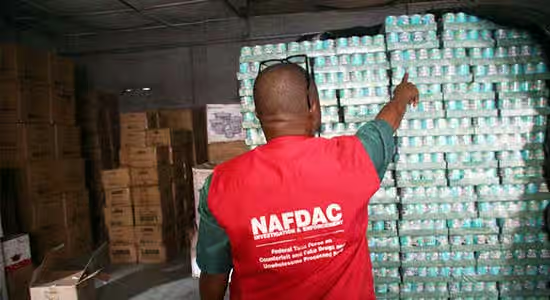
The National Agency for Food and Drug Administration and Control (NAFDAC) recently disclosed the discovery of the adulterated drugs hidden in residential-style warehouses in Lagos. Clearly, criminals have penetrated Nigeria’s pharmaceutical supply chain, putting innocent citizens at risk. It is a wake-up call for the government and stakeholders to identify weaknesses in importation and distribution and strengthen efforts to bring perpetrators to justice.
The discovery includes over 10 million doses of fake and substandard medicines, including injectable anti-malarials and antibiotics. The Director of Investigation and Enforcement and Chairman of the Federal Task Force on Fake and Substandard Products, Martins Iluyomade, underscored the gravity of the find, saying, “What we discovered should make every Nigerian cry. These were not just fake vitamins. These were life-saving medicines: injections used in emergency cases such as cerebral malaria. When fake injections are used in such situations, it becomes a death sentence.”
To falsify medicines and quietly push them back into circulation is to knowingly gamble with human life. It is business devoid of conscience and pity. Counterfeit antibiotics and anti-malarials have been blamed for antimicrobial resistance, making genuine treatments less effective over time. The World Health Organisation (WHO) attributes approximately 500,000 deaths yearly in sub-Saharan Africa to counterfeit drugs, while fake anti-malarial and tuberculosis medicines are estimated to cause nearly 700,000 deaths yearly across the continent.
The drug agency (NAFDAC), therefore, was alive to its responsibility for acting on intelligence and seizing eight trailers of counterfeit products. Its timely action has saved the lives of millions of Nigerians and dealt a substantial blow to the menace. Yet, in the same breath, questions must be asked. How could the drug operators have carried out such a daring operation involving multiple warehouses in a commercial city, functioning for months without detection? How did counterfeit goods of this magnitude pass through ports and checkpoints in a country replete with watchdog agencies and stakeholders?
The answer points in two directions. Despite the Federal Government’s long-proclaimed determination to curb smuggling and false declarations, it has not put in place foolproof mechanisms to check the menace. This suggests that existing frameworks and legislation have not been effective enough. It also implies that the nation’s multiple enforcement agencies have engaged in more barking than biting. Secondly, it suggests complicity at a level that must be regarded as a national security issue.
Like bandits and kidnappers, counterfeit medicine dealers are not spirits. They are human beings who move their products through a network of distributors, wholesalers, transporters and retailers. It is obvious that at some point, eyes that saw something did not say something, or simply looked the other way. If, as NAFDAC itself has suggested, no fake product can enter the market without some level of collaboration in the distribution chain, then enforcement must extend beyond warehouse operatives to the enablers who, by negligence or greed, create a market for death disguised as treatment.
The recent bust may possibly be a tip of the iceberg, and this is particularly frightening considering that the confiscated products are worth over N3 billion, implying that the country is up against a massive, organised crime syndicate that will stop at nothing to make money, even if that means costing lives. It suggests that NAFDAC may have only brushed against a well-financed network with vast storage, logistics, supply links and distribution channels.
It also indicates that the counterfeiting industry has significant market penetration, a challenge the Federal Government must urgently address. Nobody stocks N3 billion worth of fake medicines unless they are confident that there is a high demand and a distribution network capable of absorbing them. Given these indicators, it appears that the counterfeit and legitimate markets may even share parts of the same supply chains.
A government that cannot guarantee the authenticity of medicines for its citizens has failed in its responsibility to protect them. The authorities must stop at nothing to ensure criminals are unable to clone life-saving drugs abroad, criminally declare them as spare parts and ship them through ports, clearing them with the help of compromised officials. Intercepting consignments after intelligence tips is commendable. However, the country must go further and harden its borders with modern inspection technology. Inter-agency coordination among NAFDAC, Customs and port authorities must be strengthened. Digital tracking systems must also be deployed to prevent the concealment of falsified products behind paperwork.
The news of arrests following the seizure is welcome, as is NAFDAC’s insistence that it will “leave no stone unturned until it gets to the bottom” of the matter. Punishment for merchants of death must be severe and swift. Manufacturers, importers or distributors of counterfeit life-saving medicines are not petty traders. The Federal Government must prioritise their trials and the confiscation of their assets in line with the extant law. Prospective recruits and investors in the counterfeiting world should be made to understand from the outset that they will face the full weight of the law.
There is also an urgent need to overhaul the way medicines are distributed. Many drugs are still sold under unregulated conditions. Many Nigerians are forced to pay for treatment out of pocket because they cannot afford health insurance. Many more are drawn to very cheap drugs, mistaking low prices for good fortune instead of what they truly are: warning signs. Thus, the crisis of counterfeit drugs is also a problem of poverty. As long as genuine alternatives remain out of reach of ordinary citizens, they will continue to buy from unsafe sources, and counterfeiters will continue to thrive.
The recent seizure should be treated as an emergency, given that the health system has already been compromised. Response must go beyond periodic raids and reactive intelligence. As useful as these measures are, by the time enforcement agencies close in, counterfeit medicines may already have been distributed and used by hapless patients, with grave consequences. Criminal networks have also shown a tendency to adapt, re-strategise and keep the authorities one step behind.
Drug counterfeiting is terrorism in one of its most subtle forms, where a few individuals exploit the hopes of desperate citizens seeking recovery from illness and unleash horror. Government, therefore, cannot afford to be complacent. It must meet the audacity of counterfeiters with resolve equal to the danger posed to public health.
In this article