
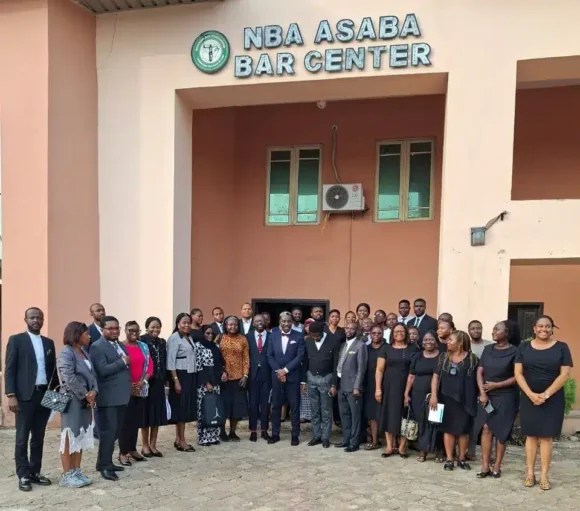
Legal practitioners play a critical role as gatekeepers of the financial and legal systems, there is a continuous need to strengthen their capacity to identify and mitigate risks associated with money laundering, terrorism financing, and other illicit financial activities that may arise in legal transactions and professional engagements. It is against this background that the Nigerian Bar Association Anti-Money Laundering Committee (NBA-AMLC), in collaboration with the African Center for Governance, Asset Recovery and Sustainable Development, organized a one-day capacity-building training for members of the Nigerian Bar Association (NBA) Asaba Branch on the Rules of Professional Conduct and Anti-Money Laundering/Counter-Terrorism Financing (AML/CFT) in Asaba, Delta State.
The training brought together 120 legal practitioners from the Asaba branch and served as an important platform to strengthen lawyers’ understanding of their responsibilities under Nigeria’s evolving AML/CFT regulatory framework and the Rules of Professional Conduct for Legal Practitioners 2023.
Participants received practical guidance on key compliance obligations, including the application of risk-based approaches, client due diligence procedures, Know Your Customer (KYC) requirements, and suspicious transaction reporting. The sessions emphasized the need for lawyers to integrate AML/CFT compliance into their professional practice while maintaining ethical and professional standards.
The workshop featured presentations by members of the NBA Anti-Money Laundering Committee, including Co-Chair of the NBA-AMLC, Prof. Ernest Ojukwu, SAN; Prof. Adedeji Adekunle, SAN; and Dr. Maryam Idris Abdulkadir, who provided in-depth insights into the regulatory and professional obligations placed on legal practitioners under the Rules of Professional Conduct 2023.
The facilitators highlighted the importance of risk assessments, proper client profiling, record keeping, and mandatory reporting obligations, particularly the filing of Suspicious Transaction Reports (STRs) when potential cases of money laundering or terrorism financing are identified.
A major highlight of the training was the introduction and demonstration of the NBA-AML Portal, an online platform developed to facilitate compliance reporting within the legal profession. Participants were guided through the portal’s functionalities and engaged in practical sessions on how to register, navigate the platform, and submit Suspicious Transaction Reports through the system.
The training forms part of the FCDO-supported project titled “Tackling Illicit Financial Flows through Asset Recovery, Management, and Strengthening ML/CFT/PF Compliance in Nigeria.” The project is being implemented by the African Center with the support of its partner organization, the Africa Network for Environment and Economic Justice (ANEEJ).
The Asaba training represents another important step in expanding awareness and strengthening compliance culture among legal practitioners across Nigeria. Participants expressed a strong commitment to applying the knowledge gained and sharing the insights within their professional networks and respective NBA branches.
By equipping lawyers with the necessary knowledge and tools to detect and prevent financial crimes, the initiative contributes to broader efforts to protect the integrity of Nigeria’s financial system and promote accountability within the legal profession.
In this article