
By Kunle Awobodu
Lagos Island has the highest concentration of high-rise buildings in Nigeria. A tourist on a voyage with a landfall at Marina would gasp in awe. Why? A panoramic vista of the Lagos Island high-rise buildings silhouetted against the sky is a sight to behold. The resplendent view is the pride of every aficionado of building construction. Hence, any human-induced threat that could endanger the serviceability of these iconic skyscrapers should be resisted by adherents of standard building sustainability.
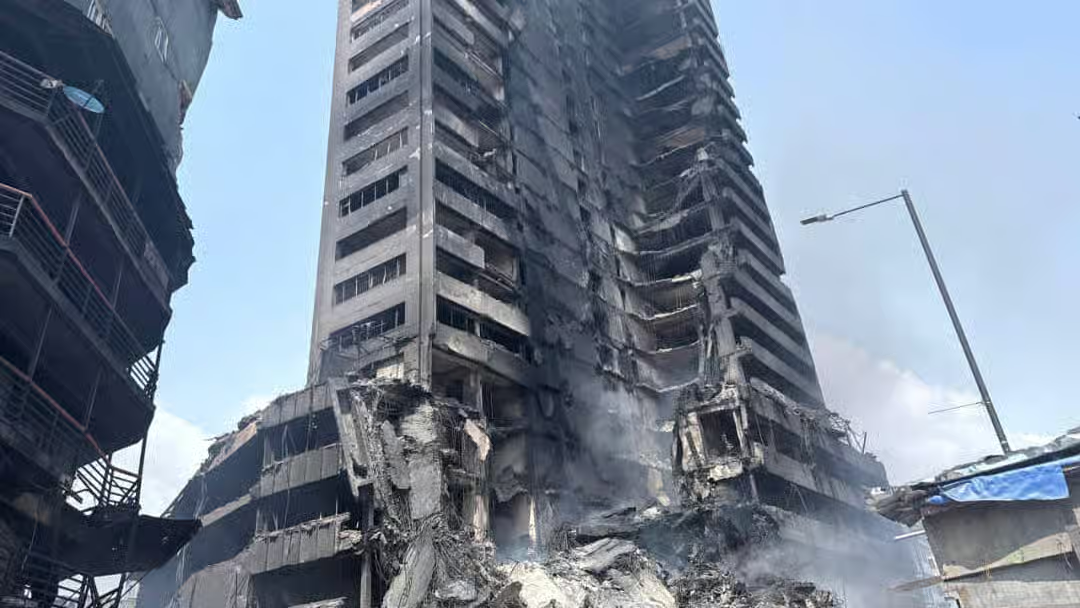
The fire that gutted the 25-storey Great Nigeria Insurance House, 45/47, Martins Street, Lagos Island on the eve of 2025 Christmas, three months after separate fire incidents at Afriland Towers and Mandilas House, has cast strong doubts on the nation’s ability to protect and preserve the massive structures that define the skyline of Lagos Island.
The first fire incident in the GNI House happened in 2005, affecting only the 5th floor. Between 2013 when fire again struck at the GNI House and the 2025 blaze that devastated the insurance house, not less than 10 high-rise buildings have been gutted by fire on Lagos Island. Colossal buildings that elevate the economic and modernisation ratings of a nation naturally deserve some functional safety measures.
On Tuesday, December 30, 2025, I inspected the two burnt popular buildings on Martins Street, Lagos Island and other affected structures in the neighbourhood. The contiguousness of houses built on fragmented plots of land totally contravenes the provisions of the national building codes and the Lagos state building regulations.
Inadequate setbacks and airspace made fire starvation in a rapid propagation a difficult task for firefighters. About four buildings, averagely of four-storey high, in the contiguous vicinity, collapsed behind the GNI House. Were they constructed to standard?
Directly opposite the GNI House was Muhammed Shitta-Bey Mosque. The road, Martins Street, created adequate space, a buffer from the blazing GNI House. Hence, the mosque was insulated from the GNI House fire of 2013 by the distance.
However, the GNI House inferno that was ignited on December 24, 2025 eventually spread to the mosque via the wall drape billboard hung on the GNI House façade. According to eyewitness accounts, the burning massive advertisement drape lost its grip on the façade and crossed the road, landing on the mosque. The petrol in the generator within the compound energised the flame, enabling its speedy spread to the adjoining Plaza in Oluwole Quarters.
A comparison between the GNI House and Shitta-Bey Mosque rekindles the analogy of Gulliver’s Gigantic and the Lilliputian. The 25-storey building palpably dwarfs the double-volume bungalow. In age, the mosque is far ahead.
While the GNI House construction by a French company, Bouygues Construction Limited, commenced in 1985, Shitta-Bey Mosque was constructed in 1892.
Despite the above-stated differences, the common denominator is standard construction. The GNI House has been attacked repeatedly by fire. In the current inferno, aside from the protruding car park slabs that gave way at the back and a phase that got disconnected vertically, resulting in a partial collapse in the front, the refusal of the high-rise building to buckle after about a week of resistance against intense fire attested to the quality of its components.
A discerning observer of the blazing GNI House might not likely miss an intriguing structural development. Due to intense heat combined with rescue operation, one or two external columns were displaced in the lower storeys of the high-rise building while the corresponding columns in the upper storeys remained stable. The beams that were primarily designed to be supported by the now displaced columns have automatically been transformed, performing an additional function in cantilevering.
Practical experience versus theoretical extrapolation. This unusual display of structural strength should excite the research-oriented structural engineer into interrogating, with calculations, the profundity of bending moment and shear force saddled with piquant analysis of stresses. The GNI House has refused to bow down despite its displaced columns. Wonderful!
These two unique buildings have become the references for standard construction on Lagos Island that has recorded a high frequency of building collapse since the advent of some unscrupulous developers.
Construction life has always been associated with risk. Working on top of high-rise buildings and in the underground entails some risks that could be aggravated by vertiginous giddiness and claustrophobia. Personal Protective Equipment (PPE) could help mitigate such risks. Years of site work have customarily dispelled fears and emboldened a search into a deformed building.
Cautiously, I emerged from the entrance of the high-rise’s basement and walked across the road. I stepped into the burnt mosque immersed in an overwhelming atmosphere of despair. The ruinous scene agonised my naked eyes, blurring my vision momentarily. Instantly, my vision retreated into the comforting memory of October 1, 2020 when I paid a technical visit to the mosque. Soon, the pristine Baroque architecture of the mosque flickered in my retinae.
October 1, 2020 marked the 60th independence anniversary of Nigeria. Design concept, at times, predicts a 60-year lifespan for a standard building that is not deprived of maintenance. Nonetheless, in reality, buildings that have lasted far more than the theoretical lifespan are many.
In view of this concept, the Nigerian Institute of Building (NIOB), under my leadership as the national president, in a programme to mark Nigeria’s Independence Day, embarked on a nationwide condition survey of pre-independence buildings.
The exercise involved surveying and examining the condition of iconic buildings that had surmounted 60 years.
On this crucial day on Lagos Island, our schedule was to pay a visit to two designated national monuments. A two-storey building named Water House on Kakawa Street. It was built in 1874 by a Brazilian emancipado (returnee), Mr. Candido Da Rocha. The other was a mosque.
I led a team of professional builders to Muhammed Shitta-Bey Mosque on Martins Street. We were joined by a well-equipped team from the Lagos State Materials Testing Laboratory (LSMTL) led by its General Manager, Dr Tajudeen Afolabi, and another team from the Lagos State Building Control Agency (LASBCA) led by the General Manager, Engr. Mrs Abiola Kosegbe.
On ground to receive us was the grand-daughter of Muhammed Shitta-Bey, Alhaja Kafayat Shitta-Bey. She gave us the history of the building. According to her, the mosque, which was designed by a Brazilian architect, João Baptista da Costa, was constructed in 1892.
A survey of the building condition was conducted. The floor, the walls and the gable roof were still in satisfactory condition. The ceiling members were made of raffia palm. This exercise could help determine practically the durable materials suitable for buildings in the equatorial region, especially coastal areas.
Awobodu is pioneer national president, Building Collapse Prevention Guild, and past national president, Nigerian Institute of Building.
The satisfactory outcome of the building condition survey of the mosque made it a worthy national monument that deserves preserving. Its years of existence doubled the years of Nigeria’s independence with extra space of time.
Gradually, I rose from the abysmal depths of the relishing past memories to face the harsh, stark reality. The fire ravaged the roof, ceiling, doors, windows, fittings and finishings, leaving a carcass of walls and floor. The walls, the altar and floor gallantly resisted the inferno. The brick walls looked firm and stable to carry a new roof.
I stepped out onto Nnamdi Azikiwe Street. Coincidentally, I met the Special Adviser to the Governor of Lagos State on Urban Development, Dr Jide Babatunde. The observation was unequivocally relayed to him: “Muhammed Shitta-Bey Mosque can be restored.”
Obvious threat to safety posed by the fire-injured GNI House made the Lagos State government intensify efforts at finding the safest method of bringing the high-rise structure down.
On January 1, 2026, when 15 seasoned built environment professionals under the aegis of the Building Collapse Prevention Guild (BCPG), on government invitation, embarked on visual inspection of the GNI House and other fire-affected buildings in the neighbourhood, insightful recommendations were collated.
Right there on Martins Street on the first day of this year, we implored the Permanent Secretary, Urban Development, Arc. Gbolahan Oki and the General Manager, Lagos State Building Control Agency, Bldr. Mrs Florence Gbaye to help protect the relics of the mosque by adopting an appropriate deconstruction methodology for the GNI House, barring negative effect on the heritage mosque.
Restoration of this historical legacy will become a reminder of the fatal consequence of human negligence that is a major cause of incessant fire-outbreaks in our cherished Lagos Island skyscrapers.
The costly blazing of GNI House and Shitta-Bey Mosque and the stability exhibited in the conflagration by these models of standard building construction should become a lesson to developers and prospective homeowners on the evergreen benefit of upholding quality in the production of buildings that would not endanger lives.
It is pathetic that lives were lost in the avoidable GNI House inferno. For instance, a mother lost three sons in the inferno. Demolishing GNI House without conducting a thorough investigation on the cause(s) of the inferno could deprive the dead and the bereaved of justice. Outcome of a technical investigation might identify the shortcomings that could help prevent a recurrence.
In this article