
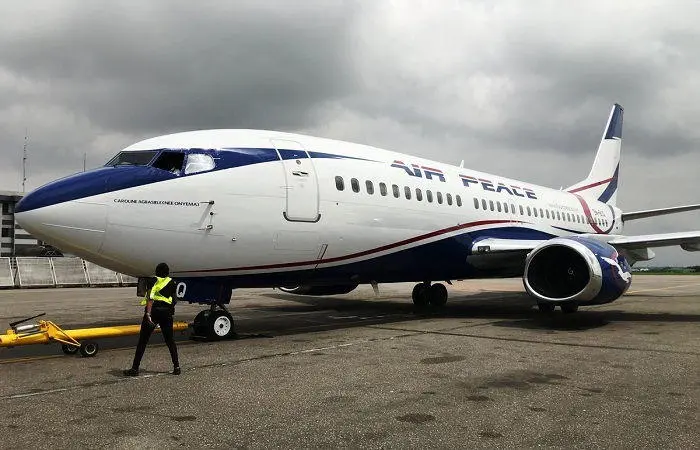
Air Peace has disputed the Nigeria Civil Aviation Authority’s report on flight disruptions in August, saying the regulator underreported its flight operations and wrongly attributed delays to the airline.
The airline said it operated 2,564 flights in August, contrary to the 1,864 flights contained in the NCAA’s monthly report, adding that only 391 of its delays during the month were caused by internal operational factors.
Air Peace’s position was contained in a statement signed by its Chief Operating Officer, Oluwatoyin Olajide, on Thursday, in response to the NCAA report which identified the airline as having the highest number of flight disruptions among domestic carriers in August.
According to the NCAA data, Air Peace recorded 1,864 disruptions in August, while domestic airlines collectively recorded 7,961 disruptions. https://punchng.com/air-peace-delayed-1864-flights-in-august-report/
However, Air Peace said the figures did not accurately reflect its operations, arguing that the omission of more than 700 flights distorted its performance metrics.
“Air Peace operated a total of 2,564 flights in August 2026, as opposed to the 1,864 flights stated in the NCAA report.
“By omitting over 700 fully operational flights from the data pool, the NCAA’s calculations skew our actual performance metrics and artificially inflate the reported delay percentages,” the airline said.
The airline also questioned the timing and scope of the NCAA’s monthly reporting.
“Why did the NCAA start the monthly series with August rather than July, immediately following the publication of Q1 and Q2 on 31st of July?” it asked.
“It is indeed worrisome that there is still no equivalent monthly data located for July, yet the NCAA published unusually granular August airline delay data only 13 days after month-end,” it added.
Air Peace also faulted the report for failing to account for the industrial action that disrupted its operations during the month.
“It is reasonable to suggest that the early release of the August publication should have been accompanied by disclosure that the month contained an extraordinary aviation-sector industrial disruption which significantly affected the airline’s operations,” the airline said.
It added that the “August 11th instigated Union disruptions of our operations lingered for over 14 days, leading to rescheduling, avoidable delays and cancellation of flights.”
The airline questioned why the regulator did not provide the causes of the delays before publishing the report.
“Why was this report published rapidly without identifying the causes of the delays attributed to individual airlines instead of publishing wrong figures that could tarnish the reputation of the airline despite prevailing operational challenges?” Air Peace asked.
According to the airline, its internal review showed that only 391 flights were delayed by factors within its control.
“An internal review of our August 2026 flight data performance analysis reveals that 391 flights, which is only 15% of the delays experienced during the month of August, were caused by internal factors.
“The rest of the delays experienced by Air Peace were caused by external factors, and we have the data to support this,” it said.
It said the internal delays were “largely as a result of technical issues resulting in unscheduled maintenance on our aircraft and fuel-related issues.”
Air Peace said airport congestion and traffic were responsible for more than half of its external delays.
“Heavy tarmac and traffic congestion accounted for more than 51% of the external delays we experienced.
“Aircraft were frequently held on the ground or in holding patterns due to infrastructure capacity limits,” the airline said.
The airline also cited bird strikes as another source of disruption, saying one of its aircraft was forced out of service after being struck by a bird in Abuja.
“One of our aircraft, 5N-BYG, was struck by a bird in Abuja, which damaged the inlet cowl beyond acceptable limits, costing us USD1.8M to fix the dent,” it said.
According to Air Peace, the aircraft operated at least eight sectors daily and transported about 1,000 passengers.
“Unfortunately, the aircraft was removed from flight operations for more than a week, resulting in huge disruptions, and only became serviceable after the inlet cowl was replaced,” the airline said.
It also blamed airport infrastructure deficiencies for some of the delays.
“Deficiencies and unexpected breakdowns in airport infrastructure heavily restricted seamless boarding and departure timelines,” it said.
On weather-related disruptions, the airline said adverse conditions during the rainy season resulted in mandatory safety holds and diversions.
It said, “Unfavourable weather patterns throughout August forced mandatory safety holds and several diversions, which further compounded the backlog.
“It is no longer news that even now, we are still in the rainy season. One flight diversion could result in almost three hours’ delay. How is the consequential delay Air Peace’s fault?”
The airline said it nevertheless continued to bear costs associated with some disruptions caused by external factors.
“Yet, we still take care of the passengers, including hotel accommodations, for external events that are beyond the airline. This is against industry standard,” it said.
Air Peace further blamed the picketing of its operations by aviation union members and damage to one of its aircraft by a ground-handling company.
It said the union action created disruptions to its operations “for over 14 days,” while damage caused by the ground-handling company resulted in an aircraft being removed from active service “for more than 14 days.”
“Again, the narrative that Air Peace is primarily responsible for these delays is completely false.
“The majority of the delays experienced by our passengers were driven by external factors and completely outside of our control,” the airline said.
The airline said it had previously refrained from making the details public but decided to respond after the publication of the NCAA report.
“We have restrained ourselves from making these facts public before now, but we have now been pushed beyond acceptable limits, hence the need to go public and state the facts the way they are,” it said.
Air Peace said it had invested in its fleet, crew availability, training and maintenance, while promising to continue working on factors within its control.
“We remain fully committed to safety, on-time performance and passenger satisfaction; however, an airline cannot safely or logistically bypass severe airport congestion/traffic, inadequate airport infrastructure, sunset restrictions or adverse weather conditions.
“We will continue to optimize our internal processes to mitigate against all the internal delay drivers,” it said.
The airline urged the NCAA to review its data collection methods.
“We respectfully urge the Nigeria Civil Aviation Authority to review and audit its data collection methods to ensure future reports accurately reflect the correct data and delay causal factors/operational environment of the Nigerian aviation sector,” it said.
The NCAA report had identified Air Peace as recording the highest number of disruptions among domestic airlines in August, followed by United Nigeria Airlines with 1,231 disruptions and Enugu Air with 878.
The report said the disruptions were part of broader challenges affecting Nigeria’s domestic aviation industry, with adverse weather and technical problems among factors contributing to delays and cancellations.
In this article