
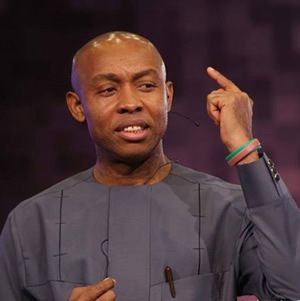
Professor of law and former Chairman of the National Human Rights Commission (NHRC), Chidi Anselm Odinkalu, has described Nigeria’s emerging political “rainbow coalition” as “political criminality” rather than pragmatism, arguing that the country currently operates a civilian government rather than a genuine democracy.
Odinkalu made the remarks during an appearance on Channels Television’s Hard Copy, where he discussed the judiciary’s role in elections, political alliances, insecurity, poverty and the conduct of future elections.
He said democracy fundamentally requires citizens to determine who governs them, arguing that Nigeria’s electoral system has increasingly shifted that responsibility to the courts.
“I like to speak about what we do in Nigeria as civilian government, not democracy. Civilian government is a different thing from a democracy,” Odinkalu said.
According to him, although civilians currently occupy public offices, that does not necessarily mean Nigeria is operating a democracy.
“Fundamental to a democracy is the idea that the people decide who governs. When judges decide, as they did in 2023, about 82 per cent of the offices contested, that’s not a democracy,” he said.
Odinkalu noted that the trend was not new, citing the 2007 elections, when he said just under 86.5 per cent of contested offices were decided by the courts.
He also referred to an alleged corruption case arising from the 2003 election cycle in Anambra State, involving the Uba brothers and the Anambra North senatorial seat.
Odinkalu alleged that Ugochukwu Uba was installed as senator after N27 million and two buildings were given to two of three judges on the Court of Appeal panel handling the matter.
“This is not me making up a story. This is the report of the National Judicial Council,” he said.
He added that Uba subsequently completed his tenure, while the appellate justices implicated in the alleged bribery were dismissed by the administration of former President Olusegun Obasanjo.
According to Odinkalu, there have been numerous established cases of alleged bribery involving judges handling election petitions, but effective remedies remain lacking.
He also accused sections of the legal profession of contributing to the problem, recalling the case of an election petition tribunal chairman who was dismissed over improper contacts with lawyers. He alleged that a senior advocate involved in the matter was initially sanctioned by the Legal Practitioners Disciplinary Committee but was later cleared by the Supreme Court on a technicality.
Turning to the emerging political alliances ahead of the 2027 elections, Odinkalu questioned the description of the arrangement as a “rainbow coalition.”
He initially joked that he was not qualified to discuss rainbows because he is colour blind, before arguing that a genuine rainbow coalition should involve people with different political identities and ideologies.
“But quite seriously, secondly, a rainbow cannot be made up of one colour,” he said.
Odinkalu argued that what he sees in the current political alignment is a collection of politicians united largely by access to power rather than a shared political ideology.
“These are not people with any particular ideology other than access to power and plunder based on power,” he said.
He was particularly critical of the Minister of the Federal Capital Territory and former Rivers State governor, Nyesom Wike, whom he accused of maintaining political influence across the Peoples Democratic Party and the All Progressives Congress.
Odinkalu recalled Wike’s previous comments about his ability to engage in anti-party activity and criticised his reported influence within both political camps.
“He says he is the leader of the APC and the leader of the PDP in Rivers State, and has actually been installed as such, or recognised as such, by the President,” Odinkalu said.
“This, as far as I’m concerned, is not politics. It verges quite honestly on criminality.”
He also referred to Wike’s reported statement that he could have been deployed to Osun State to help the APC win the governorship election if President Bola Tinubu had wanted him to do so.
“That is not democracy. That is criminality. Let us be very clear about that,” Odinkalu said.
Rejecting the argument that such political arrangements amount to pragmatism, Odinkalu distinguished between legitimate coalition politics and the abandonment of party identity for political advantage.
He cited Nigeria’s political history, noting that coalition governments existed at independence, when the Northern People’s Congress and the National Council of Nigeria and the Cameroons formed a government at the centre.
He also referred to the 1979 presidential election, when Shehu Shagari emerged victorious after a closely contested legal battle at the Supreme Court over the constitutional requirement for winning two-thirds of the states.
“Is it possible to retain party affiliation and identity on the one hand while being able to do electoral alliance on the other hand? And the answer is yes. Is that what we’re having now? Absolutely no,” he said.
“What we have now is quite honestly political criminality. It has nothing to do with political pragmatism.”
On whether Nigeria is making progress democratically, Odinkalu challenged Nigerians to judge the country’s performance by their everyday experiences.
He asked whether citizens were safer, better fed, able to move more freely, receiving better education and benefiting from more affordable prices than they were several years ago.
He also questioned whether the police and courts had become more effective and fair.
“If the answer to that is yes, then we’re doing better. If the answer is no, oh well,” he said.
Addressing the growing number of children begging on the streets of Abuja, Odinkalu rejected the description of the situation simply as poverty.
“I don’t think we’re dealing with poverty. We’re dealing with impoverishment,” he said, arguing that impoverishment involves deliberate or systemic actions that leave people worse off.
He linked the situation to what he described as the failure of Nigeria’s political system to make government accountable to citizens.
According to him, democracy should operate on the principle that governments improve citizens’ lives and are rewarded with renewed mandates, while governments that fail to do so should be voted out.
“In Nigeria, the question of whether or not government cares about you or does well does not arise, because government can procure a mandate without you being relevant,” he said.
Odinkalu also objected to the description of children living on the streets as “urchins,” arguing that such language dehumanises vulnerable Nigerians.
He said many of the children begging in Abuja were internally displaced persons or children of internally displaced persons from states including Niger, Kaduna, Borno, Nasarawa and Benue.
He cited claims of large-scale displacement and destruction in Benue State, alleging that millions had been displaced and thousands killed, while accusing the government of failing to respond adequately to the crisis.
Odinkalu argued that addressing Nigeria’s political and social problems requires restoring citizens to the centre of the democratic process.
“Restore the underlying logic of the democratic system. Take judges away from our electoral outcomes. Return the source of the mandate to the people,” he said.
He argued that removing citizens from the process and concentrating political power among politicians, security officials and judges had weakened democratic accountability.
“The people no longer matter, and now we call them urchins,” he said. “Once the people matter, their children will no longer be urchins.”
He further accused politicians of relying on violence and the militarisation of elections to influence electoral outcomes, arguing that such practices prevent citizens from freely choosing their leaders.
On calls for President Tinubu to publicly withdraw his earlier statement that “all is fair in politics,” Odinkalu said a verbal recantation would not be enough.
He argued that the President would need to direct law enforcement agencies to prosecute individuals involved in political violence and threatening rhetoric.
According to him, failure to impose consequences would encourage political actors to continue such behaviour because they would believe it enjoys the backing of the ruling establishment.
He warned that politicians who use violence to secure electoral victories could subsequently be rewarded with political appointments or other forms of preferment.
“And if they are announced as the winners in 2027, they will then get preferment, because they have enabled the president to come back to power through violence,” Odinkalu said.
In this article