
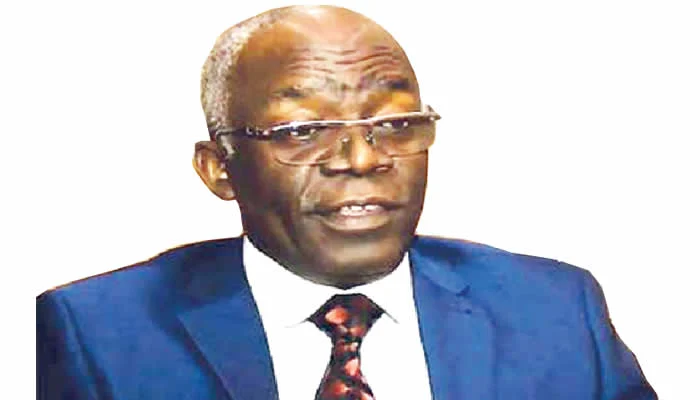
Human rights lawyer and Senior Advocate of Nigeria, Femi Falana, has criticised the Nigerian Bar Association for inviting former Liberian President, George Weah, to address lawyers at its 66th Annual General Conference, held at the Yakubu Gowon Stadium, in Port Harcourt, Rivers State.
Falana urged the NBA leadership to stop inviting what he described as dictators from African countries to speak at its conferences, questioning Weah’s record on democracy, the rule of law and judicial independence during his tenure.
Former Liberian President George Weah had in his keynote address warned that democratically elected leaders can gradually become dictators by weakening the judiciary and legislature, urging lawyers across Africa to defend strong institutions and the rule of law.
Weah gave the warning while delivering the keynote address at the NBA conference.
Speaking on the theme, “Beyond Limits,” Weah said democracy could not survive on elections alone, stressing that strong institutions, particularly an independent judiciary and a fearless Bar, were essential to preserving democratic governance.
“Democracy does not survive on the strength of elections alone. Elections are neither the doorway into democracy nor the house itself. What holds the house up… are institutions,” he said.
The former president cautioned that the threat to democracy was not limited to military coups or defeated politicians refusing to accept election results.
He said elected leaders could also become authoritarian after assuming office by gradually bending the judiciary to their will and turning the legislature into an “echo chamber” rather than an effective check on executive power.
“A tyrant with a certificate of return is still a tyrant,” Weah said.
Falana, who spoke as a panellist at the conference, however, said Weah’s administration captured the Liberian judiciary to such an extent that citizens seeking justice had to reach out to those outside their country to obtain legal redress at the ECOWAS Court.
“I want to appeal that the Bar Association must stop inviting dictators in Africa to come and address us,” Falana said.
He said Weah, who governed Liberia from 2018 to 2024, had no moral authority to lecture Nigerian lawyers on democracy and the rule of law, alleging that his administration undermined the judiciary and disobeyed judgments of the ECOWAS Court.
Falana cited the case of the Mandingo people of Liberia, whose landed properties were allegedly seized during the country’s civil war.
He said the affected people could not secure justice within Liberia because of the state of the judiciary and had to contact lawyers outside the country to pursue their case before the ECOWAS Court.
According to him, the regional court eventually ruled in favour of the Mandingo people and ordered redress over the seizure of their properties, but Weah refused to enforce the judgment while he was president.
Falana noted that the current Liberian government under President Joseph Boakai had constituted a committee to enforce the ECOWAS Court judgment.
The senior advocate also cited the case of an Associate Justice of the Supreme Court of Liberia, whom he said Weah dismissed without justification.
He said lawyers again took the matter to the ECOWAS Court, which set aside the judge’s dismissal, ordered his reinstatement and awarded him $200,000.
Falana said Weah also refused to comply with that judgment.
“Now, that is the man coming here to talk to us about the rule of law and democracy,” he said.
The activist lawyer also alleged that drug barons gained significant influence in Liberia during Weah’s administration.
He referred to the arrest of Weah’s former vice-president, Edith, on August 19, alleging that she was facing trial over a $370m drug-trafficking case.
Falana argued that the development further raised questions about the governance record of the former football star.
He also took a swipe at Weah over his conduct during the 2022 FIFA World Cup in Qatar, where his son, Timothy Weah, represented the United States national team rather than Liberia.
Falana alleged that Weah spent nine days in Qatar supporting his son and used Liberian public resources for the trip.
He questioned the propriety of such conduct, particularly given the economic challenges confronting Liberia at the time.
Falana therefore urged the NBA to scrutinise the records of political leaders before inviting them to address Nigerian lawyers, especially on matters concerning democracy, judicial independence and the rule of law.
He said the legal profession should not provide a platform for leaders whose records, in his view, contradicted the principles they were invited to discuss.
In this article