
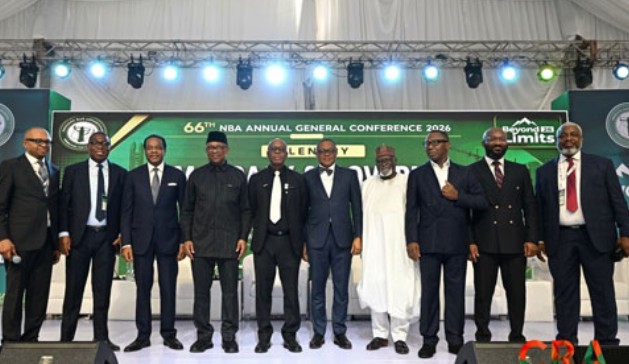
The Nigerian Bar Association hosted Presidential candidates during it plenary session in it ongoing Annual General Conference in Port Harcourt. Some of the leading opposition figures have declared that they would only accept the outcome of the January 16, 2027 presidential election if the process is free, fair and credible, with Nigeria Democratic Congress candidate Peter Obi expressing confidence that he would win the contest.
The politicians spoke during an interactive session at the 66th Annual General Conference of the Nigerian Bar Association in Port Harcourt, where they were asked a direct question: if they lost the 2027 presidential election, would they accept the result?
The question drew varying responses, but the dominant position among the candidates was that acceptance would depend on the credibility of the electoral process.
One of the candidates responded simply: “No, if it’s not fair.”
Former Cross River State Governor and PRP presidential candidate Donald Duke similarly rejected the idea that candidates should accept an outcome they consider fundamentally flawed.
“Why should I accept something that is wrong?” Duke said.
“I Will Win” — Peter Obi Declares At 2026 NBA AGC As Adebayo, Duke, Sowore, Amaechi Reject Unfair 2027 Election Result
He added that although he might decide not to challenge such an outcome in court, he would not personally accept a result arising from an election he considered unfair.
“If it’s not fair, I will not accept it. I may not go to the court, but personally, I will not accept it,” he stated.
When the same question was directed to Peter Obi, the former Anambra State governor responded confidently: “I’ll win.”
His response drew attention in an auditorium where lawyers had earlier chanted “Obi! Obi! Obi!” as he entered for the conference session.
Pressed on the broader question of accepting an electoral outcome, the candidates maintained that a genuinely free and fair election would leave no basis for rejecting the result.
“Definitely, if it is free and fair, we will accept. If not, we will not accept,” one of the responses stated.
The politicians emphasised that the real issue should be ensuring that the electoral process commands public confidence rather than demanding unconditional acceptance of whatever result is announced.
ADC vice-presidential candidate Rotimi Amaechi also expressed confidence in his side’s prospects, saying there would be no need to contemplate defeat.
“There will be no need for the question. So we will win,” he said.
Amaechi also sought to present the opposition platform as one transcending Nigeria’s ethnic divisions.
“We are not Yoruba, we are not Igbo, we are not Hausa, we are Nigerian candidates,” he said.
He added that political victory would require determination and a willingness to fight politically for the mandate.
“There is no way we can win if we don’t fight. And there’s no way we can lose since we are fighters. Yes, we will win,” he said.
He nevertheless maintained that an election falling short of the required standard would not be accepted.
“No, we will not accede if it’s not free, fair and credible,” he stated.
Others identified during the session as taking the same position included SDP presidential candidate Adewole Adebayo, AAC presidential candidate Omoyele Sowore, and APM presidential candidate Seyi Makinde, who was represented by his deputy, Lawal.
Their common position was that while they would respect the verdict of voters in a credible election, they would not be bound to accept a process they considered neither free nor fair.
The session later took another turn when a participant questioned why the opposition candidates could not unite behind a single candidate ahead of the presidential election.
The lawyer recalled that the ruling All Progressives Congress itself emerged from the coming together of several political parties and suggested that opposition parties could adopt a similar approach.
Directing his question particularly at Amaechi, the participant referred to an earlier assertion attributed to him that Sowore could not win the presidential election.
“You made bold to say that Mr. Sowore cannot win the presidential election. I, with all due respect, I also make bold to say that, with all due respect, sir, you also cannot win the presidential election,” the participant said.
He then asked why the opposition figures could not come together under one political platform.
“Why can’t all of you come together to have one party?” he asked.
The participant went further to describe Obi as, in his assessment, the most popular candidate among those present and suggested that the other opposition figures consider supporting him against the incumbent political establishment.
“Because Mr. Peter Obi is the most popular of all the candidates here. So why can’t you come together and give him the support to go against the status quo?” he asked.
The assertion that Obi was the most popular candidate represented the participant’s opinion and was not established by the conference itself.
The exchange highlighted two issues likely to dominate opposition politics ahead of the 2027 election: the credibility of the electoral process and continuing calls for opposition parties to consolidate behind a common candidate.
While the candidates differed in how they answered the hypothetical question of losing, their responses converged on one central point — they would recognise a defeat arising from a free, fair and credible election, but would not accept an outcome they considered fundamentally compromised.
In this article