
By Alabi Williams
Not less than 30 persons were reported killed in incidents linked to last Saturday’s governorship election in Osun State. Kimpact Development Initiative (KDI), a non-profit research group, reported that 44 election-linked incidents occurred across the state between October 2025 and June 2026. As the D-day approached, violence intensified between members of the All Progressives Congress (APC) and the Accord Party (AP). Properties were also vandalised while law enforcers got sucked in.
Apart from the violence and killings, there was also uncertainty as to how many parties would be on the ballot. Just three days before the election, the court ordered the Independent National Electoral Commission (INEC) to field the Social Democratic Party (SDP) and the Peoples Democratic Party (PDP). The PDP (Turaki faction) declined to contest because the time was too short for any meaningful appearance. If care is not taken, Osun could be the standard for the larger elections in 2027. The factions are still in courts and those fanning embers of violence are still in business.
For Osun, the stakes were really high, for the APC and Accord party. And there were no pretenses on either side.
Governor Ademola Adeleke was not going to let go of his constitutionally licensed four more years (second term) without a fight.
The APC was desperate to reclaim Osun to their swelling numbers, particularly coming from the South-West and home state of President Bola Tinubu. A win would boost the confidence of the ruling party ahead of 2027. A bloodied nose would amount to a serious setback, having in mind the growing resistance in neighbouring Oyo State. So, everything was put into Osun, including the federal might and enormous resources.
The war drums sounded earlier in different forms, beginning with legal battles to put to rest controversies around the 2022 local government elections. Former Governor Gboyega Oyetola, nephew of President Tinubu and now Minister of Blue Economy conducted the council elections on October 15, 2022, after he lost the governorship election to Adeleke in July of that year. Adeleke was then of the PDP.
Clearly, the timing of that election was suspicious, for an outgoing governor. Another party, the Action Peoples Party (APP) felt the council election was illegal and challenged it in court because it failed to comply with the Electoral Act 2022, by not giving the 360 days election notice and 150 days of publication.
The election was nullified by the Federal High Court, Osogbo, in November 2022 and it was declared unconstitutional. When Adeleke formed government in 2022, he directed senior civil servants to take over the councils in compliance with the judgment.
The PDP filed an originating summons at the Court of Appeal Akure, to challenge the validity of the election. The Appeal Court dismissed it on February 10, 2025 on the ground that the notice of election had not been published before the suit was filed. But another Appeal Court judgement of January 13, 2025, had affirmed the APP victory at the FHC Osogbo.
The APC claimed the judgment of February 10, 2025, reinstated the ousted APC chairmen and councilors. Opponents said it disregarding the APP judgement and the subsequent appeal. Both sides gave conflicting reading of the judgments. The APC with the assistance of the Federal Government and the Attorney General, Lateef Fagbemi (SAN), invited the sacked chairmen and councilors to return to office. The AGF declared that the Court of Appeal judgment of February 10, 2025 effectively restored the tenure of the sacked council office holders. He said their tenure was to end on October 10, 2025, based on his reading.
Not done, the Osun State Government conducted new local government elections on February 22, 2025, which was contested by the PDP alone. The winners were sworn into office but they had no physical offices to take over. The Federal Government had insisted that the tenure of those elected in 2022 had not lapsed. That was the beginning of deadly violence in the state.
In Irewole local government, five people were killed, including the APC chairman. It was the failure of the chief law officer of the federation to dispassionately manage the legal logjam that led either side to forcefully seek control of the local councils. The NLC and NULGE then instructed workers to stay away from the 30 secretariats because they were no longer safe. That led to reprisal killings and the law enforcement failed to rise to the occasion because powerful men were involved.
Osun is among the states struggling with their finances. Until recently, Osun could not effectively pay salaries of public workers, paying half and owing months of arrears. That has changed, thanks to more allocation from the Federation Account Allocation Committee (FAAC). The state used to hover at number 24 on the list of states’ Gross Domestic Product (GDP).
A lot of the state’s wealth are located in agriculture, solid minerals and tourism. They remain untapped. And that makes politics very attractive, as whoever controls government will have control over the state’s resources. It is the reason politics is the main industry and people are ready to kill to access political office all over the country, not just in Osun.
The Federal Government made matters worse when it decided to freeze council allocations to Osun, thus heightening the desperation. Popular legal opinion does not favour the interpretation of the court judgments by AGF Fagbemi. They say his intervention was one-sided and partisan. His intervention was not designed to achieve peace but to forcefully capture the state on behalf of the ruling APC.
Despite the freeze, the state government alleged that council allocations were channelled into accounts operated by the council officials backed by the APC, lamenting that the situation got the state government to shoulder around N6.5 billion in monthly salary obligations to council workers.
While the official face-off lasted, there were reported back-channel efforts by Gov. Adeleke to resolve the issues. One solution, as reported was Adeleke’s offer to join the APC. That was before his former party, PDP, was disfigured by the collaborative works of the Federal Government and the FCT Minister, Nyesom Wike. Adeleke was denied membership by state operatives of the party. Perhaps, they were not comfortable knowing that he might be too independent for their control.
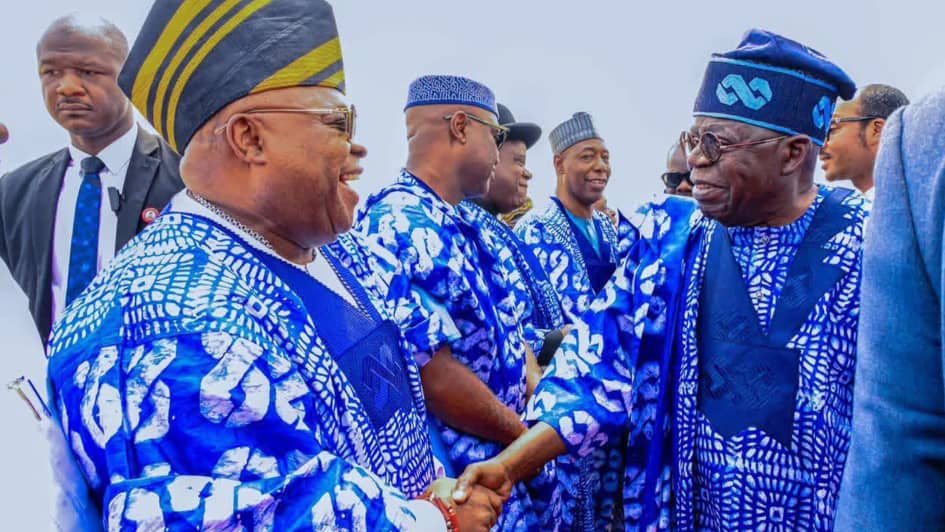
Another effort was the use of soft power to appeal to President Tinubu, to soften the awesome federal might against the state government. On one occasion in June 2025, the governor and his elder brother, Dr. Adedeji Adeleke, together with his nephew, the Afrobeat superstar, David Adedeji Adeleke, popularly known as Davido, visited the President at his private residence in Ikoyi. A jubilant governor Adeleke shared the visit on his X (formerly Twitter) account.
The Governor posted: “This evening, alongside the scion of the Adeleke dynasty, my elder brother, Dr Deji Adeleke, and my nephew, whom we are immensely proud of, David Adeleke, popularly known as @davido, we paid a courtesy visit to President Bola Ahmed Tinubu at his Lagos residence ahead of the Sallah celebration.”
Even though details of the visit were not made known, expectations were that the relationship could begin to take a friendly turn.
But the hostility at the home front refused to abate. On December 7, 2025, during the 10th coronation anniversary of the Ooni of Ife, wife of President Tinubu, Oluremi, disrespectfully stampeded the governor out of the podium. She told the governor to stop singing and go on with his speech.
The governor, a dancer and singer was bent on doing a verse of praise worship as prelude to his speech. But the wife of the President was unimpressed. She couldn’t stand him. She couldn’t even hide her disdain. Adeleke even pledged to support President Tinubu in 2027. No dice!
Mrs. Tinubu was to later donate gifts of cars to APC women leaders in Osun, Abia, Anambra, Bauchi and Oyo, where opposition parties are still struggling. The idea is to mobilise the grassroots for coming elections. The impact of that mobilisation was visible in Osun throughout last week, in the form of branded rice and raw cash on full display.
As a final act, perhaps to properly nail the political coffin, the Economic and Financial Crimes Commission (EFCC), was pushed to freeze accounts belonging to the Osun State Government for allegedly playing around suspiciously with some N11 billion. The EFCC cited an ongoing investigation active since March 2026, that proved the mismanagement of intervention and ecological fund allocated to the state government.
But the backlash and outrage were resounding and the government got the message. The popular question was: why wait until the eve of election before freezing the state accounts. The procedure seemed contrived as the governor claimed it was intimidation and the allegation had no proof. Neither was the state presented with a due court process that ordered the Post-No Debit (PND) restrictions. Legal opinion was divided on this. Some argued that the EFCC Act allows it to freeze accounts when there is sufficient suspicion. Others suspected political witch-hunt.
Same EFCC had written to Oyo State’s Accountant-General on June 2, 2025, demanding among other things, copies of all contracts involving the state and details of all transactions and payments made to contractors from 2021 to date. The state government went to the Oyo High Court and pleaded that the EFCC’s demand, covering a number of years, was oppressive, unduly burdensome and unreasonable, given the volume of transactions that had taken place.
Justice Nkeonye Maha ruled that the EFCC had embarked on a fishing expedition. While EFCC has powers to investigate and demand information, the plaintiff deserves fair hearing, the Justice said.
Sensing the image problem for government, President Tinubu jumped into the arena, told the EFCC to return to court to vacate the purported order. That exposed the EFCC to undue intervention. If the president had acted through his Attorney-General, perhaps the drama could have made a little sense.
There are concerns that the Osun template might be tested in the remaining opposition states, come 2027. That could spell more trouble for democracy!
In this article