
By GEB
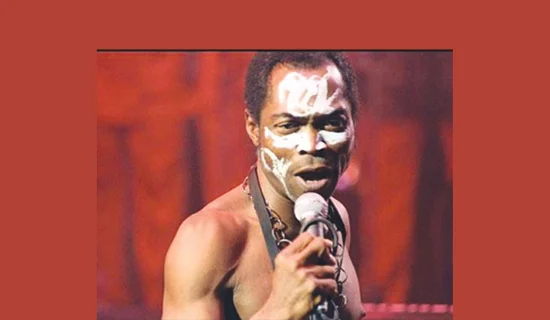
An artificial intelligence (AI)-generated video of music legend Fela Anikulapo-Kuti, trending on social media and depicting the late icon receiving his Grammy Award, is a simple reminder of his super-stardom, even 29 years after his death. The Nigerian music legend, Fela Anikulapo Kuti, described by John Darnton in July 1977 as Nigeria’s ‘Dissident Superstar’, has finally been recognised by the Grammys and honoured with a Lifetime Achievement Award on Sunday, February 1, 2026. Fela certainly deserved the award.
The Afrobeat pioneer, who died in 1997 at the age of 58, is the first African to receive such an honour, which was first awarded in 1963. The award comes after the Grammys introduced the Best African Performance category in 2024. Other musicians who received the award alongside Fela include Mexican-American guitarist Carlos Santana, Chaka Khan, the American singer known as the Queen of Funk, and Paul Simon.
Born Olufela Olusegun Oludotun Ransome-Kuti, ‘the man who had death in his pouch’, as suggested in his name Anikulapo, released more than 50 albums, fusing jazz and funk with traditional Yoruba music and politically charged lyrics. He was not simply a musician; he was a cultural theorist, political agitator and the undisputed architect of Afrobeat. He pioneered the genre alongside drummer Tony Allen, blending West African rhythms, jazz, funk, highlife, extended improvisation, call-and-response vocals and politically charged lyricism.
Like most aspiring Nigerian musicians in the 50s, Fela began his career playing calypso‐influenced high life and imitating the sounds of local stars such as Victor Olaiya and Roy Chicago. Kuti’s musical evolution was later shaped not only by Nigeria but also by Ghana.
During the 1950s and 1960s, highlife music, pioneered by Ghanaian musicians such as ET Mensah, Ebo Taylor and Pat Thomas, became a defining sound across West Africa. Fela spent time in Ghana absorbing highlife’s structure, horn phrasing, and dance-oriented arrangements before fusing it with jazz, funk, the rhythms of his own Yoruba people, and political storytelling.
Two women helped shape his career and sharpen his revolutionary outlook: His mother, Funmilayo Ransome-Kuti (1900-1978), an educationist, political campaigner and women’s rights activist who was hugely influential in his life, helping to shape his political consciousness; and the United States of America-born singer and activist, Sandra Izsadore.
He had met Izsadore, a black-rights activist, in California during a 10-month U.S. tour with Koola Lobitos Band in 1969. She introduced him to the writings of Malcolm X, Angela Davis, H. Rap Brown, Stokely Carmichael, Huey Newton, Frantz Fanon and other revolutionary thinkers.
In the 1970s, Fela, the multi-instrumentalist and full-of-life performer, invented Afrobeat: a mixture of jazz, funk and African rhythms. He later became one of the most influential cultural figures in modern African history, known for using music as a tool for political protest and resistance, as well as for social and economic advocacy. In 1975, he changed his name to Fela Anikulapo-Kuti, removing “Ransome’ that he considered a slave name imposed on his family by British colonialism.
In 1977, after the release of the album, Zombie, which satirised government soldiers as obedient, compliant, but irrational enforcers, irate soldiers, reportedly numbering about 1,000 brutally raided “Kalakuta Republic”, his home and music centre in Moshalashi in Lagos; ransacked the premises, razed the property and threw his mother from a window on an upper floor of the Kalakuta Republic building on February 18, 1977, consequence of which her leg was broken, an injury she never really recovered from until her death on April 13, 1978. Fela later commemorated the incident with his album “Unknown Soldier”, to which the federal government had attributed the attack, following a judicial commission of inquiry.
Fela, in deploying his music to criticise excesses of the military and police personnel, clearly incurred the wrath of Nigeria’s successive military regimes. But all through his life, he remained fearless and determined. Fela was arrested frequently by military governments during his career, mostly for political activism and sometimes also on allegations of crime, such as involvement in prohibited Indian hemp. Most of the offences were not substantiated or proven in court, and he denied them all. Fela was reported to have been arrested about 200 times, although his most significant conviction was in November 1984 when a military tribunal found him guilty of currency smuggling and sentenced him to five years in prison. In fact, he had on him British Pounds that he planned to sustain his band with during a tour of Europe.
His first brush with the law dated back to 1974 when he released his famous album “Zombie”, generally considered by the military authorities in power as a diatribe levelled at them. His songs were long, defiant and explicitly anti-government in power and anti-corruption.
His lifetime of clashes with successive powers in Nigeria laid the groundwork for Afrobeats – a later genre that has attracted a global audience by blending traditional African rhythms with contemporary pop sounds, with its roots in Nigeria.
Reacting to the Grammy Lifetime Achievement Award, Nigerian President Bola Tinubu, in a statement, said that Fela was more than a musician. “He was a fearless voice of the people, a philosopher of freedom, and a revolutionary force whose music confronted injustice and reshaped global sound… his courage, creativity, and conviction defined a generation and continues to inspire the world. In Yoruba mythology, he has transcended to a higher plane as an Orisa. He is now eternal,” the President declared, adding that the award is an affirmation of Fela’s enduring global influence and the foundational role he has played in the evolution and impact of Africa on modern music.
Rikki Stein, a long-time friend and manager of the late musician, says the recognition by the Grammys is “better late than never”. Westerners, first hearing Fela’s Afrobeat music, find it an acquired taste. The numbers seem too long, often lasting 20 minutes or more, with the brief snatches of lyrics in pidgin English, the lingua franca of the lower classes.
Unlike Jamaican reggae, it is difficult to understand without a grounding in fundamentals. There is a heavy, driving sound from an unusual array and mixture of instruments: Western drums, trumpets and trombones.
Fela Kuti’s music resonated with people across Africa and the Diaspora. The musician’s ideology was a blend of pan-Africanism, anti-imperialism, and African-rooted socialism.
Today, Kuti’s music remains popular with millions worldwide, and his influence is evident in modern artists such as Burna Boy, Kendrick Lamar, and Idris Elba. The award-winning actor and DJ has curated an official vinyl box set, Fela Kuti Box Set 6, which publicly compared him to icons such as Sade and Frank Sinatra, and to illustrate the point that Fela Kuti has his own unique sound.
In this article