
Amid mounting outrage over alleged judicial corruption, the National Judicial Council (NJC) has launched an unprecedented crackdown on errant judges, raising hopes of self-cleansing, though doubts linger over whether it marks real change or just another cosmetic sweep.
Though the judiciary is a key arm of government that routinely sanctions its members, unlike the executive and legislative branches, it has increasingly come under heavy scrutiny over allegations of corruption and political influence.
Specifically empowered to carry out this responsibility is the NJC. It is constitutionally clothed with the duty to discipline and appoint judicial officers in the country.
Its powers and functions are derived from Paragraph 21 of Part I of the Third Schedule to the 1999 Constitution (as altered).
To also affirm the NJC’s exclusive disciplinary role, in Nganjiwa v. Federal Republic of Nigeria (2017), the Court of Appeal held that a judge cannot be prosecuted for misconduct committed in the course of judicial duty unless the NJC first investigates and disciplines the judge.
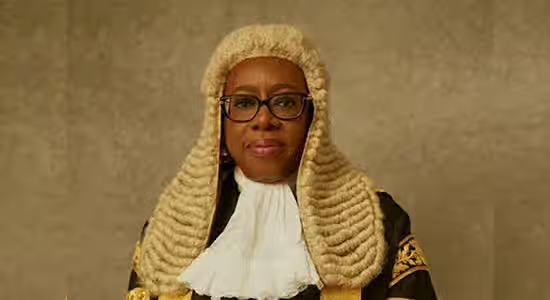
The Chief Justice of Nigeria (CJN), Justice Kudirat Kekere-Ekun, who presided over the National Judicial Council’s decision at its 109th meeting in June 2025, compulsorily retired 10 judges from Imo State and others accused of infractions.
The affected judges from the 109th decision of the council include five from the State High Court and four from the Customary Court of Appeal, all found guilty of falsifying their dates of birth in a bid to unlawfully extend their tenure on the bench.
Among those sanctioned was Justice T.N. Nzeukwu, who was compulsorily retired for violating the constitutional provision on the appointment of Acting Chief Judges. He was found to have bypassed seniority rules to install himself in an acting capacity, a move the NJC described as a clear breach of Section 271(4) of the 1999 Constitution.
T
he Council’s findings revealed a pattern of systemic irregularities in judicial appointments and tenure records, particularly in Imo State, raising broader concerns about the integrity of the judicial recruitment and promotion processes. The NJC has vowed to intensify its verification of judges’ credentials in collaboration with relevant agencies.
Earlier, in April 2025, the Council handed down one-year suspensions without pay to three judges for professional misconduct. Justice Jane Inyang of the Court of Appeal, Uyo Division, was sanctioned for issuing an ex parte order directing the sale of a petrol station during ongoing litigation, a move considered prejudicial and contrary to Rule 3(5) of the Code of Conduct for judicial officers.
Similarly, Justice Inyang Ekwo of the Federal High Court in Abuja was punished for delivering a judgment without granting the parties a fair hearing.
He was also placed on a five-year watchlist and barred from being considered for elevation within that period
Justice Aminu Baffa Aliyu of the Federal High Court in Zamfara received the same suspension for issuing restraining orders against law enforcement agencies and neglecting the binding nature of superior court decisions—another breach of judicial ethics.
The Council further sanctioned Justice Isaac J. Essien of the National Industrial Court, barring him from elevation to a higher court for three years. Justice Essien had controversially issued a N1 billion garnishee order against the Nasarawa State Government despite a pending appeal.
He was also found to have personally interfered with court processes and used official stationery for personal correspondence, conduct the NJC described as unbecoming of a judicial officer.
In addition to outright suspensions and retirements, the NJC issued formal warnings and cautions to several judges for professional lapses ranging from delays in delivering judgments to abuse of judicial discretion.
The Chief Judge of Edo State, Justice Daniel Okungbowa and Justice G.B. Okolosi of Delta State received warnings over such infractions, while Justice Sa’adatu I. Mark of the Federal High Court was cautioned for delivering judgments well beyond the constitutionally mandated 90-day window.
According to the NJC, it is guided by the Judicial Discipline Regulations, 2017, which provide a structured process for handling complaints against judges.
The rule provides that such a complaint must be in writing, signed, and supported by an affidavit. Anonymous or unsigned petitions are dismissed outright. Once received, the NJC first assesses whether the petition has merit and falls within its jurisdiction.
If it does, the judge is issued a formal query and given time to respond, usually within 14 days.
The rule also stipulates that if the response is unsatisfactory, the NJC may set up an investigative panel to conduct a hearing, during which the judge has the right to a fair hearing and legal representation.
Based on the findings, the NJC may issue sanctions such as a warning, reprimand, suspension, or recommend compulsory retirement or removal to the appropriate authority.
Unfortunately, the major challenge is that the executive has always failed to carry out its own task in the process. In certain cases where NJC recommended judges for compulsory retirement, the respective executive arm saddled with the responsibility to give effect to such removal had failed to do so.
For instance, the NJC in 2018 recommended the removal of Justices Rita Ofili-Ajumogobia and Gladys Olotu, but that never happened until those judges fought their way back to the bench through the courts.
While some stakeholders have hailed the NJC’s recent actions as a much-needed cleansing of the judiciary, and in accordance with the rules, others remain sceptical, considering that the executive plays a vital role in perfecting the sanctions.
A prominent human rights advocate and former chairman of the National Human Rights Commission, Prof. Chidi Odinkalu, accused the NJC of complicity in the rot within the judicial system, describing the latest wave of sanctions as too little, too late.
“These are slaps on the wrist. If the NJC truly wants to reform the judiciary, it must match its disciplinary actions with transparency, criminal accountability, and structural reform,” Odinkalu said.
While former chairman of the Nigerian Bar Association (NBA), Ikorodu Branch and the Convener of Fight Against Corruption in the Judiciary, Bayo Akindele, said the recent crackdown has exposed a lot of weakness within the Judiciary.
He, however, noted that it is also a good sign that the NJC under the current leadership is not afraid of doing the right thing.
A Lagos-based lawyer, Paul Mgbeoma, believes the recent disciplinary actions of the NJC are still a work in progress.
According to him, it needs to be sustained over a long period of time before the public confidence will gradually begin to be rekindled.
I do not think it should be viewed as exposing deeper structural weaknesses. It should rather be viewed as a step in the right direction,” he said.
Some civil society organisations, including Citizens’ Gavel, have commended the NJC for what they termed “a step in the right direction” but called for more robust internal mechanisms to detect and prevent misconduct.
The Council, in response to public outcry, has reportedly commenced verification of judges’ records in collaboration with the National Population Commission and the National Identity Management Commission to curb age falsification and fraudulent appointments. Digital case tracking and e-filing systems are also being adopted to reduce human interference and improve efficiency in court processes.
Nevertheless, the NJC has come under fresh scrutiny following its rejection of a legislative proposal seeking to empower the NBA to sanction judicial officers.
The Council insisted that under the 1999 Constitution, only the NJC is vested with the authority to discipline judicial officers, and any attempt to usurp that function would undermine judicial independence.
In this article