
By Stanley Olisa
Africa has made many demands of the world over the decades. Few have carried the moral clarity and political weight of the one now taking shape: a unified continental claim for reparations from Britain for the crimes of colonialism. What was once dismissed as rhetorical or symbolic is quietly becoming structured and serious.
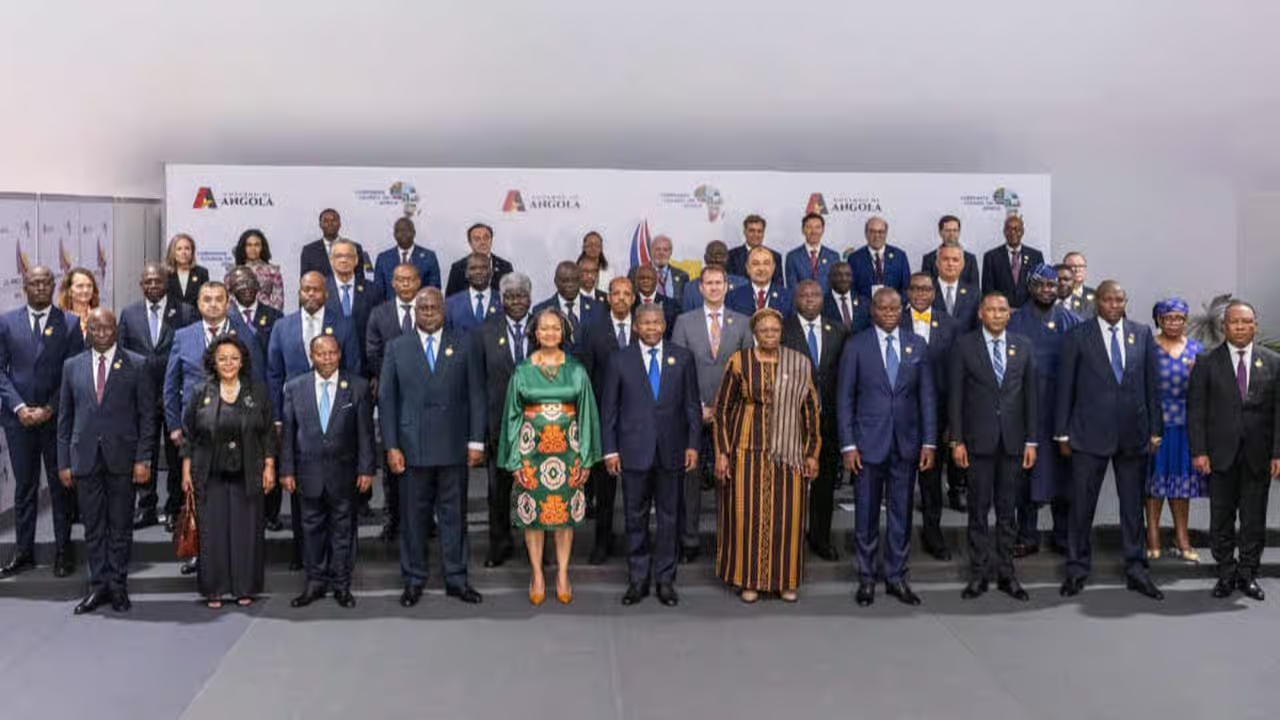
Recent deliberations by African leaders in Algiers, building on resolutions adopted by the African Union earlier in 2025, mark a turning point. For the first time, the continent is moving beyond fragmented national conversations towards a coordinated legal and diplomatic framework that seeks recognition, accountability and redress for colonial-era crimes. This is a reckoning with structures that continue to shape African economies and institutions.
Colonialism was an organised system of extraction. Britain’s empire was built on forced labour, land seizures, punitive taxation and the redirection of African resources into imperial markets. Railways were constructed not to connect African communities but to move raw materials to ports. Administrative systems were designed to govern cheaply, not fairly. Borders were drawn to serve imperial convenience instead of social coherence. The economic consequences of these decisions did not evaporate at independence.
Nigeria’s role in the current reparations push illustrates how this debate is evolving. In September, Senator Ned Nwoko formally submitted a claim to the British government demanding $5 trillion in reparations for colonial exploitation. The figure drew attention but more important was the signal it sent. It demonstrated that African actors are beginning to frame reparations not as grievance politics, but as a matter of international justice grounded in historical evidence and contemporary harm.
Predictably, Britain’s response has been defensive. Officials in London have rejected reparations demands outright, portraying them as unreasonable and inconsistent with what they describe as modern partnerships with former colonies. This posture is familiar. European powers have long preferred narratives of benevolent empire and postcolonial goodwill to difficult conversations about accountability. Yet partnerships built on selective memory remain unstable.
What is different now is the terrain on which this argument is unfolding. Public opinion, especially among younger generations, is shifting. Across Africa and the diaspora, there is a growing insistence that colonial history be treated with the same seriousness as other historical crimes that have warranted apologies, restitution and reparative frameworks. This shift is being reinforced by scholarship, archival research and cultural interventions that challenge sanitised versions of empire.
One such intervention is the documentary, From Slavery to Bond, which has recently circulated widely online. The film traces how British imperial policies entrenched economic dependency, dismantled indigenous governance systems and removed vast quantities of cultural property from colonised societies. It connects colonial decisions to contemporary crises, from underdevelopment to political instability. For many viewers, it fills gaps left by formal education systems that mention colonialism without fully examining its consequences.
The documentary also underscores why reparations cannot be reduced to a single cheque or headline figure. Reparations are as much about acknowledgement as compensation. They involve recognising colonialism as a crime with identifiable victims and lasting consequences. They include the return of looted artefacts, many of which remain in British museums despite repeated calls for restitution. They raise questions about debt, trade terms and global financial structures that still disadvantage former colonies.
Internationally, Africa is not alone in this conversation. Caribbean nations, organised under the CARICOM Reparations Commission, have spent over a decade articulating a legal and moral case against former colonial powers, including Britain. Their approach has combined historical research, diplomatic engagement and public advocacy. Recent meetings between Caribbean leaders and British officials have kept the issue firmly on the global agenda, even in the face of resistance. Africa is now signalling that it is ready to engage at a similar level of seriousness.
Sceptics argue that reparations claims risk reopening old wounds or distracting from domestic governance challenges. That framing is misleading. Addressing colonial injustice does not absolve African leaders of responsibility for present-day failures. It simply recognises that contemporary African states operate within systems shaped by historical dispossession. As a public affairs analyst, I have seen how often Africa is asked to move forward without an honest accounting of how its starting point was engineered. A society can demand accountability at home while also seeking justice abroad. The two are not mutually exclusive.
There is also a pragmatic dimension to a unified African approach. A single country pressing a reparations claim can be isolated or ignored. A continent speaking through a common framework is harder to dismiss. Analysts are right to note that a joint African Union claim would carry greater geopolitical weight than scattered national initiatives. It would force former colonial powers to engage not with individual governments, but with a collective historical case.
The road ahead will be slow. Legal definitions must be sharpened. Evidence must be consolidated. Diplomatic strategies must be carefully calibrated. There will be pushback, both external and internal. But the significance of this moment lies less in immediate outcomes than in the shift it represents. Africa is no longer asking whether colonialism caused harm. It is asking how that harm should be addressed within modern international law and diplomacy.
Reparations begin with an honest reading of history and a willingness to act on its consequences. For too long, Africa has been expected to move forward without accounting for the forces that shaped its starting point. That expectation is now being challenged. Whether Britain is ready to listen remains uncertain. What is clear is that Africa is finding its voice, collectively, on its own terms.
Olisa, a public affairs commentator and communications practitioner, wrote from Lagos.
In this article