
The Wole Soyinka Centre for Investigative Journalism has raised fresh concerns over the state of civic freedoms in Nigeria, revealing that 245 incidents of civic space violations were documented across the country in 2025, with state actors responsible for the overwhelming majority of the cases.
The findings are contained in the Centre’s 2025 Journalism and Civic Space Status Report, titled “Silenced Voices, Shrinking Space: Civic Freedoms Under Pressure,” presented by Nurudeen Salako during the WSCIJ Journalist Timeout in Lagos on Thursday.
Salako said the report was based on the monitoring of 54 print, online, television and radio media organisations throughout 2025, documenting violations reported between January and December.
According to him, the centre recorded 245 incidents of civic space violations, which generated 570 reports across the monitored media platforms.
He explained that print media accounted for 309 reports, representing 54.2 per cent of the total coverage, followed by online platforms with 207 reports, television with 45 and radio with nine.
Salako said straight news reports accounted for more than 82 per cent of the coverage, while editorials, features, interviews, opinion articles, photographs, cartoons and videos made up the remaining reports.
He noted that freedom of expression was the most violated civic right during the period under review, followed by the right to peaceful assembly and participation.
According to him, the report found that 219 of the 245 documented incidents were allegedly perpetrated by state actors, while only 26 were linked to non-state actors such as thugs and organised civilian groups.
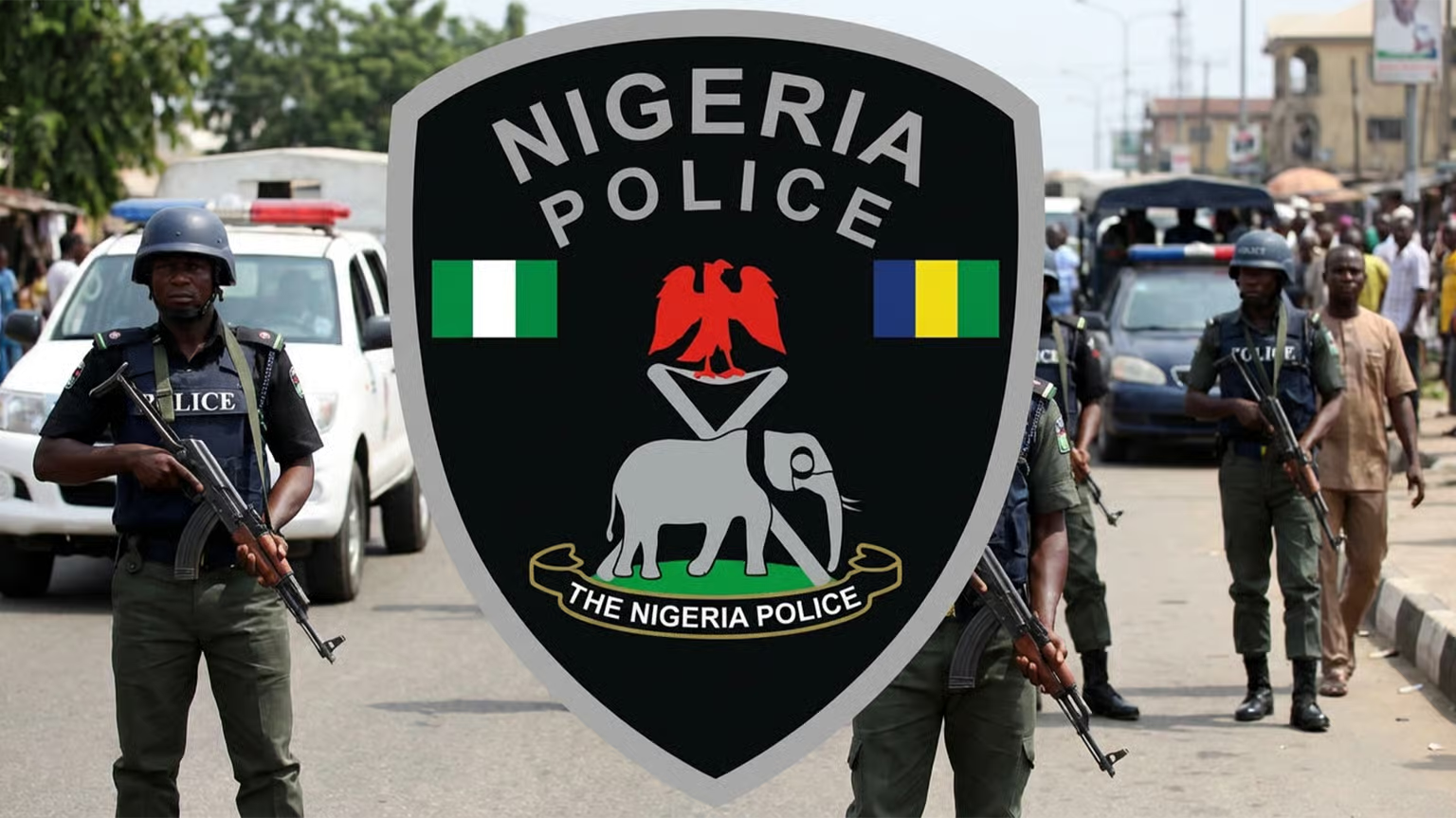
“The Nigerian Police accounted for 118 out of the 219 incidents involving state actors. That is 53.9 per cent and shows how critical the police are to the civic space challenges we are facing,” Salako said.
He added that other state actors identified in the report included the Department of State Services, political officeholders, state governments, the Nigerian Army, state-owned universities, the Economic and Financial Crimes Commission, the Nigerian Air Force and the National Broadcasting Commission.
The report also showed that non-violent forms of repression remained more common than physical attacks, with 145 incidents, representing 59.2 per cent of all documented violations, involving arrests, detention, intimidation, threats, restrictions on media coverage and other administrative actions.
The remaining 100 incidents involved physical violence, including killings, assaults and harassment of journalists, activists and citizens.
Salako said March recorded the highest number of civic space violations, with 37 incidents representing 15.1 per cent of the annual total.
He attributed the spike largely to the political controversies surrounding the suspension of Natasha Akpoti-Uduaghan by the Senate and the Rivers State political crisis involving Governor Siminalayi Fubara, both of which triggered protests and public demonstrations.
According to the report, ordinary citizens emerged as the biggest victims of civic space violations in 2025, accounting for 133 incidents or 54.3 per cent of those affected.
Journalists recorded 60 cases, representing 24.5 per cent, while activists, media organisations and labour unions were also affected.
Geographically, the Federal Capital Territory recorded the highest number of violations with 58 incidents, followed by Lagos State.
Salako said Abuja’s position as the nation’s political headquarters contributed significantly to the concentration of civic space violations recorded there.
He further observed that arrests, detention and the dismissal of journalists had become the dominant forms of non-violent repression, while security agencies remained the leading perpetrators of civic space violations.
The report also noted that states such as Zamfara and Katsina recorded little or no media documentation of civic space violations during the period under review.
Salako, however, cautioned that the absence of reports should not be interpreted as the absence of violations, but could reflect fear, under-reporting or poor documentation.
Comparing the findings with previous editions, he said WSCIJ documented 134 incidents in 2023, 103 in 2024 and 245 in 2025, indicating a significant increase in civic space violations.
He also noted that the number of media organisations monitored rose from 32 in 2023 to 38 in 2024 and 54 in 2025.
Salako urged media organisations to strengthen investigative and data-driven journalism, devote greater editorial attention to civic space issues and improve the safety and legal protection of journalists.
He also called on security agencies to respect constitutional rights, while urging civil society organisations to deepen monitoring, documentation, strategic litigation and public awareness campaigns.
Earlier, WSCIJ Programme Officer Mariam Alo said the Civic Space Guard programme was established to promote and protect civic freedoms in Nigeria and ensure journalists could carry out their constitutional responsibilities without fear.
She explained that the annual Journalist Timeout provides journalists with an opportunity to step away from newsroom pressures and engage in discussions on issues affecting the media and democracy.
According to Alo, the Centre introduced annual civic space reporting after abandoning its initial 10-year review cycle, saying yearly assessments provide a more effective way of tracking developments.
“Our first Civic Space Status Report covered 2012 to 2022, but we realised that 10 years was too long for effective monitoring. That is why we now publish the report annually,” she said.
She described journalists as the “frontline defenders” of civic space, stressing that they must be physically, psychologically, legally and digitally protected to effectively perform their watchdog role.
“If not for you, a civic space infraction would take place in whatever part of the country and we wouldn’t be aware. You are the frontline defenders,” Alo said.
She urged journalists and other stakeholders to interrogate the report’s findings and work collaboratively to strengthen civic freedoms, press freedom and democratic accountability in Nigeria.
In this article