
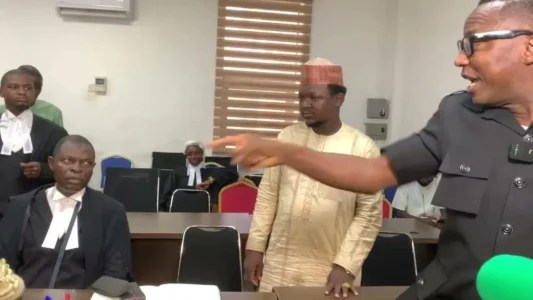
Human rights activist and African Action Congress (AAC) presidential candidate, Omoyele Sowore, has accused the Department of State Services (DSS) and the Federal High Court in Abuja of orchestrating what he described as a predetermined judicial process designed to secure his imprisonment over charges arising from his description of President Bola Ahmed Tinubu as a “criminal.”
Speaking with journalists on Monday after proceedings at the Federal High Court in Abuja, Sowore alleged that the prosecution’s objective was to prevent him from fully presenting his defence, insisting that the outcome of the case had already been decided before the trial concluded.
According to him, his lead counsel openly challenged the conduct of the court because of concerns over what he described as irregularities during the proceedings.
“They have already written the judgment,” Sowore alleged, claiming the judicial process mirrored past cases in which, according to him, the courts were used against prominent figures, including Ken Saro-Wiwa and the late Chief M.K.O. Abiola.
Sowore urged journalists covering the trial to attend court proceedings personally rather than rely on official accounts from the DSS, arguing that firsthand observation would provide a more accurate account of events.
He alleged that during Monday’s sitting, the prosecution sought to foreclose the defence’s case despite the court registry’s failure to provide documents his legal team considered essential for cross-examination.
According to Sowore, efforts to terminate the defence have been consistent throughout the trial. He further claimed members of his legal team had previously been subjected to unfair treatment in court and alleged he had been informed of an agreement between the prosecution and the judge to have him imprisoned.
Sowore also linked his previous remand at the Kuje Correctional Centre to what he described as the same alleged arrangement, maintaining that he had been jailed after missing only one court appearance.
He rejected claims that his legal team was responsible for delays in the proceedings, insisting they had consistently participated in the trial and accusing the prosecution of misrepresenting the facts.
Drawing comparisons with other high-profile criminal cases, Sowore questioned the speed with which his matter was being handled, noting that several corruption cases involving politically exposed persons had remained in court for years without conclusion.
He also defended his lead counsel, Senior Advocate of Nigeria Adeyinka Olumide-Fusika, saying the lawyer objected to what he described as repeated accusations by the prosecution that the defence was employing “dilatory tactics.”
Sowore further alleged that the Director-General of the DSS, whom he expected to testify, failed to appear in court, adding that the witness eventually presented by the prosecution was unfamiliar to the defence.
He maintained that his legal team was prepared to proceed with the trial but required access to relevant documents to effectively challenge the prosecution’s evidence, arguing that denying the defence such materials undermined his constitutional right to a fair hearing.
According to him, lawyers present in court also objected to what they viewed as continued attacks on the defence team before the judge adjourned the case.
Sowore renewed his call for the trial judge to recuse himself from the matter, insisting that public confidence in the proceedings had been compromised.
Responding to questions on the country’s political landscape ahead of the next presidential election, Sowore said the Independent National Electoral Commission’s published list of presidential candidates placed the AAC second among the participating parties.
He also criticised President Tinubu’s educational background, urging him to pursue further education while allowing what he described as “serious people” to contest for the presidency.
Sowore called on Nigerians to recognise what he termed the country’s worsening condition, accusing the current administration of undermining national development.
He announced that the RevolutionNow movement would hold nationwide protests on August 5, describing the demonstrations as part of its continuing campaign for systemic reforms since the movement’s launch in 2019.
Outlining his policy priorities if elected president, Sowore said his administration would focus on security, electricity, education, healthcare, economic reforms, anti-corruption efforts, food security, agriculture, technology, infrastructure, tourism and justice sector reforms.
He reiterated his proposal for a national minimum wage of ₦500,000, arguing that the current wage structure is insufficient to meet the cost of living. He also pledged to build a technology-driven economy capable of competing globally, while addressing insecurity, infrastructure deficits and reforms within Nigeria’s policing and justice systems.
Throughout his remarks, Sowore’s allegations reflected his position on the ongoing case. The DSS and the Federal High Court had not publicly responded to the specific claims at the time of his comments.
In this article