
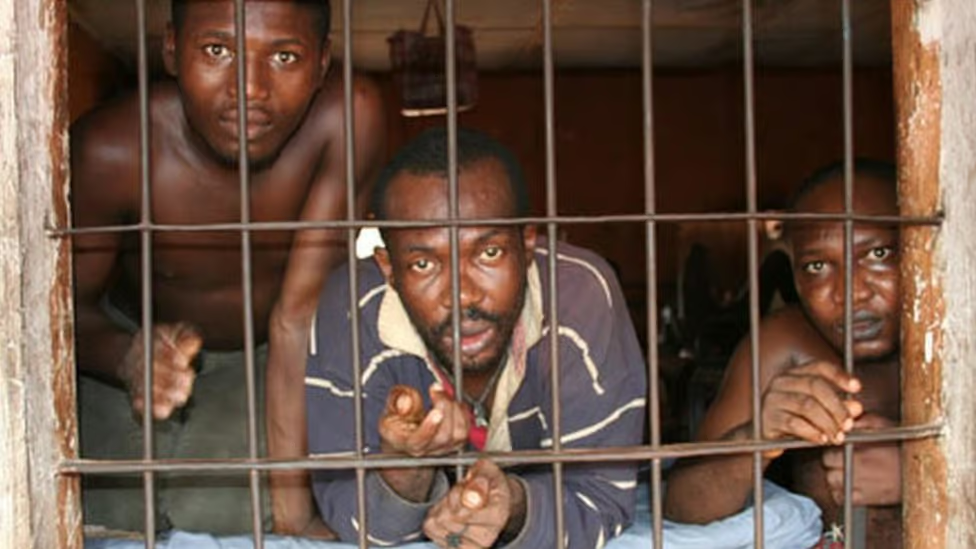
The Tunji Braithwaite Foundation has called for urgent reforms in Nigeria’s criminal justice system, lamenting that thousands of Nigerians presumed innocent remain in correctional facilities for years without trial.
The foundation said the continued detention of awaiting-trial inmates amounted to a grave violation of their constitutional rights and urged the judiciary, lawmakers and other stakeholders to take immediate steps to address the crisis.
The Executive Director of the foundation, Olaoluwa Braithwaite, made the call in a statement made available to newsmen on Tuesday after the foundation’s “March of Silence” held in Lagos to commemorate the 10th anniversary of the late legal icon and politician, Dr Tunji Braithwaite.
The march, which coincided with the United Nations International Day in Support of Victims of Torture, began with an outreach to the Ikoyi Custodial Centre before participants proceeded silently to Tunji Braithwaite Park, where they demanded reforms in the justice system.
Braithwaite described the prolonged detention of thousands of inmates awaiting trial as one of the country’s most pressing human rights concerns, noting that many had spent between five and 10 years in custody without their cases being concluded.
According to him, about 70 per cent of inmates in Nigerian correctional centres are awaiting trial despite being presumed innocent under Section 36 of the Constitution.
“Our data shows that 70 per cent of people in Nigerian prisons are still awaiting trial. Presumed innocent under Section 36 of our Constitution, yet punished daily. Justice delayed is justice denied. And the loudest thing about it is the silence,” he said.
He painted a grim picture of how minor offences and poverty often condemn Nigerians to years behind bars.
“Imagine being arrested for not using the overhead bridge to cross the expressway and being unable to pay a fine of N20,000, only to end up spending five years in prison. This is the silence we must break,” he said.
Braithwaite said the foundation chose Ikoyi Custodial Centre because it symbolises the wider crisis confronting Nigeria’s correctional system.
“Ikoyi Prison, like many correctional facilities across the country, currently groans under the weight of severe, inhumane overcrowding. But the real tragedy is not in its population density; it is in the legal status of its inhabitants.
“Most of its inmates have not been convicted of any crime by a competent court of law. They are merely awaiting trial,” he stated.
He blamed the situation on missing case files, absent investigating police officers, unaffordable bail conditions and systemic inefficiencies.
“These individuals are victims of lost case files, missing investigating police officers and bail conditions that mock their economic reality. The current system effectively criminalises poverty.
“A wealthy man accused of a crime can secure bail and defend himself from the comfort of his home, while a poor man accused of a minor infraction, or sometimes no infraction at all, is swallowed by the prison system,” he added.
Braithwaite said the foundation deliberately organised a silent procession to symbolise the plight of inmates whose voices had been drowned by bureaucracy.
“We walked in silence to honour those whose voices have been silenced behind prison walls, to provoke reflection among Nigerians and to conserve our strength for the moment the silence would finally be broken,” he explained.
According to him, participants wore white shirts, while some covered their mouths with black tape to symbolise the voicelessness of thousands of inmates awaiting trial.
He said the foundation formally presented a petition containing three key requests to the Chief Judge of Lagos State, seeking measures to strengthen access to justice, accelerate criminal justice reforms and improve humane correctional practices.
Braithwaite said the campaign would not end with the march.
“We will knock relentlessly on the doors of the courts, the last hope of the common man. We will petition lawmakers. We will push for reform. We will not stop, we will not tire, and we will not be silenced again until the fundamental right to a fair, speedy, and just hearing becomes a tangible reality for every Nigerian citizen,” he said.
He also urged the media to sustain attention on the plight of awaiting-trial inmates and hold public institutions accountable.
“You are the amplifier. Your cameras make what is invisible visible. Headlines make what is ignored urgent. Questions make what is accepted accountable.
“Run the story. Ask the government the hard questions. Hold them to constitutionalism. Because when the media speaks, the nation listens.
“We are breaking the silence today, but we will not return to silence after,” he added.
In this article