
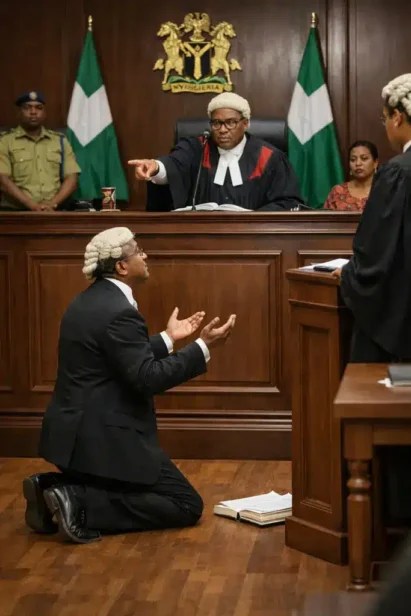
My view on the Supreme Court ruling in the Gwandu emirate matter having read the Decision of the Supreme Court. On 15 May 2026 the Supreme Court, sitting as a full panel of five Justices (Abba Aji, Saulawa, Agim, Nwosu-Iheme and Tukur, JJSC), dismissed an attempt to reopen the Gwandu emirate appeal. Tukur, JSC delivered the lead ruling and Nwosu-Iheme, JSC concurred. The decision, and the orders that came with it, are therefore the decision of the Court, not the act of one or two of its members.
The background: the former Emir of Gwandu, deposed by Kebbi State in 2005, won at the High Court and the Court of Appeal but lost at the Supreme Court on 4 June 2025, by three to two, on the ground that he had sued without first exhausting the grievance procedure the Chiefs Law required, so the trial court had no jurisdiction. Having lost, his counsel asked the Court to set that judgment aside for “fraud” and to empanel fresh Justices to rehear the appeal.
That was hopeless, and the Court rightly dismissed it. By section 235 of the Constitution the Supreme Court is final, and once it had delivered its judgment on 4 June 2025 it was functus officio: it had fully discharged its office in the matter and retained no power to reopen it. It may correct a slip, and in rare cases set aside a judgment obtained by real fraud or given without jurisdiction, but it does not sit on appeal over itself. The “fraud” alleged was merely disagreement with how the majority read the statute, propped up by the two dissenting opinions, as though a dissent could become the judgment of the Court.
The irony is that the two dissenters, Abba Aji and Saulawa, JJSC, sat on the very panel that threw the application out. The Application by counsel was an abuse of process.
The costs against counsel personally are also defensible, because the Court has done exactly this before. In the Bayelsa matter, after it had voided the election of the All Progressives Congress candidates, David Lyon and his running mate Biobarakuma Degi-Eremienyo, on 13 February 2020 over Degi-Eremienyo’s false certificate, the Court on 26 February 2020 dismissed the applications by the party and its candidates to set that judgment aside, and, in the lead ruling of Augie, JSC, ordered their two lead counsel,
Chief Afe Babalola, SAN and Chief Wole Olanipekun, SAN, to pay punitive costs of thirty million naira each, sixty million naira in all, for filing applications it called vexatious, frivolous and an abuse of process. So the principle is settled. Counsel here was on notice that costs against him were being sought, and the amount, heavy as it is at fifty million naira, lies within the Court’s discretion.
My difficulty is with the last order: that counsel cease to have right of audience in any court in Nigeria until he pays. That is, in substance, a suspension from practice, and the power to suspend a lawyer does not lie at large in a costs ruling. It belongs to a statutory scheme. Section 8 of the Legal Practitioners Act gives every lawyer the right of audience in all our courts, removable only through that scheme. Section 13 lets the Supreme Court itself discipline a lawyer, but only for infamous conduct in a professional respect, only after hearing him, and only by a defined sanction (striking off, suspension for a fixed period, or admonition), with notice in the Federal Gazette. This order meets none of those conditions. It is indefinite, tied to the payment of money, with no Gazette notice and no finding of infamous conduct. Tellingly, the Court was asked to refer counsel to the Legal Practitioners Disciplinary Committee, the body built for the purpose, and declined, fashioning its own punishment instead.
It is also disproportionate. Costs are a civil debt, enforceable by execution. We do not jail ordinary debtors; we should not strip a lawyer of his livelihood across the whole country, for as long as he does not pay, simply for owing money. And a single panel cannot truly bind every other court in the land to refuse him audience automatically the day he misses the deadline.
Nor can contempt save it. The rule that a contemnor will not be heard shuts out the disobedient party in his own case; it has never disqualified a lawyer from appearing for other clients everywhere. Counsel has not even been declared a contemnor; the trigger is a future possibility that he may not pay, and disobedience to a money order is enforced by execution, not by ending a career. The contempt power is extraordinary, meant to protect justice, not to collect a debt or to soothe wounded feelings, and even it requires that a man be told his offence and allowed to show cause before he is punished. This order strikes automatically, with no further hearing. It is neither a true committal for contempt nor a lawful discipline under section 13; it borrows the sting of both and the safeguards of neither.
One last point, with respect. The lead ruling of Tukur, JSC was stern but dignified. The concurrence of Nwosu-Iheme, JSC was not. To call counsel “uncultured,” “recalcitrant,” “bereft of common sense” and “not worthy to be called a legal practitioner,” to dismiss his application as “trash,” and to predict that it would “haunt him for the rest of his career,” was not fair to the man. That judges the man, not the work. To brand a lawyer unworthy of his profession is, in effect, to find him unfit, and that is a finding no one may make against him until he has been charged and heard. He was condemned unheard.
The epithets added nothing to the reasoning and served only to wound, and there is an inequality in a Justice abusing a lawyer who cannot answer back. The lead ruling itself proves the censure could be delivered firmly, and in full, without a single insult.
So my conclusion. The Court’s central message is sound: it is not a revolving door, its time is precious, and lawyers who file hopeless applications must expect to pay for it.
The dismissal was right, and the costs were within the Court’s power. But the order driving counsel from every courtroom in Nigeria until he settles a bill belongs to a kind of punishment that the law has placed in careful hands and hedged with safeguards, and it was made outside all of them. I do not suggest that this concluded matter can or should be reopened; the Court is final, and there it must rest. I say only, with respect, that the right of audience order was the one step too far, and that when the question next comes before the Court it is to section 13 of the Legal Practitioners Act and to the Legal Practitioners Disciplinary Committee, and not to a costs ruling, that the discipline of a lawyer properly belongs.
Eyimofe Atake, SAN, PhD(Cantab).
In this article