
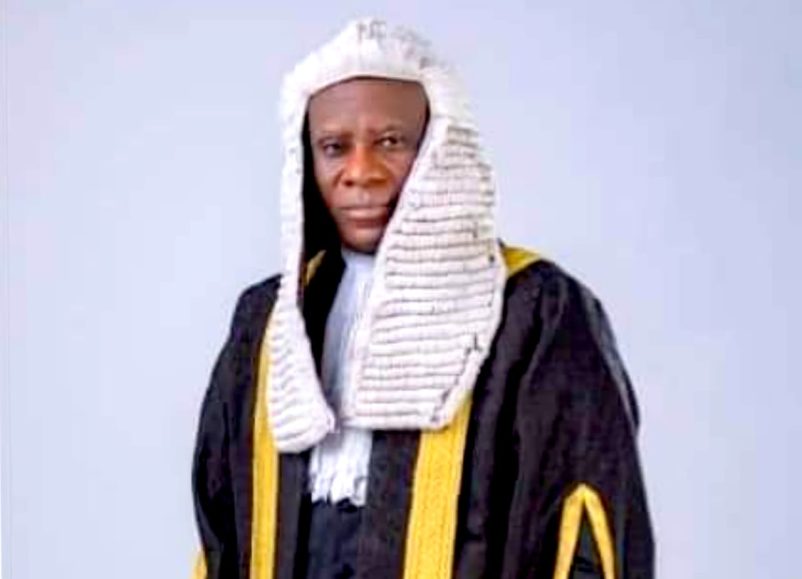
Senior Advocate of Nigeria, Olukunle Ogheneovo Edun, has warned that Nigeria risks social and institutional collapse if urgent reforms are not undertaken to address what he described as the growing commodification of justice and the erosion of public confidence in the country’s judicial system.
Edun delivered the warning while presenting a paper titled, “Justice for Sale: Who Truly Pays the Price?” as the lead paper at the 2026 Nigerian Bar Association (NBA) Benin Branch Law Week on June 2, 2026.
Addressing judges, lawyers, Senior Advocates and members of the public, Edun argued that justice in Nigeria has increasingly become accessible only to the wealthy, undermining the rule of law and public trust in democratic institutions.
He said the problem manifests through judicial corruption, forum shopping, procedural abuses, prolonged litigation designed to frustrate weaker parties, and unequal access to quality legal representation.
According to him, the consequences extend beyond individual litigants to the legal profession, the judiciary and society as a whole.
Edun also challenged the rule preventing Senior Advocates of Nigeria from appearing before Magistrate Courts and other inferior courts, questioning its constitutionality in light of Section 36(6)(c) of the 1999 Constitution, which guarantees an accused person the right to counsel of choice.
Citing the Supreme Court decision in Isiaka & Ors v. Ogundimu & Ors (2006), he argued that litigants should be free to engage any legal practitioner of their choice. He further referenced an unreported ruling in Charge No. MCOSU/64c/2024, in which he successfully argued that a SAN holding the fiat of a state Attorney-General could prosecute matters before a Magistrate Court.
Edun contended that it was discriminatory for the state to engage Senior Advocates to prosecute defendants in Magistrate Courts while denying defendants the same right to retain SANs for their defence. He expressed hope that the Supreme Court would revisit the issue and reconsider authorities such as Bamigboye v. COP (2025), which upheld the restriction.
The senior lawyer also criticised the popular phrase “go to court,” describing it as a reflection of public cynicism rather than confidence in the judiciary.
To illustrate delays in the justice system, he cited Suit No. FHC/CS/67/2023, Samuel C. Idoh & 17 Others v. Federal Government of Nigeria, concerning dangerous federal highways in Delta and Edo states. According to him, the matter remains unheard more than three years after it was filed.
He questioned the value of judicial victories that take years to secure and even longer to enforce, noting that litigants often spend decades pursuing justice through the appellate process while the value of awarded sums depreciates over time.
Edun warned that the failure of formal justice institutions has created space for non-state actors, including area boys, thugs, militants and community youths, to establish informal systems of dispute resolution and punishment.
He said the growing loss of confidence in the judiciary and legal profession had encouraged these groups to administer what they consider swift justice, a development he described as dangerous and unlawful.
The SAN also criticised government officials for failing to comply with court orders, describing such disobedience as widespread. He cited the case involving former Kogi State Governor Yahaya Bello and dissolved local government councils, noting that despite favourable judgments up to the Supreme Court level, aspects of the court’s orders remain unimplemented.
He further accused some senior lawyers of advising clients on how to frustrate court orders and judgments, warning that such conduct damages the legal profession and weakens public trust in the judiciary.
On forum shopping, Edun described the practice as the strategic manipulation of court jurisdictions and procedures to obtain favourable outcomes. He said such conduct contributes significantly to perceptions that justice can be influenced by money and power.
He also expressed concern about inconsistencies in the application of judicial precedent. Referencing Centre for Oil Pollution Watch v. NNPC (2018), he noted that despite the Supreme Court’s expansion of locus standi in public interest litigation, lower courts continue to dismiss some public interest cases on grounds of lack of standing.
Edun additionally pointed to the Supreme Court’s April 30, 2026 decision in PDP v. Alhaji Sule Lamido, saying the judgment had continued to generate debate, partly because of a dissenting opinion delivered by Justice Haruna Simon Tsammani.
As part of broader political reforms, he advocated constitutional recognition of independent candidacy, arguing that it would reduce litigation arising from internal disputes within political parties.
The senior lawyer also lamented the continued lack of true financial autonomy for the judiciary, despite constitutional provisions guaranteeing it. According to him, executive influence over funding and appointments continues to undermine judicial independence.
He called for the decentralisation of the Legal Practitioners Disciplinary Committee to the six geopolitical zones, arguing that the current arrangement, which requires disciplinary proceedings to be conducted in Abuja, imposes excessive financial burdens on complainants and respondents from other parts of the country.
Edun concluded that the poor suffer when justice becomes inaccessible, the legal profession loses its integrity, the judiciary loses its legitimacy, and the nation risks instability.
He proposed a series of reforms, including improved judicial welfare and independence, expanded use of technology through e-filing and electronic case management systems, stricter enforcement of professional ethics, wider access to legal aid and pro bono services, and stronger disciplinary measures against erring lawyers and judicial officers.
He also urged the NBA to take a leading role in protecting judicial integrity, sanctioning unethical conduct within the profession and advocating systemic reforms involving the executive, legislature and civil society.
Closing his presentation with the words of Christopher Sapara-Williams, Nigeria’s first indigenous lawyer, Edun said lawyers exist to serve society and advance humanity.
In this article