
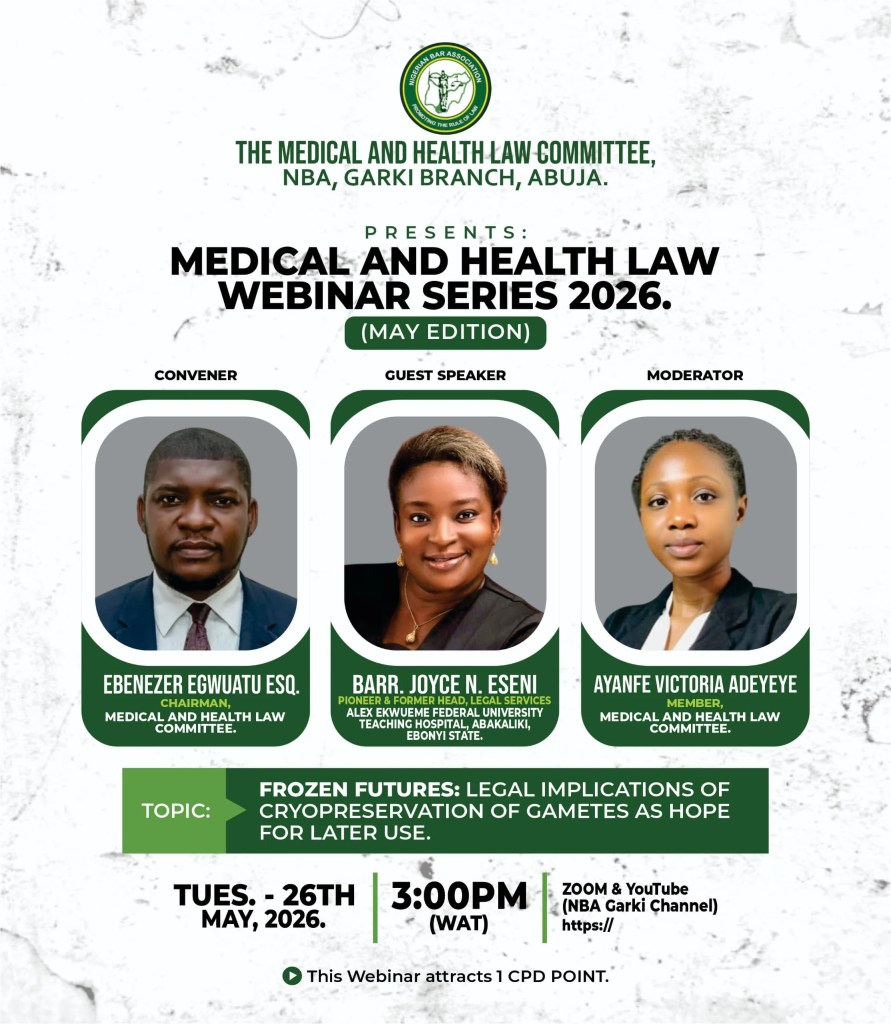
The Medical and Health Law Committee of NBA, Garki Branch, Abuja, organizes medical law webinar on the legal implications of cryopreservation of gametes (freezing of eggs and sperm) for later use.
For the May 2026 edition of its monthly Medical and Health Law Webinar, the Medical and Health Law Committee of the Garki Branch of the NBA will be discussing the topic: “Frozen Future: The Legal Implications of Cryopreservation of Gametes for Later Use.” The webinar is slated to hold tomorrow, 26th May, 2026, by 3:00pm on Zoom. It will also be livestreamed on the YouTube Channel of NBA Garki Branch, Abuja.
The Guest Speaker is Joyce Eseni Esq., a seasoned medical law practitioner, who served as the pioneer and former Head, Legal Services, Alex Ekwueme Federal University Teaching Hospital, Abakaliki, Ebonyi State, and currently serves as the 2nd Vice Chair, Medicine and Law Committee, NBA Section on Legal Practice.
The legal community is enjoined to register and participate in this crucial webinar via the link below:
https://us06web.zoom.us/meeting/register/9QwifcwhSYST40ZeO3K5JA
Shedding light on the topic and its significance, the Chairman of the Medical and Health Law Committee of Garki Branch, Ebenezer Egwuatu Esq., stated that social egg freezing and fertility preservation are no longer futuristic concepts; they are happening in clinics across Nigeria today. Across the world, and increasingly in Nigeria, more women and men are exploring cryopreservation of gametes, commonly known as egg and sperm freezing, as a way to preserve the possibility of parenthood for the future.
For many, it represents hope. Hope for the young professional woman pursuing career advancement before motherhood. Hope for cancer patients facing treatments that may affect fertility. Hope for couples struggling with delayed conception. Hope for individuals who simply want more control over the timing of family life in an increasingly demanding world.
However, while science offers a “frozen future” of hope and expands reproductive possibilities for career-focused individuals, medical tourists, and patients undergoing oncological treatments, it simultaneously opens a Pandora’s box of unprecedented legal and ethical questions, including but not limited to:
Who owns a frozen egg, sperm, or embryo in the event of divorce, death, incapacity, withdrawal of consent, or abandonment?
Can stored gametes be inherited or destroyed without consent?
What level of consent is truly sufficient?
What rights do women truly have over their reproductive future?
Can a child conceived posthumously inherit properties under Nigerian succession law?
How do we navigate the total absence of a robust, dedicated statutory framework for Assisted Reproductive Technology (ART) in Nigeria?
What are the responsibilities and liabilities of fertility clinics and healthcare providers?
And perhaps most importantly, are Nigerian lawmakers prepared for the ethical and legal complexities created by assisted reproductive technology?
The above questions are no longer theoretical; they are realities confronting medical lawyers, fertility clinics, and Assisted Reproductive Technology (ART) practitioners, and the law should provide answers to these questions.
The growing popularity of fertility preservation has created an emerging intersection between medicine, law, ethics, religion, human rights, and public policy. Yet public understanding remains limited, and legal regulation in many jurisdictions, including Nigeria, continues to evolve slowly in the face of rapidly advancing medical technology.
For legal practitioners, this emerging field presents a new frontier in medical and health law. It will help lawyers expand their practice into the rapidly growing field of medical law by understanding the contractual obligations and intricacies of clinic-patient agreements, reproductive rights, liability mitigation for fertility centres, medical negligence, inheritance, and how to advise clients on estate planning involving cryopreserved genetic material or posthumous reproduction under Nigerian jurisprudence.
Lawyers advising individuals, hospitals, fertility clinics, or healthcare institutions must now grapple with issues that did not exist in traditional legal frameworks.
Perhaps the most personal dimension of this conversation lies with young professional women, including female lawyers, particularly those between the ages of 27 and 34, many of whom are navigating intense career demands, economic realities, social expectations, and concerns about declining fertility.
Egg freezing is often marketed as empowerment and flexibility, but beneath the attractive messaging lie medical risks, financial implications, emotional considerations, and unresolved legal uncertainties that deserve honest and informed discussion.
Furthermore, he stated that this webinar is also relevant for healthcare practitioners such as doctors, nurses, and fertility practitioners. The webinar will help them learn the boundaries of informed consent, the legal risks of genetic material mix-ups, and how to implement strict clinical governance standards in the absence of explicit local legislation.
For today’s modern, forward-thinking, and career-oriented woman between the ages of 27 and 35, taking control of her reproductive timeline is an empowering choice, but the important question is: are they legally protected?
This webinar will equip participants to discover the critical questions they must ask their fertility clinic before signing a contract, and also help them know their rights regarding egg ownership, storage fees, and the long-term security of their frozen gametes.
In conclusion, Egwuatu Esq. stated that these and many other reasons propelled the Medical and Health Law Committee to choose this topic. He encouraged lawyers, healthcare professionals, and modern-day
career-driven women to register and participate in this important webinar.
He also thanked the leadership of NBA Garki Branch for their support to the Committee.
In this article