
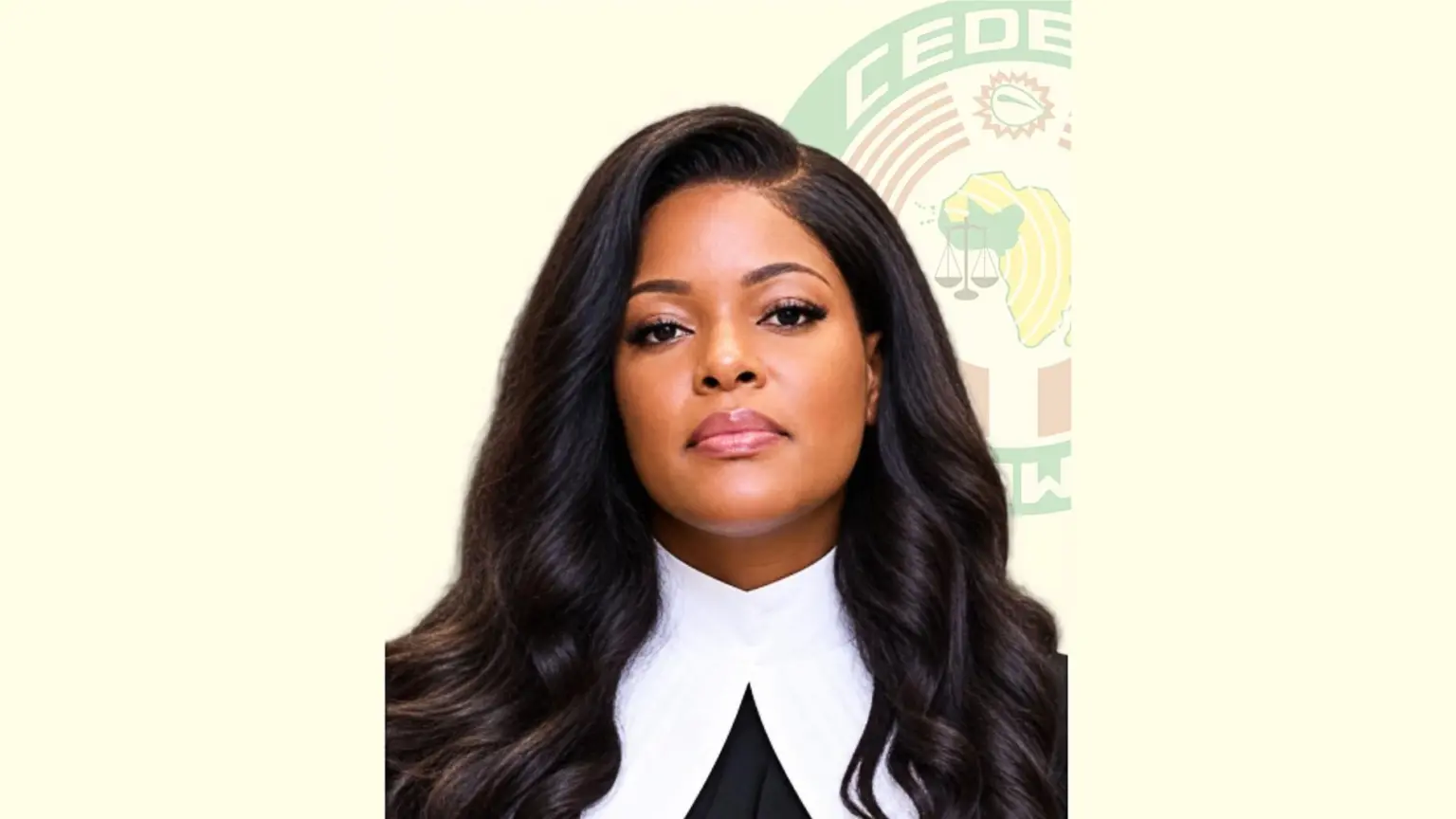
The newly elected President of the Community Court of Justice, Economic Community of West African States, also known as the ECOWAS Court, Justice Charlyne M. Brumskine of Liberia, has assured of her administration’s commitment to restore citizens’ confidence in the regional court.
Aware of the challenges confronting the court, one of which is poor enforcement of its decisions, especially by the governments of the respective West African States, Brumskine vowed to protect human rights by employing every legal instrument to ensure implementation of the court’s judgment.
The emergence of Brumskine and her Vice, Justice Désire Henri Aihou of the Republic of Benin, followed the recent swearing-in ceremony presided over by the Chairman, ECOWAS Authority of Heads of State and Government, Bassirou Diomaye Faye, who is also the Senegalese President.
Some of the reforms expected of the new President include the implementation of Strategic Plan 2026–2030, also known as Justice 2030.
The reform will provide a framework for strengthening access to justice, improving judicial efficiency, enhancing institutional effectiveness, increasing the court’s visibility and consolidating public confidence in the regional justice system.
She assured that during her tenure, the court will expand access to justice for community citizens, strengthen regional legal harmonisation to resolve disputes more efficiently, promote transparency and stakeholder engagement, as well as foster digital transformation in judicial processes to address emerging challenges in justice delivery.
“The plan represents a significant step towards institutional transformation and aims to consolidate past achievements while addressing the evolving needs of the ECOWAS region”, she said.
Adding: “I accept this responsibility, fully conscious of the obligations it entails, and the expectations that accompany leading a regional judicial institution, entrusted with interpreting and applying community law and protecting human rights.”
The new leadership was elected last week by the new college of judges, and their emergence marked the beginning of a new leadership chapter for the regional judicial institution following the conclusion of the tenure of the outgoing college of judges.
The new leadership will steer the Court’s judicial and institutional affairs for the next two years of their four-year non-renewable mandate that ends in 2030.
The other three members of the Court include Justice Awa Bah of The Gambia, Justice Yaouza Ouro-Sama of Togo and Justice Henrietta Uzoamaka Didigu of Nigeria.
As the President, Justice Brumskine will provide overall judicial leadership and represent the Court in its institutional and external engagements, while the Vice President, Justice Aihou, will support the President in the discharge of the responsibilities of the office and perform other functions in accordance with the Court’s governing framework.
In her inaugural address, Brumskine stated that her election was an opportunity to serve the Court, the ECOWAS Community and ultimately, the people of West Africa with commitment and a deep sense of responsibility.
“With profound humility and a deep sense of duty, I address you as the newly elected president of this distinguished institution. I am sincerely grateful to my esteemed colleagues for the confidence they have each reposed in me.
“Today marks the beginning of a new chapter in the institutional life of the court. The formal handover of the affairs of the court from the outgoing to the incoming college represents an important moment of continuity, renewal and collective responsibility”, she said.
Also, the outgoing President of the Court, Justice Ricardo Cláudio Monteiro Gonçalves of Cape Verde, said the ceremony expressed the fundamental principle of institutional continuity beyond the conventional call to service.
The new leadership will be instrumental in advancing the Court’s institutional priorities and ensuring that the administration of justice remains responsive to the needs and expectations of ECOWAS citizens.
In this article