
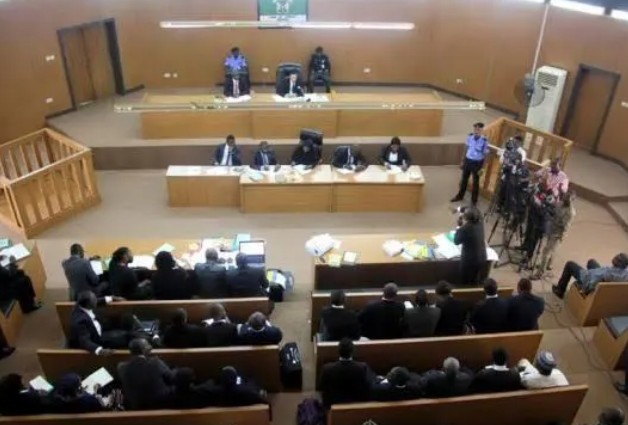
Federal Government has commenced moves to transform the Code of Conduct Tribunal (CCT) from its current quasi-judicial status into a full-fledged National Anti-Corruption Court with jurisdiction to hear corruption-related cases across the country.
The proposed reform is expected to significantly broaden the mandate of the CCT, which currently adjudicates cases referred to it by the Code of Conduct Bureau (CCB) over alleged violations of the Code of Conduct for Public Officers, including breaches relating to asset declaration and abuse of office for personal gain.
According to the Tribunal, its Chairman, Dr. Mainasara Kogo, is collaborating with the National Assembly through the Attorney-General of the Federation and the Secretary to the Government of the Federation on an Executive Bill to provide the legal framework for the proposed transformation.
The Acting Director of Litigation at the CCT, Yahaya Laraski, disclosed that the proposed National Anti-Corruption Court would operate as a full-fledged court with seven judicial divisions spread across Nigeria and would have the authority to try corruption-related offences.
Under the proposed arrangement, the Chairman of the court would have a status equivalent to that of the Chief Judge of the Federal High Court, while members of the Tribunal would enjoy a status comparable to judges of the Federal High Court.
The proposed transformation is part of a broader reform programme being implemented by the current leadership of the Tribunal following Kogo’s appointment as Chairman in January 2025.
The Tribunal said the new leadership inherited more than 1,037 pending cases, with some having remained unresolved for between five and 10 years.
Kogo subsequently directed that the outstanding case files be returned to the Code of Conduct Bureau for scrutiny to determine which matters should proceed before the Tribunal.
As part of the reform efforts, the CCT is also seeking to overhaul its procedural framework through the introduction of new Practice Directions.
Laraski said the existing Practice Direction had become outdated and did not adequately incorporate key provisions of the Administration of Criminal Justice Act 2015 and the Proceeds of Crime (Recovery and Management) Act.
He said the proposed Practice Directions had been forwarded to the Chief Justice of Nigeria, the Supreme Court, the Chairman of the Code of Conduct Bureau, the Attorney-General of the Federation and the Director of Public Prosecutions of the Federation for consideration.
The Tribunal said the reforms were also designed to accelerate the disposal of cases. Under the current administration, newly filed matters are expected to receive prompt attention, with the Chairman directing sittings shortly after cases are filed by the CCB.
The Tribunal disclosed that, as of July 10, 2026, when it commenced its annual vacation, there was no newly filed case from the Code of Conduct Bureau left unattended in its records.
However, the CCT identified its dependence on the CCB for the filing of cases as one of its major limitations, noting that it can only adjudicate matters brought before it by the Bureau.
The Tribunal also raised concerns over inadequate funding, stating that its approximately ₦2 billion annual budget was rarely fully funded. It added that it lacked adequate official accommodation, vehicles, furniture, ICT equipment and resources for staff development.
The CCT further disclosed that two of three landed properties allegedly sold unlawfully had been recovered. The recovered properties included the official residence of the Chairman and the Tribunal’s North-East zonal office in Bauchi.
The Tribunal also said seven new departments had been created, in addition to the three departments that previously existed. It added that outstanding staff promotions had been implemented, 13 new allowances introduced and staff members exposed to more than 20 capacity-building programmes within one year.
If the proposed Executive Bill receives legislative approval, the reform would mark a major restructuring of the Code of Conduct Tribunal, transforming it from a body principally focused on violations of the Code of Conduct for Public Officers into a nationwide court with a broader mandate to adjudicate corruption-related offences.
In this article