
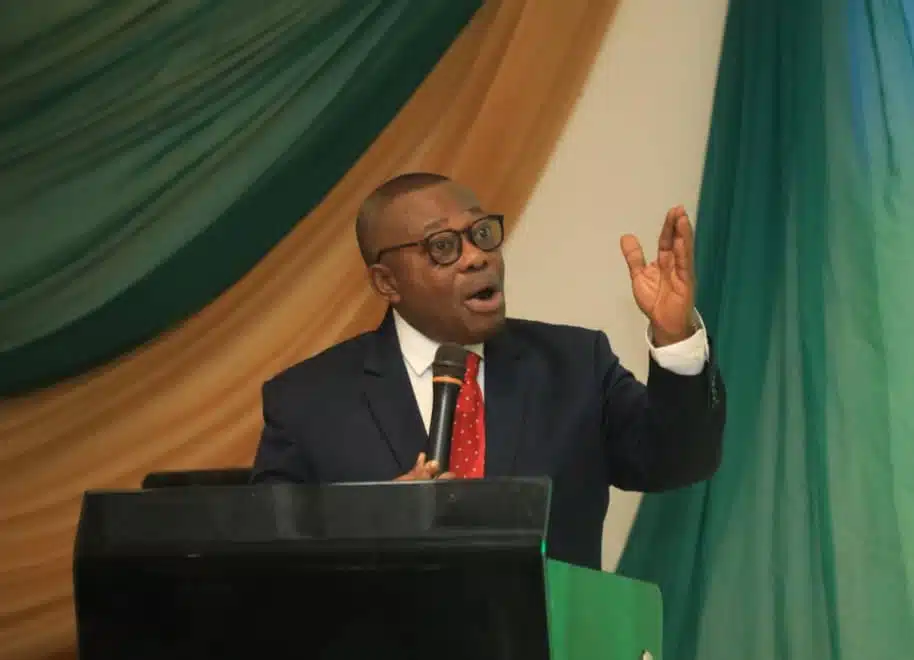
A Senior Advocate of Nigeria (SAN), Dr Monday Onyekachi Ubani, has criticised the organisation of the Nigerian Bar Association’s 66th Annual General Conference in Port Harcourt, saying the event fell below expected standards and exposed serious shortcomings in logistics and planning.
Speaking on Channels on Friday, a day after publishing an interim assessment of the conference, Ubani said his criticism was not directed at the outgoing NBA leadership but was intended to highlight areas requiring improvement.
According to him, the response from lawyers to his assessment had been largely supportive, with many agreeing with his observations.
“The reaction from the lawyers, and that is a very important constituency, is that they virtually agreed with what I said. It’s something that many people were not bold enough to speak, but I had to do this,” he said.
Ubani stressed that his comments should not be interpreted as an indictment of the leadership of the outgoing NBA President, Afam Osigwe.
“It is not clearly a criticism of Afam’s governance or leadership. It’s just that the observation I made is that the standard of our conference this year fell below standard, and that is the truth,” he said.
He cited his extensive experience within the legal profession as part of the basis for his assessment, noting that he had attended more than 20 NBA conferences and previously served as a branch chairman, NBA Vice President and chairman of the Section on Public Interest and Development Law.
On the conference’s logistics, Ubani said delegates were subjected to considerable discomfort, including inadequate facilities, poorly functioning air conditioning and overcrowded venues.
“This year’s conference really fell below standard in terms of logistics and organisational planning. We were put into a lot of discomfort. There was no place for you even to go and urinate easily, and that was not taken into consideration,” he said.
He said the halls used for the programmes were unsuitable for the large number of delegates who attended.
“The places where we had our programme were not conducive. The air conditioners were not functioning properly and the environment was very, very hot,” he said.
According to him, the poor conditions resulted in many lawyers remaining outside the halls rather than attending lectures and other sessions.
He also criticised the arrangements for feeding delegates, saying the process was disorganised and uncomfortable.
Ubani further recounted his experience leaving the conference venue after heavy rainfall, saying flooding made access difficult.
“Yesterday, you see the pool of water. I was lifted like a small boy into my car. I had to be lifted by this young man and I had to pay for it,” he said.
He added that the large number of people attending the conference also contributed to severe traffic congestion, recalling an occasion when he spent almost two hours in a traffic hold-up.
For Ubani, the major issue was the failure to match the conference’s facilities with its record attendance.
“I think this is the highest ever in the history of the NBA. Over 24,000 lawyers registered for this conference,” he said.
He questioned why adequate facilities were not provided when organisers were aware of the expected number of delegates.
“Imagine you are bringing 24,000 lawyers to a conference and the biggest platform you created for them is 2,000 only,” Ubani said.
He argued that delegates who paid significant sums to attend the conference deserved a better experience.
“It’s like there was no proper arrangement made for the number of persons that were coming, and you took money from them and you made them pass through a rigorous and strenuous process in a conference that’s supposed to be simple, entertaining and very exciting,” he said.
Ubani also defended his decision to criticise the quality of the conference materials, particularly the conference bag, saying such items form part of the lasting experience delegates take away from annual conferences.
He recalled that previous NBA administrations had provided quality bags that he continued to use years after attending the conferences.
He compared the situation with conferences organised by the Institute of Chartered Accountants of Nigeria, saying the professional body had also provided durable conference bags.
Ubani said he paid more than N200,000 or N300,000 to attend the conference and argued that the NBA could secure sponsorships to improve the quality of conference materials without placing the entire burden on members.
He described this year’s conference bag as unimpressive, saying it resembled a market bag or funeral souvenir.
Beyond the immediate logistical challenges, Ubani questioned the NBA’s practice of rotating its annual conference among states that may not have the facilities required to accommodate the growing number of delegates.
“If it has become known to us that the number of lawyers for our annual conferences is increasing, and we do not have the facility in any particular state, then we should avoid that state,” he said.
He argued that the NBA should prioritise locations with sufficient infrastructure, citing Abuja and Lagos as examples of cities capable of hosting large conferences.
According to him, another option would be for governments and the NBA to invest in purpose-built international convention centres capable of accommodating tens of thousands of delegates.
He suggested that the NBA could even undertake such a project itself over a five- or six-year period.
“Let’s build a convention centre where we can be holding our annual conferences,” he said.
Ubani linked the proposal to the theme of this year’s conference, Beyond Limits, arguing that the profession should embrace innovation and undertake projects that would improve future conferences.
He also said state government support could have a significant impact on the success of NBA conferences, recalling previous events in Port Harcourt, Lagos and Enugu where he said government involvement had been more visible.
He noted that host states benefit economically from the influx of thousands of lawyers, pointing to increased hotel occupancy and spending by delegates.
According to Ubani, the economic activity generated by the conference runs into billions of naira, making government participation beneficial to both the state and the NBA.
However, he said he did not observe the same level of government involvement in the organisation of this year’s conference, despite the presence of the state governor at the event.
Ubani also argued that the NBA must maintain high standards within its own affairs if it is to continue criticising institutions and governance at the national level.
“If we can sit down and criticise what goes on at the national level, then we must be above board in terms of the way we organise our electoral process and the way we organise our conferences,” he said.
He urged future NBA leaders to learn from international conferences and improve the association’s organisational standards rather than allowing them to decline.
Turning to the controversy surrounding some of the guests invited to the conference, Ubani said he had no objection to exposing delegates to diverse viewpoints.
However, he said organisers should conduct adequate background checks on prospective speakers and consider their antecedents, character and the environment in which they would be speaking.
“I don’t have any problem with having mixed voices in our conference. Hear from everyone, even the low and the rich, the elite, the intellectuals, even the market woman,” he said.
“But let it be that you are conscious of the environment where you are bringing the guests, so that we don’t run into problems at the end of the day.”
He said disagreements among lawyers over guest selection should not necessarily be interpreted as evidence of deeper divisions within the profession, noting that individuals were entitled to hold different opinions.
Ubani also distinguished between the entertainment and intellectual components of the conference, saying younger lawyers should have opportunities to participate in entertainment while academic and professional discussions should be carefully structured around the experience and expectations of the wider membership.
He ultimately urged the NBA to move beyond speeches and communiqués by ensuring that recommendations from its annual conferences translate into concrete policy actions.
“We should go beyond the issue of talking and begin to insist on implementing these things,” he said.
According to him, policy makers, government officials and other key stakeholders should be actively involved in the conference so they can hear and act on the issues raised by lawyers.
Ubani said the NBA’s conferences should therefore serve not merely as annual gatherings but as platforms for generating ideas, influencing public policy and contributing meaningfully to national development.
In this article