
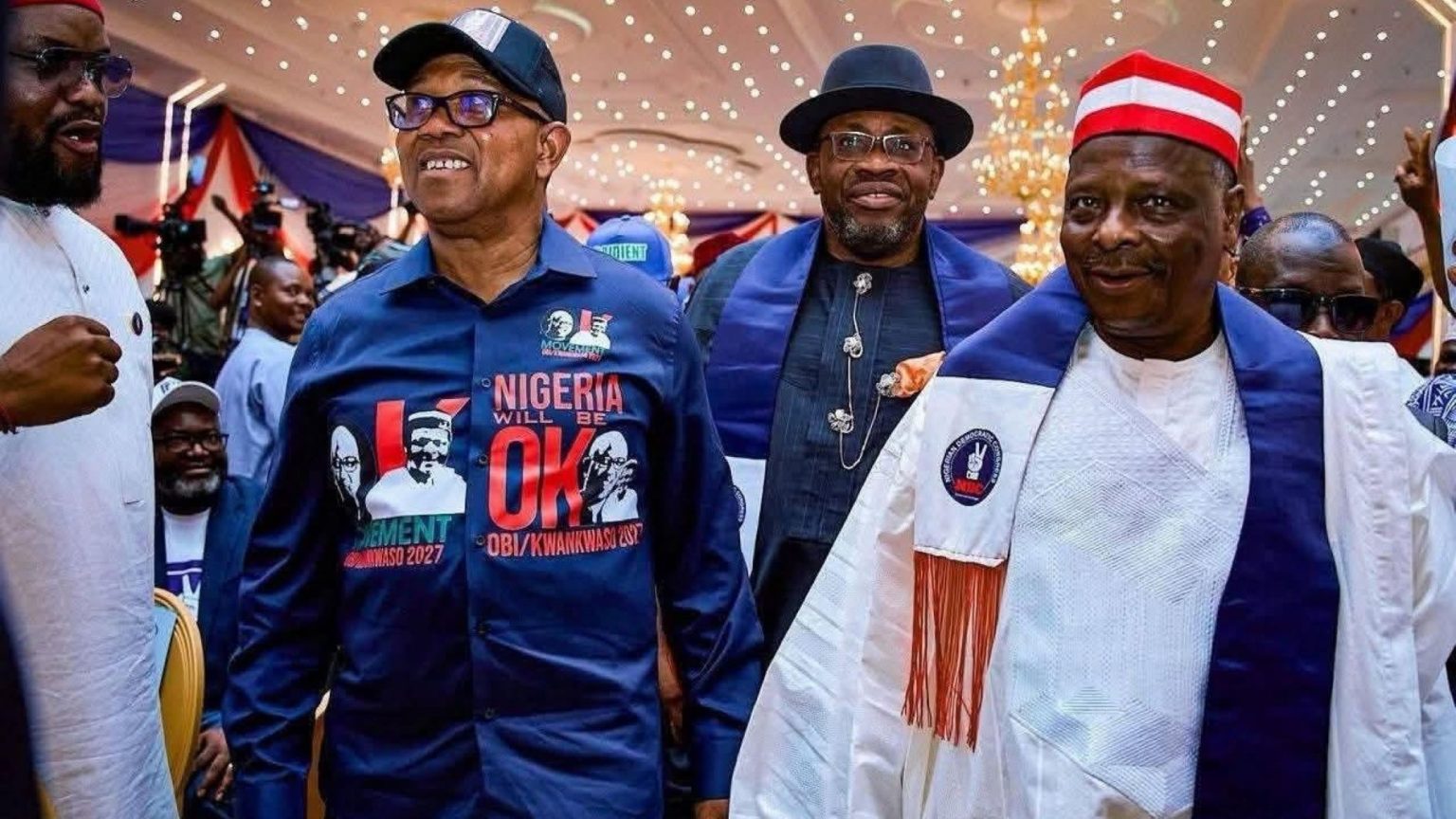
Former Labour Party presidential candidate, Peter Obi (left); Former Bayelsa State Governor, Seriake Dickson, and past Kano State Governor, Rabiu Kwankwaso, during the Nigeria Democratic Congress (NDC) Convention in Abuja
By Magnus Onyibe
Nigeria’s political landscape has, once again, been upended—this time by the rapid rise of the Nigerian Democratic Congress (NDC), a party barely three months old.
Founded in February 2026 by former Bayelsa State governor Senator Seriaki Dickson, the NDC is already being touted as a major opposition force, with claims of over nine million members. But what has truly jolted the political establishment is not just its growth—it is the speed and caliber of defectors swelling its ranks.
Within the space of 24 hours, from May 2 to 3, two of Nigeria’s most prominent presidential hopefuls—Peter Obi and Musa Kwankwaso—abandoned the African Democratic Congress (ADC) to join the NDC. Their exit has left the ADC, once positioning itself as the nucleus of opposition politics, severely weakened and hemorrhaging.
Their defection is no minor political footnote. Obi, former Anambra State governor and Labour Party’s 2023 presidential candidate, alongside Kwankwaso, former Kano governor and NNPP flagbearer in the same election cycle, are heavyweights. Their swift migration signals not just opportunism, but a deeper instability within Nigeria’s opposition architecture.
At the heart of this shift lies a legal crisis crippling the ADC. The Supreme Court’s reversal of a controversial “status quo antebellum” ruling by the Court of Appeal has thrown the party into uncertainty. With a looming May 10 deadline to submit membership registers to the Independent National Electoral Commission (INEC), the ADC risks disqualification from the 2027 elections.
Faced with the possibility of political extinction, its members are doing what politicians often do best—jumping ship.
But the ADC is not alone in its troubles. The Peoples Democratic Party (PDP), once Nigeria’s dominant political force, continues its steady decline. Since its defeat in 2015, the party has struggled with internal divisions, legal battles, and a loss of coherence. Today, it stands as a shadow of its former self, with many of its members also drifting toward safer political harbors like the NDC.
Only days ago, there appeared to be a glimmer of hope. A high-profile opposition summit in Ibadan brought together key political actors with the aim of forming a united front against President Bola Tinubu in 2027. For a moment, it suggested that Nigeria’s fragmented opposition might finally coalesce.
That optimism has evaporated almost as quickly as it emerged. The so-called Ibadan consensus has dissolved into yet another episode of political uncertainty, reinforcing a troubling pattern: Nigerian politics remains less about ideology and more about survival.
Nowhere is this more evident than in the career trajectories of Obi and Kwankwaso. Both men have traversed multiple political platforms in recent years. Obi alone has moved across APGA, PDP, Labour Party, ADC, and now NDC since 2019. Kwankwaso, similarly, has cycled through the PDP, founded the NNPP, aligned briefly with the ADC, and now landed in the NDC.
This constant movement raises uncomfortable questions. Are political parties in Nigeria merely vehicles of convenience? And do ideological commitments matter at all?
Critics argue that such frequent defections reflect a relentless pursuit of power rather than a commitment to building enduring political institutions. Supporters, however, may counter that politicians must remain flexible in a fluid and often hostile political environment.
Yet, beyond these debates lies a deeper reality: Nigeria’s political system increasingly resembles a game of musical chairs. Parties change. Alliances shift. New platforms emerge. But the players remain largely the same.
From the PDP to the APC, from the Labour Party to the ADC, and now to the NDC, a familiar cast of political elites continues to recycle itself across election cycles. Names like Atiku Abubakar, Peter Obi, Nasir El-Rufai, and Rotimi Amaechi dominate the conversation, regardless of party labels. Meanwhile, governance outcomes remain largely unchanged.
Since Nigeria’s return to democracy in 1999, a relatively small circle of political actors—perhaps no more than a few hundred—has rotated through key positions: governors become senators, senators return as governors, and ministers re-emerge in new administrations.
The system rewards continuity, not renewal. This is not reform. It is rotation.
In a true democracy, political evolution should expand participation, deepen ideology, and strengthen institutions. In Nigeria’s case, however, the game simply rearranges the seats without changing the players—or the rules.
The rise of the NDC may appear, on the surface, to signal a new chapter. But unless it offers a clear ideological direction and breaks from the entrenched patterns of elite recycling, it risks becoming just another platform in Nigeria’s endless game of political musical chairs.
And when the music stops in 2027, Nigerians may once again find that, despite all the movement, very little has truly changed.
The likelihood that both former presidential aspirants in the 2023 elections—on the platforms of the Labour Party (LP) and the New Nigeria Peoples Party (NNPP), respectively—Mr. Peter Obi and Dr Musa Kwankwaso, are now emerging as likely flagbearers of the newly registered NDC, whether as an Obi/Kwankwaso (OK) or Kwankwaso/Obi (KO) ticket, is a testament to the fact that Nigeria’s political space is witnessing a game of musical chairs.
In this game, politicians and parties constantly swap positions, yet the same individuals end up in power. The music stops, everyone scrambles for a seat, and very little actually changes.
Put succinctly, it is political musical chairs—what we are currently witnessing as politicians jump from one party to another in the run-up to elections, aligning with whichever platform appears most likely to secure victory Invariably, policies shift only marginally, while the underlying power structure endures.
This is the classic Nigerian version of political musical chairs.
The reality is that Nigeria’s political landscape has been dominated by roughly the same 200–300 individuals over the past 27 years of multi-party democracy, albeit in different roles.
This falls short of genuine reform, as the game neither introduces new players nor changes the rules. Instead, it merely rearranges who sits where.
But it is welcoming that the realignment of political forces are emerging in the run up to the 2027 polls and the political space in Nigeria is not descending into a one party state as we had tried to assure Nigerians after critical and unbiased assessment.
My assessment is that Nigerians should expect more surprises in the political space as party primaries draw closer and elections D-Day loom larger.
Onyibe, an entrepreneur, public policy analyst, author, democracy advocate, development strategist, wrote from Lagos.
In this article