
Like the NBA, lawyers have expressed concern over acts of bullying being displayed by some judges in the course of court proceedings, saying such action speaks to a deeper unease within the justice system. Akeem Nafiu and Tunde Oyesina report
Some senior lawyers have spoken with one voice in condemning the growing spate of bullying and intimidation of lawyers by judges. The lawyers expressed concerns over what they described as “bullying from the Bench”, saying it’s a systemic issue that could have farreaching implications for justice delivery and the rule of law.
While the courtroom has always been a space of discipline, hierarchy and decorum, recent complaints suggest that the delicate balance between authority and fairness is, in some instances, being eroded. Across various jurisdictions in Nigeria, lawyers have raised alarm over what they perceived as a troubling trend, judges openly rebuking counsel in harsh tones, issuing threats of contempt in questionable circumstances or displaying conducts that undermines the dignity of legal practitioners.
When judges engage in conduct that appears oppressive or dismissive, it can intimidate lawyers, discourage robust advocacy, and ultimately weaken the adversarial system upon which justice depends. Younger lawyers, in particular, are said to be the most affected, often lacking the confidence to challenge judicial excesses for fear of professional repercussions.
The issue has also sparked broader conversations about judicial accountability, professional respect and the need for clearer boundaries in courtroom conduct. While judges are vested with enormous powers to maintain order and ensure efficient proceedings, those powers are not without limits. The principle of judicial restraint remains a cornerstone of ethical adjudication, and any deviation from it raises serious concerns within the legal community.
NBA fumes
Piqued by the ugly developments, the Nigerian Bar Association (NBA) has slammed judges for bullying lawyers and ordering their detention. In a statement issued by the President and General Secretary, Mazi Afam Osigwe (SAN) and Dr. Mobolaji Ojibara respectively, sequel to varying reports, the NBA said such conduct undermines the dignity of the legal profession and erodes the mutual respect that must define the relationship between the Bench and the Bar.
The NBA further noted that the actions, as well as procedures adopted by the judges fly in the face of the rationale for punishment for contempt, which is the need to vindicate the dignity of the court and thereby protect due administration of justice.
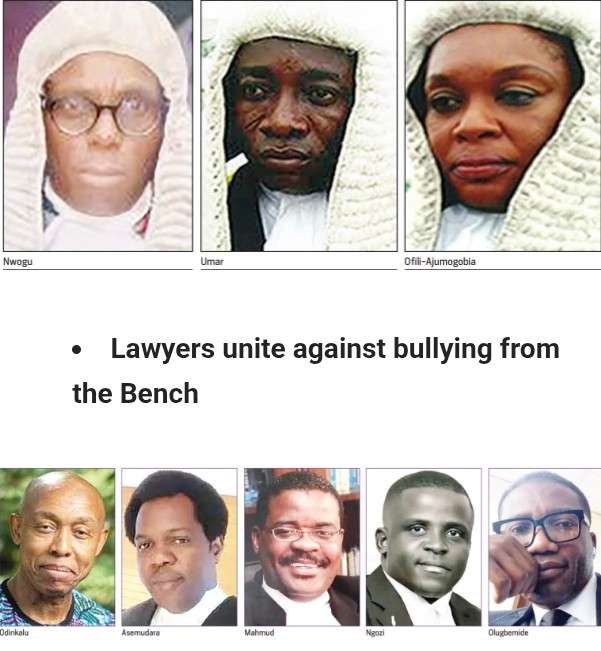
The statement reads: “The first report emanated from proceedings in suit no. PHC/301/2016, Mr. Bodiseowei Zidougha v. The Chief of Naval Staff & 2 Ors before the High Court of Rivers State presided over by Hon. Justice Chinwendu Nwogu. “According to the report, the trial judge convicted and ordered the detention of defendants’ counsel after delivering judgement in the matter.
His lordship purported to have convicted the counsel for the defendants (Chief of Naval Staff and the Nigerian Navy), Mrs. Lovinah Ugbana Benjamin, of contempt of court for allegedly making false statements and imputations against the court in a written address she filed in the matter.
“The second report related to the summary order of Honourable Justice Rita Ofili-Ajumogobia of the Federal High Court, Abuja, for the detention of Martin Anyanwu, a legal officer in the employ of Federal Medical Center, Keffi, in the Court’s holding facility on March 25, 2026.
“There have been recent reports of lawyers being subjected to degrading and demeaning treatment in courtrooms, including being asked to kneel or stand facing the wall under threat of contempt. Indeed, resort to the exercise of power in these manners degrades lawyers and demeans the legal profession. These reports are not only frightening, but appear to show an increasing intolerance and penchant for abusing judicial powers by some judges. “These actions of the learned trial judges are not only unfair, but are exceedingly high-handed. We hereby deprecate them.
The actions appear to have been taken rather to bolster the power and dignity of each of the judges as an individual. “We wish to remind the judges that a judge’s invocation of his power to punish for contempt of his court is an unwarranted exhibition of naked judicial power which puts counsel and their clients in fear of the court and erodes an important safeguard of fair trial. “In deprecating these actions, we must also remind judges that not every act of discourtesy to the court by counsel amounts to contempt.
It is not a contempt of court to criticize the conduct of a judge
Courts must distinguish between acts of discourtesy, incivility, uncouth behaviour or rudeness. “While these acts may be annoying, they are not necessarily acts of contempt of court. Contempt must not be equated with conduct which will inevitably obstruct or disrupt the proceedings of the court or which is not to the liking of the judge. A distinction must be drawn between what may annoy a judge and what amounts to contempt.
It is not a contempt of court to criticize the conduct of a judge or the conduct of a court, even if such criticism is strongly worded, provided that the criticism is fair, temperate, and made in good faith. “In our view, the power to punish for contempt was abused in these circumstances as the remand orders appear to have been used to assuage the injured feelings of the presiding judge.
It is not contempt of court when a judge does not agree with learned counsel’s method of advocacy or with the facts as narrated by counsel. “A lawyer has a constitutional right of audience in court and should neither be intimidated nor detained for carrying out this duty. How a lawyer chooses to present his case is his own style. It would be unconstitutional and an abuse of office for a judge to abridge counsel’s right of audience by invoking his powers of contempt for carrying out this duty. “In light of the foregoing, the NBA demands the immediate release of the affected counsel.
“That the Honourable Chief Judge of Rivers State immediately investigate the circumstances surrounding this incident and take appropriate administrative action. “That appropriate disciplinary steps be taken by the National Judicial Council where necessary”.
The NBA Human Rights Institute has since secured the release of Mrs. Lovina following engagement with relevant judicial and administrative authorities, as well as the NBA Port-hacourt branch. In a separate statement, the NBA equally condemned the judge’s order directing a lawyer to kneel down during proceedings in his court.
In the statement, the NBA slammed Justice Mohammed Umar of a Federal High Court in Abuja over attempt to subject a lawyer, Marshall Abubakar, to a stress-position punishment during proceedings. Justice Umar ordered Abubakar to kneel during a tense exchange between them, but the directive was resisted by the lawyer and ultimately halted following the intervention of other counsel in the courtroom. “A judex directing a legal practitioner or indeed any person whatsoever to kneel in court is not a recognised judicial sanction under our laws and does not align with the standards of judicial conduct expected on the Bench”, NBA said.
The Association noted that the courtroom is a temple of justice, governed by law, procedure and decorum. It said judges can maintain order, “but they must act within the law and recognised judicial standards.” The NBA further noted that while courts can punish for contempt, “the power is limited by procedures that protect fairness, objectivity and the rights of all participants.”
“Lawyers are obliged to advocate firmly and fearlessly for their clients, but such advocacy must always be exercised within the bounds of courtesy and decorum,” the statement said. The statement added that disagreements, “no matter how strongly felt, must go through proper legal channels and not disrupt proceedings or undermine court authority.” It reiterated that “legal profession depends on a careful balance of mutual respect between the Bar and the Bench, a relationship fundamental to administering justice.”
The Association therefore called for calm and restraint, urging that any grievances from courtroom incidents be addressed through institutional and disciplinary mechanisms. Abubakar appeared before the judge as the lead defence lawyer for Sahara Reporters publisher, Omoyele Sowore, who is facing prosecution for calling President Bola Tinubu a “criminal” in his posts via his X and Facebook handles last year.
Lawyers speak
In the meantime, a cross-section of senior lawyers have spoken against the growing cases of lawyers’ bullying by judges. Speaking on the issue, a former Chairman of National Human Rights Commission (NHRC), Prof Chidi Odinkalu, slammed Justice Umar over reports that he ordered a lawyer to kneel during court proceedings.
In a post shared on his X handle, Odinkalu expressed disbelief at the development, questioning the conduct of the judge and the implications for judicial decorum. “So, Moh’d Umar, a judge of @FederalHigh, ordered a lawyer in his court to kneel down? I am sure there are people saying ‘As the court pleases,’” he wrote. Odinkalu, a professor of law and prominent human rights advocate, criticised the abuse of judicial authority, suggesting that the judge may have misunderstood the traditional courtroom honorific.
“He takes a very literal view of being called ‘My lord’ and seems to think that means he is entitled to be worshipped and glorified,” he added. Speaking in the same vein, a former President of Public Interest Lawyers , Dr. Abdul Mahmud, noted that the concerns raised by the NBA touches on the balance of authority and professional dignity in the courtroom.
He said: “The relationship between the Bench and the Bar is not hierarchical in the crude sense, but relational, symbiotic, and grounded in the shared duty to uphold justice. “When actions from the Bench are perceived as overbearing, disrespectful, or dismissive, they risk eroding the confidence that lawyers must have in the fairness and openness of judicial proceedings.
“The courtroom should not become a place of intimidation but a forum of reason, where advocacy is met with patience and where disagreement is engaged with intellectual rigour rather than institutional weight. “At the same time, the Bar must continue to hold itself to the highest standards of decorum, recognising that courtesy to the court is integral to the dignity of the legal and judicial processes. “Courtesy cannot be one sided. Judges, having emerged from the ranks of the Bar, are intimately familiar with the demands and pressures of courtroom advocacy, and that memory ought to tamper the exercise of judicial authority with restraint and empathy.
“Mutual respect is not merely an ethical aspiration, but a functional necessity, for without it, the administration of justice becomes strained, and the delicate equilibrium upon which the system rests begins to falter”. In his comments, an Abuja based lawyer , Ngozi Prince Igbo, disclosed that judicial authority is a sacred trust, one that must be exercised with restraint, dignity, and an unwavering commitment to justice.
“The courtroom is neither a theatre for intimidation, nor should it become an arena where lawyers are subjected to undue hostility or oppressive conduct. Judges, as custodians of the rule of law, are expected to uphold fairness and ensure that proceedings are conducted in an atmosphere of mutual respect. “It is therefore imperative to emphasize that the power to punish for contempt is not a weapon to silence or harass legal practitioners. Rather, it is a narrowly tailored mechanism designed to preserve the integrity of the court and ensure the proper administration of justice.
“Any misuse of this power, particularly as a tool of intimidation against lawyers who are merely discharging their professional duties, constitutes an abuse of judicial authority and undermines public confidence in the judiciary”, Ngozi said. In his submissions, a senior lawyer, Emmanuel Ekwo, said the concerns raised by the Nigerian Bar Association are both timely and significant. “The relationship between the Bar and the Bench is foundational to the administration of justice, and it must be anchored on mutual respect, independence, and fidelity to the rule of law.Democracy insights
“Any perception or reality of intimidation or undue pressure on legal practitioners by judicial officers undermines not only the confidence of lawyers, but also the integrity of the justice system itself. “While it is not in dispute that judges are vested with the authority to maintain order and discipline in their courts, such powers must be exercised judiciously and without descending into arbitrariness.
The courtroom is not a theatre for dominance, but a forum for justice. Where members of the Bar begin to feel bullied or silenced, it creates a chilling effect on advocacy, which is essential for the proper ventilation of cases before the court”, he added. In his views, a rights activist, Abiodun Olugbemide, noted that the increasing report of bullying and intimidation of lawyers by those that should honour their sacredness of the profession, with great pride and dignity, is becoming unbecoming.
He said: “Without much ado, respect between the Bench and the Bar should be reciprocal. For a lawyer to be openly and publicly insulted through personal attacks on his intelligence, to inquire degradingly on which institution he graduated from, and what year did he graduate, just to ridicule him. This is highly unnecessary. “We all know that there are contempts of court. Contempt in Facie Curiae, meaning contempt in the face of the court, that is, conducts which obstruct or disrupt court proceeding.The court has the power to punish this contempt summarily , that is, immediately it happens.
“Then, we have Contempt Ex Facie, that is, contempt outside the court. We call it the disobedience to the lawful order of the court. The court can punish the offender, but however, the procedure or process for this kind of contempt must be followed. “Now, if care is not taken, this powerful sword can be used in an arbitrary manner, as most often, what constitutes a contempt is often at the discretion of the judge”.
In his submissions, a Lagos based lawyer, Ige Asemudara, said the relationship between the Bar and the Bench must be of mutual respect.
“The NBA was right in its position. The judges and legal practitioners must demonstrate not just camaraderie, but also exemplify nobility which is at the core of the legal profession to which both of them belong. “The very strange hitches that we began to see recently are reflective of ethical failure in the profession. Lawyers must know what their roles entail and deliver them responsibly. Judges too must hold gavel with honour. Judges must not forget that the powers they weird and the position occupied are not for personal ego, but for the protection of the dignity and integrity of the institution of justice.
The problem is that many of our people now play to the gallery or are carried away by the situation around. “While a High Court judge has power to deal with contempt in facie curie as it arises, it must be understood that a lawyer’s legitimate conduct of his client’s case is not within the purview of contempt and cannot be treated as such. Even when there is a genuine case of contempt, the institution of Justice, as well as the legal profession cannot be brought so low as to order a lawyer to kneel down in open court.
“So, what must be done is that there is a need to train and retrain legal practitioners and judges on ethical issues and mode of dealing with them. Some of these events just clearly show a system drifting apart as a result of slack in regulation, discipline and training. It is time to turn to the Rules of Profession Conduct for lawyers and the code of conduct for judicial officers. It is unfortunate that we have got to that juncture, but it is the reality of our situation and we have to deal with it”, he added.
In this article