
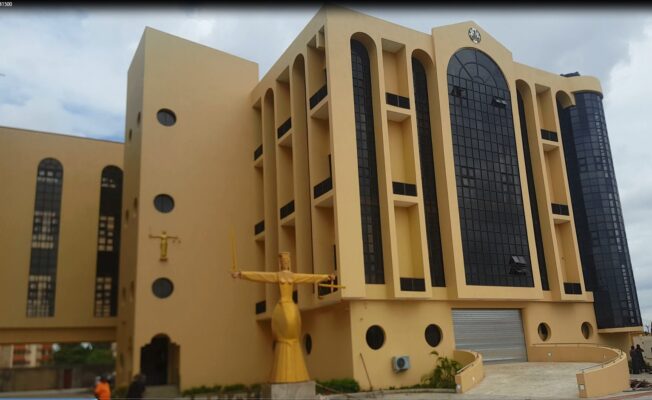
The Federal High Court, Lagos, has frozen the accounts linked to Petrocam Trading Nigeria Limited and its principal, Patrick Ilo, over an alleged N9.05 billion debt to Zenith Bank Limited.
The court, citing extensive pre-loan conditions filed with it and involving Nigeria’s core payment infrastructure, said that the respondents’ funds stand frozen.
Justice Chukwujekwu Aneke granted the interim order in a suit marked FHC/L/C5/393/2026 following an ex parte application filed by Zenith Bank to preserve funds allegedly owed it as of May 31, 2025.
The judge, however, adjourned the case to March 17, 2026, for mention.
The court restrained the defendants, whether acting personally or through agents, privies, or assigns, from withdrawing, transferring, dissipating, or otherwise dealing with funds up to N9,057,511,855.63, pending the hearing and determination of the motion on notice.
A key feature of the ruling is the targeting of Bank Verification Number (BVN), reportedly used by Ilo to operate Petrocam’s accounts.
Justice Aneke directed all financial institutions within the court’s jurisdiction to place a lien or “Post-No-Debit” restriction on all accounts linked to the BVN.
Significantly, the order extends beyond traditional banks to include critical payments infrastructure operators.
Listed as respondents are the Nigeria Inter-Bank Settlement System (NIBSS), Interswitch Limited, and Interswitch Financial Inclusion Services Limited.
The NIBSS, responsible for the interbank settlement framework and BVN database, ensures systemic enforcement across the banking network, while Interswitch and its subsidiary expand enforcement to digital wallets and electronic transactions.
According to the court documents, the disputed facility was subject to extensive conditions precedent before disbursement.
Petrocam was required to formally accept the facility through its authorised signatories, submit a board resolution approving its use, and provide disclosure of existing indebtedness to other lenders, including facility limits, outstanding balances, and collateral pledge.
Other pre-disbursement requirements included the domiciliation of sales proceeds and Sovereign Debt Note (SDN) subsidy payments from Oando Plc and/or Total Nigeria Plc to Petrocam’s account with Zenith, submission of contract agreements subject to Zenith’s approval, and a five per cent counterpart contribution for every transaction.
Also, necessary security documentation had to be executed before facility disbursement.
Continuing obligations required Petrocam to submit quarterly management accounts within 60 days of quarter-end, audited yearly accounts within 120 days, and route all import duty payments and Letters of Credit through its Zenith account.
Petrocam was to establish Letters of Credit for petroleum imports, provide supporting documentation, obtain comprehensive marine insurance naming Zenith as first loss payee, and ensure the bank was fully informed of suppliers and vessels.
Zenith also appointed General Marine and Oil Services Ltd to monitor product warehousing at Petrocam’s expense.
In addition, foreign exchange obligations were stipulated, with Zenith authorised to pay maturing Usance obligations at 12 per cent interest if Petrocam failed to provide funds.
All legal, recovery, and ancillary costs in the event of default were to be borne by Petrocam.
Justice Aneke directed the respondent institutions to file an affidavit of return within seven days, disclosing all accounts linked to the BVN, account balances, and six months of transactional history.
Zenith Bank was granted leave to serve the defendants by substituted means at their last known Victoria Island address.
The motion was argued by A.A. Aribisala (SAN) on behalf of Zenith Bank.
In this article