
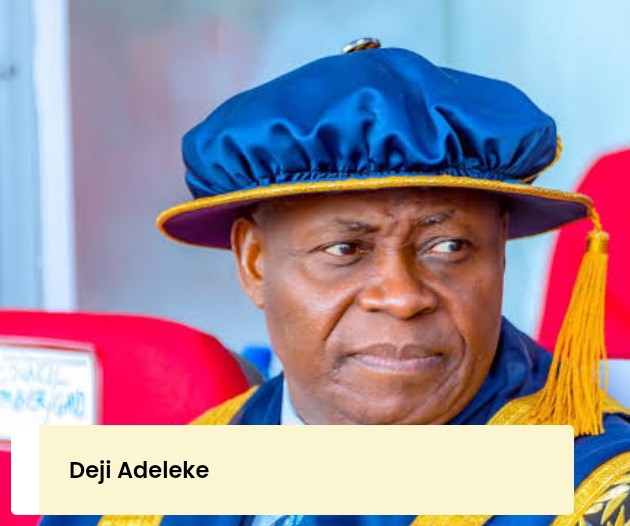
By Sola Akinsanmi
Billionaire businessman and philanthropist, Deji Adeleke, has attributed the recurring paternity controversy involving his son, Afrobeats singer David Adeleke, to online impersonation and misinformation, saying multiple DNA tests had already ruled out the claim.
Speaking at a press conference in Lagos on Wednesday, Adeleke said the allegations linking Davido to a girl, Anuoluwapo, had persisted for more than a decade despite repeated scientific findings.
He accused social media commentator Kemi Olunloyo of sustaining the claims by impersonating the child and her mother online.
“I am Deji Adeleke, I’m the father of five children, three boys and two girls. David Adeleke, who you all know as Davido, is the baby of my family,” he said.
“I’m calling this press conference, and this is my very first time addressing the press, and for just one single reason… this issue that keeps coming up almost every year.”
The controversy concerns one Ayo Labinjo, an Ibadan-based woman who claimed she became pregnant after meeting Davido during a visit to the city several years ago.
The matter resurfaced recently after an Instagram account said to belong to the child appealed to the singer to undergo another DNA test.
Davido responded that five DNA tests had already been conducted, all returning negative results.
Adeleke said he first became aware of the allegation in 2014 after receiving a DHL package from Ibadan containing photographs, documents and a birth certificate listing “Adeleke David” as the child’s father, alongside a letter from the child’s grandmother.
“She wrote that she was a widow with two daughters… She said her eldest daughter informed her that David Adeleke was responsible for her pregnancy after meeting him when he came to Ibadan for a show,” Adeleke said.
“She stated clearly that she was not asking David to marry her daughter, only to confirm paternity and take responsibility if confirmed.”
He said he immediately contacted the family and arranged a DNA test at Vedic Lifecare Hospital in Lagos, with samples analysed in South Africa.
According to him, saliva samples were taken from Davido and the child in the presence of all parties, with both he and the grandmother designated to collect the results.
“When the results were ready, both the grandmother and I went to collect them together,” Adeleke said.
“The result stated that the probability of paternity was zero percent. The lab explained clearly that David was not the father of the child.”
He said that despite the result, he suggested additional tests to remove any lingering doubts, offering to cover accommodation and logistics while the family stayed in Lagos.
He said further DNA tests were conducted at other centres, all producing the same outcome.
“The grandmother broke down and cried,” he said. “I told her mistakes could happen and suggested we do two more DNA tests at other reputable centres.”
Adeleke rejected calls for the DNA reports to be made public, citing security and legal concerns.
“It is dangerous for anyone’s DNA profile to be in the public domain,” he said, adding that releasing such information could expose both Davido and the child to risks.
He said the family had no reason to deny a child, noting that he already has 14 grandchildren. “What is one more?” he asked. “Is it that I cannot afford to take care of her? But there is science. And science is clear.”
He urged the public to disregard online narratives around the case, describing them as misleading and driven by impersonation and misinformation.
In this article