
• Lagos govt insists demolitions are about safety
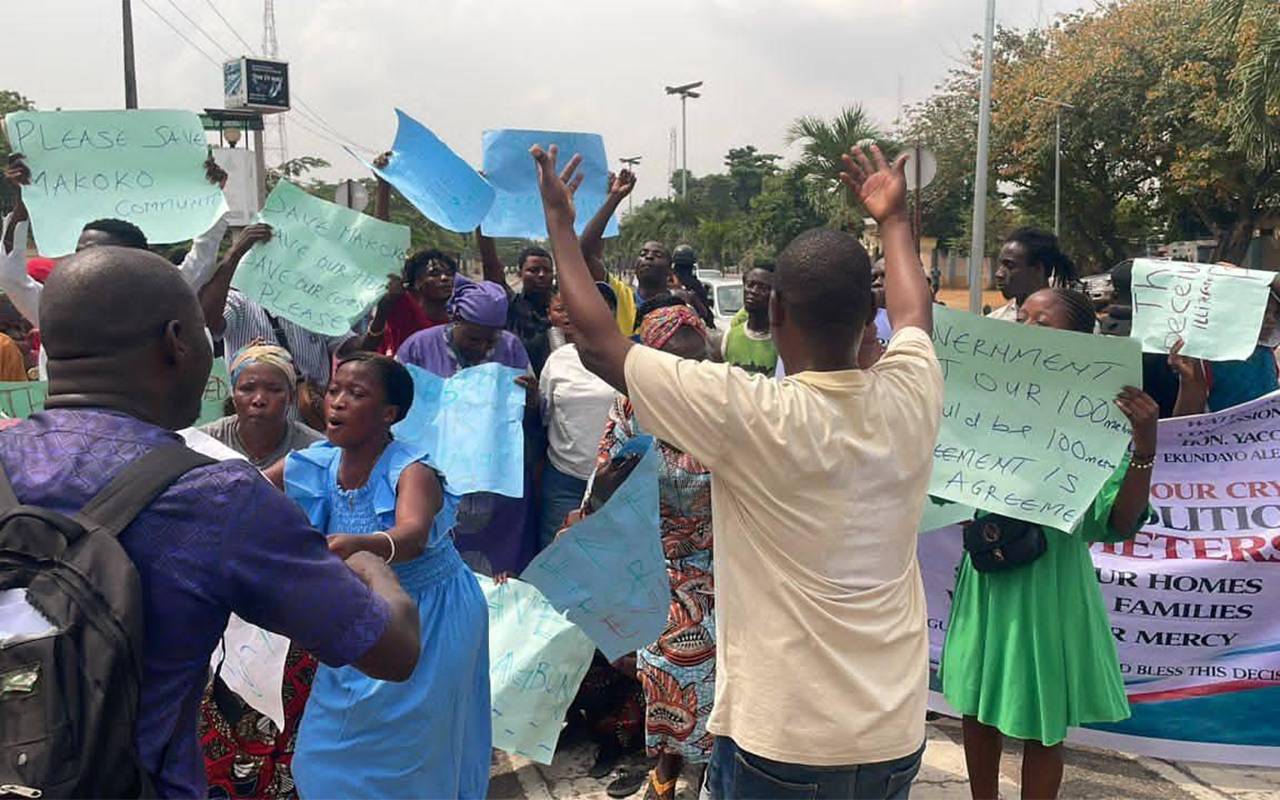
Residents of Makoko, Ilaje Aiyetoro Community, Yaba Local Council Development Area (LCDA), yesterday stormed the Lagos State House of Assembly, blocking part of the road in protest against the Lagos State Government’s ongoing demolition of their buildings.
The demonstrators, made up of affected residents, appealed to the Lagos State Government to restrict the demolition exercise to a 100-metre limit, warning that a wider operation would leave many families homeless.
They also urged the state government to spare their homes, saying the demolitions in Makoko were destroying livelihoods and threatening the welfare of their families.
However, while the protest was ongoing, government officials continued to remove other structures in the area, suggesting that the exercise was not limited to buildings under high-tension power lines but aimed at clearing a larger portion of the community.
In Makoko, thousands of residents are estimated to be affected by the demolition.
The waterfront community has repeatedly faced forced evictions and government-led demolitions over the years.
While the government has cited urban development and safety concerns as justification for the exercise, civil society organisations and residents have called for alternative arrangements to be provided for vulnerable residents.
The residents, many of whom have lived on stilts over water for generations, rely largely on fishing and small-scale trading for survival.
The Justice Empowerment Initiative, in collaboration with the Nigerian Slum/Informal Settlement Federation and other civil society organisations, condemned the eviction of residents in Makoko.
Speaking with The Guardian, the Lagos State Commissioner for Information and Strategy, Gbenga Omotoso, said: “They have the right to protest, which the government cannot take away from them. In this kind of situation, we must look at facts and figures on the matter. The government has been engaging them for over five years; it is all about safety and security.
“The law stipulates that buildings must be 250 metres away from power lines, but they are built under the power lines, and no government will accept that. The Lagos State Government called several meetings, and they agreed that structures under the power lines should be removed and that buildings should be 100 metres away. They later asked for 50 metres, and the government removed structures covering the 50 metres. I have videos of the meetings held and how they commended the government.”
So, if some people we are trying to save from themselves decide to protest, I do not think anyone should panic over that. There is no basis for the protest.”
When asked whether the government was providing alternatives for displaced residents, he said: “We are losing the city, and if we continue to use sentiment and emotion, we will lose the city completely. One day, we will wake up to see buildings on the Third Mainland Bridge, and people will ask for compensation. The moment we begin to compensate for illegality, illegalities will thrive, so we must be careful.
“Nobody can approve a house to be built under high-tension wires, and if the government asks anyone to leave, they must go.”
In this article