
By Glory Nneka Ukwenga
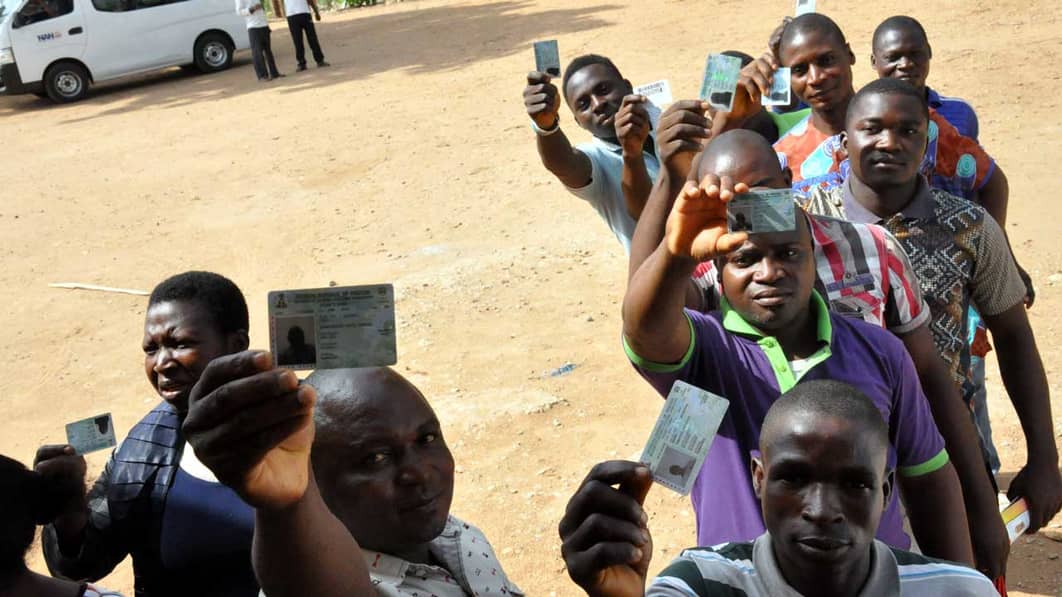
Nigerian voters display their PVCs prior to voting at an election. Nigerians will return to the polls in February 2023. Photo: AFP
Data from the Lagos Bureau of Statistics shows that over 50 per cent of Lagos residents are non indigenes, drawn by employment, education, and enterprise opportunities. However, election outcomes tracked by INEC and state electoral records indicate that more than 85 per cent of elected state and local government officials are either Lagos indigenes or members of long established local families.
The implication is clear. While labour markets in Nigeria have become nationally integrated, political representation remains locally closed. Mobility fuels the economy, but indigeneity continues to gatekeep power.
This disjuncture creates a structural trap. Youths build careers, identities, and survival strategies far from the constituencies where elections are won. Unemployment and underemployment, which persist above 40 per cent among young Nigerians, further entrench this reality by pushing them into informal urban economies disconnected from ward structures, party hierarchies, and community leadership pipelines.
The consequence is not merely absence. It is cost. Distance dramatically inflates the cost of political participation. Viable candidates are expected to demonstrate long-term community embeddedness often spanning 10 to 20 years. This involves constant presence at funerals, festivals, town meetings, religious events, dispute mediations, ward consultations, and informal social rituals that quietly accumulate trust. These demands are time consuming, repetitive, and expensive. Older politicians, armed with decades of social capital, patronage networks, and financial buffers, can afford to maintain visibility or outsource it through donations and emissaries. Young people, largely underemployed and geographically displaced, cannot.
Nigeria despite being a constitutional democracy, operates through narrow margins of identity politics. Indigeneity strictly defined by origin, language, intonation, and perceived loyalty matter more than citizenship when courting votes from constituents. Even indigenous candidates who appear foreign whether through prolonged absence or altered social identity are required to compensate financially to be taken seriously. While isolated cases exist of candidates winning outside their traditional environments, such victories are invariably backed by exceptional wealth or entrenched political networks. These conditions remain inaccessible to the typical Nigerian youth. The system does not reward underdogs; it prices them out.
Migration, therefore, does not merely disrupt youth political ambition. It makes it prohibitively expensive. This burden is compounded by internal party structures that privilege closely rooted indigenes, monetise delegate votes, and impose exorbitant nomination fees that bear no relationship to authentic leadership capacity. Indirect primaries have elevated delegates into transactional power brokers, further eroding merit-based entry.
Campaigning itself remains capital intensive. Logistics, mobilisation, advertising, and sustained visibility cannot be substituted by social media alone. Political content faces heavier regulatory constraints on digital platforms than entertainment, while the bulk of voters remain rooted in offline information ecosystems. Visibility accrues to those who can pay repeatedly. Trust compounds with presence. In this sense, Not Too Young to Run lowered formal barriers but the socio-economic and geographical constraints remain deeply-rooted. Youths are legally eligible but structurally excluded.
If Nigerian youths and their allies are serious about converting demographic strength into political leadership, the conversation must move from abstraction to strategy. Waiting for political parties to reform themselves is not a plan. Party structures remain firmly within the control of older elites, and while reform is necessary, it is neither imminent nor youth led. Youth political agency must therefore be built deliberately, by youths, within the constraints that exist.
Any credible youth inclusion agenda must begin with labour and mobility realities. Political participation cannot be separated from where people live, work, and contribute economically. Citizenship must be understood beyond origin narratives. Nigeria’s Constitution does not prohibit contesting elections outside one’s state of origin. Courts have repeatedly affirmed residency and citizenship over indigeneity, and INEC already recognises voter registration, physical residence, and community participation as sufficient markers of political belonging. If these criteria determine where Nigerians can vote, they should equally determine where they can be voted for.
This shift demands more than legal clarity. It requires a transition from passive to active citizenship. Youths must move from being present to being invested. Political engagement does not begin at the ballot alone. It is built through sustained contribution, local organising, and visibility within communities of residence. Structured mentorship systems that prioritise political education, mobilisation, and performance monitoring are no longer optional. They are foundational.
Platforms that lower entry barriers and normalise youth leadership, such as being modelled by the Nigeria House of Commons political reality TV show, should be supported deliberately, not symbolically. Visibility is political capital. Young professionals, who are already upwardly mobile across cities and sectors, carry a distinct responsibility. They have the resources and networks to pool funding, verify and amplify credible youth candidates, and mentor those with demonstrated leadership capacity. Without this intervention, the youth majority risks remaining politically extractive: mobilised as political thugs at worst and assistants to old elites at best.
The uncomfortable truth is not that young Nigerians are not ready to lead. It is that the political system is misaligned with the realities of youth life. Until labour mobility, geographic proximity, and social acceptance are treated as central variables rather than afterthoughts, youth leadership will remain legally possible but practically unreachable.
Ukwenga is the executive director of Africana League and executive producer of Nigeria House of Commons.
In this article