
By Toluwalope Shodunke
Dolly Parton sang about “Coat of Many Colours”, a song that explores love, dignity, innocence, cruelty, and gratitude. In the same vein, the high-pitched fever of enjoyment, thunderous ovation, ecstasy of victory, gloom of defeat, and fans’ engagement during football matches are not mere occurrences. They are the result of carefully woven threads formed through training, tactical video sessions, strict diets, gym work, and players’ personal superstitious rituals. These threads are emerging as colours on the coat. Among the multitude of colours in the coat, the personal superstitious aspect has grown in leaps and bounds, moving from the locker room to the dugout and the stands.
Oftentimes, words like “god of soccer” are not far from the lips of football fans when the result is not in their favour. This inevitably places football at an intersection of humanity and spirituality. One important story that stands as a testament to the spiritual dimension in the round leather game is that of Béla Guttmann, the then-coach of S.L. Benfica, who placed a curse on the team. “Not in a hundred years will Benfica ever be European champions.” After winning the European Cup for the second time in 1962, he asked for a pay rise, which the club rejected. In anger, he resigned and dropped the “Curse of Benfica” as a strapline — one that the Benfica brand has not seen a copywriter rewrite. The club has so far missed out on lifting the coveted trophy in eight finals. While the club tries to break hexes, superstition in football does not stop at clubs alone; players’ jersey numbers also carry the burden of superstition under which a player either flourishes or crumbles. Among the jersey numbers worn by Benfica’s 1961/1962 conquering squad, one number stood out: No. 10, worn by Mario Coluna. Yet Eusébio, known as “The Black Panther”, was the heartbeat of the team, his game embodying the functions associated with a No. 10.
Apart from him (The Black Panther), the likes of Pelé, Zico, Sócrates, Zinedine Zidane, Michel Platini and others wrote positive stories about this number. This jersey, No. 10, is not only iconic but also regarded as the lifeline of a football team. For every match, the No. 10 shirt determines the colour of the team — a decision on whether a game would be colourful or not. It is a number that has continually, over time, come to represent the antithesis and continuation of superstition in football.
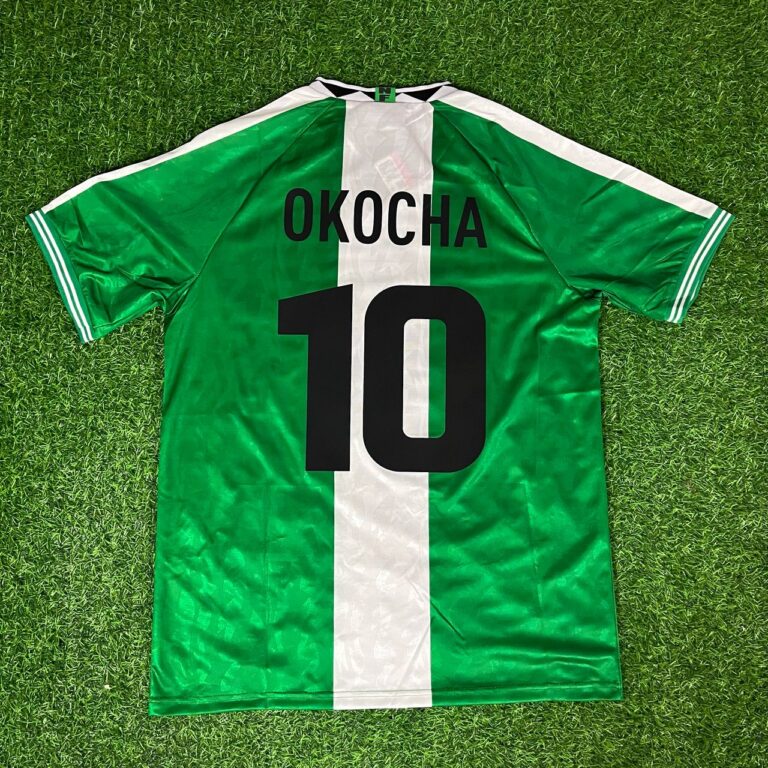
In Nigeria, the likes of Henry Nwosu, Jay-Jay Okocha, Friday Ekpo, Etim Esin, John Obi Mikel and others have at one time or another worn this highly influential jersey. Each carried its tale in the mode of superstition. While some crumbled under the weight of the jersey, others had a middling career, while still others flourished. From this list of precocious talents, Nwosu stands out — his lean shoulders began carrying the heavy jersey at age 17.
One of those who changed the face of jersey No. 10 in Nigeria is Henry Nwosu. An elite No. 10 must possess glue-like control, an eye-catching first touch, cleverness in tight spaces, and an elegant proverbial tailor’s pin to knit the defence and attack together, allowing them to run in behind and act as a winger. Henry Nwosu ticked all these boxes except the last. Nwosu’s decision-making is faster than time, and his passes on the field are like pure art calligraphy on paper. Though petite, Henry Nwosu is among the very few No. 10s who belong to the realm of the pantheon, while a long list of other Nigerian players who donned the jersey gasped for breath.
Why do some No. 10s crumble and others flourish? An answer emerges from an unfamiliar place — Madison Avenue.
The answer lies in the Ogilvy incubation room, an unfamiliar terrain far from anything associated with football. Ogilvy & Mather was given a brief to rebrand Shreddies and position it as the number one in the cereal market by Kraft Foods. During the strategic session, a 26-year-old intern, Hunter Somerville, was probably immersed in the creative realm, holding Shreddies and jokingly saying, “It isn’t a square; it’s a diamond.” This statement struck a chord in the creative muse residing in Nancy Vonk, the leader of the creative team working on the project. She encouraged further synthesis of that idea, which gave rise to Diamond Shreddies. Despite being the same product — traditional and combo pack (a combination of traditional and Diamond Shreddies) — with the same advertising campaign, Diamond Shreddies got 18 per cent of market share during the first month. This shows that perception rather than logic determines how much products or brands are perceived in the minds of consumers.
Like the consumers who chose Diamond Shreddies despite being the same content as the old, football fans put their hope on No. 10 to snatch victory from the jaws of defeat when humiliation on the field beckons.
A replica of these perceptual dictates explains why some players crumble or shine when putting on a jersey No. 10. The number on the jersey is ordinary; it does not, in the real sense, add or take away anything from the player’s ability. However, because of the exploits of those players who donned the jersey in the past, there is a built-up perception on that number that occupies a space in the minds of coaches, football aficionados and is passed from one generation to another like an ancient mark.
From St. Finbar’s College under the guidance of Father Slattery to the NNB Football Club of Benin, which turned the WAFU Cup into its birthright, ACB, ASEC Mimosas of Côte d’Ivoire, Nwosu deepened the ancient mark and added more to the weight of No. 10. But on 14 March 2026, at 62, he put a final control on the ball at Lagos State University Teaching Hospital.
A Yoruba adage says: “Iru Olorun ni o si, iru eniyan po janti re re,” meaning there is nobody like God, but humans of the same character abound. This adage is fantastically true. But since Henry Nwosu’s swan song, we have not seen players who exhibit his extreme and brutal simplicity on the field. Neither have we seen a player with such a low centre of gravity who could, with a simple header, turn a goalkeeper like Joseph-Antoine Bell into a kid who had lost his footing in the rain during the 1988 African Cup of Nations.
Perhaps, if I am permitted, I can tweak the adage to: “Iru Olorun o si, iru eniyan na sowon,” meaning there is no one like God, and men of similar character are scarce too. I say: Henry Omo Nwosu, o daro!
Shodunke, a media practitioner, writes via tolushodunke@yahoo.com
In this article