
By GEB
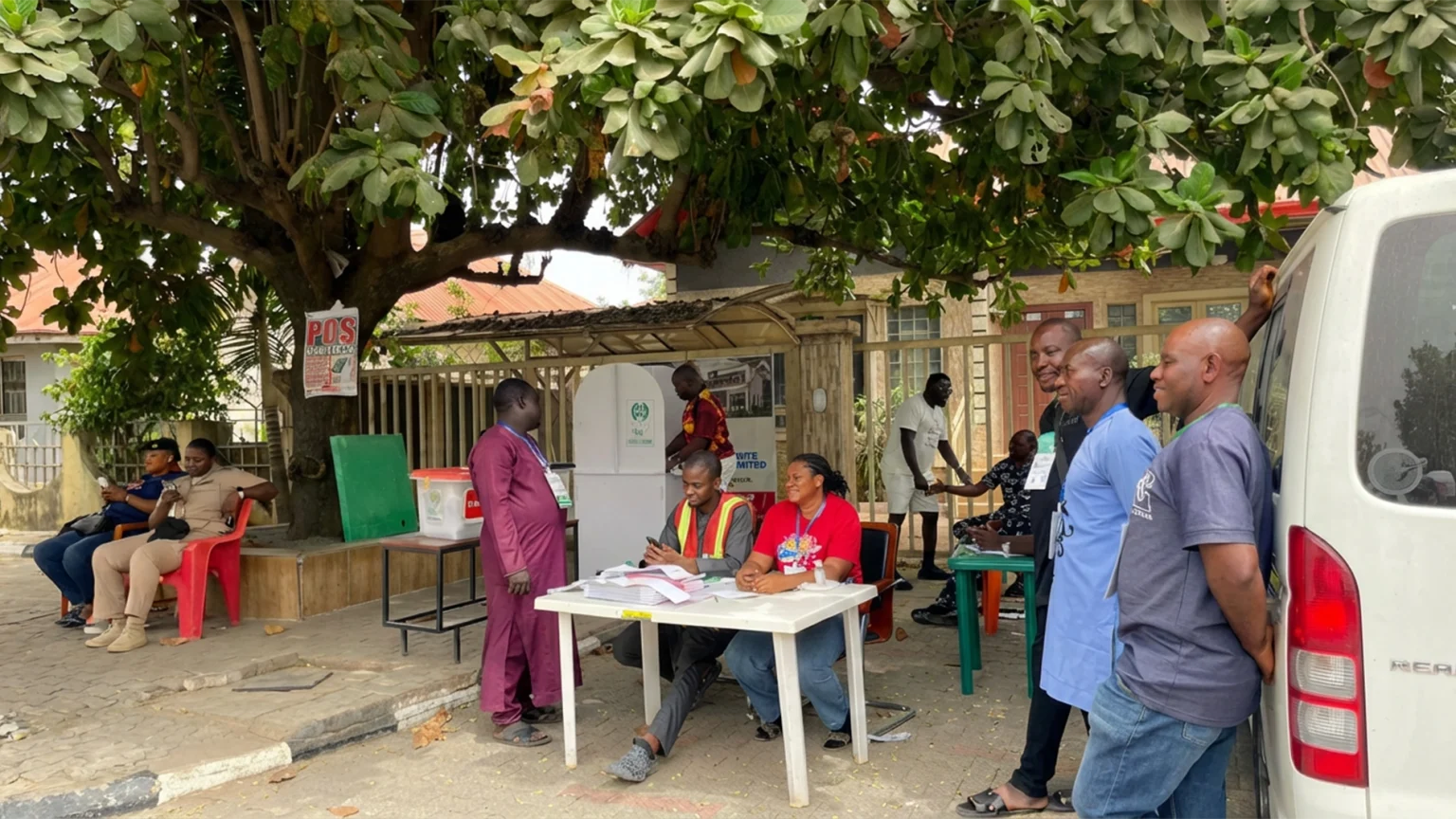
Last month’s area council election in the Federal Capital Territory is a sad metaphor for how elections should not be held in any country, let alone one widely considered the largest democracy on the African continent. The machines were there. The booths were in place. INEC sent 4,345 BVAS machines to 2,822 polling units. But the voters failed to show up. Taking place in the nation’s capital and barely a year before the 2027 general elections, the development points to democratic defect, a malady that must be treated with utmost urgency.
Of the 1,587,025 voters who had collected their Permanent Voter Cards, only 239,210 turned out to perform their civic duty. That amounts to roughly 15 per cent turnout. In the Abuja Municipal Area Council alone, where 837,338 voters are registered, only 65,676 were accredited on the day, less than eight per cent. In some polling units, as few as 10 people were said to have voted all day.
Incidents of low turnout in the FCT are not new. The numbers have been falling over the years. The recent election may only show that citizens’ faith in the democratic process has slipped one rung further. And even if that is not the case, there is still no reason to rejoice that what is very wrong today was only slightly less wrong yesterday.
Figures from the Catholic Bishops Conference of Nigeria show that in the 2003 general elections, turnout was reportedly 69 per cent. By 2007, it had fallen to 57 per cent, then to 54 per cent in 2011, 43.65 per cent in 2015, 35.66 per cent in 2019, and 23 per cent in 2023.
If elections in the FCT, a fair specimen of the country’s democratic pulse, are recording turnout below 15 per cent, where does that leave the rest of the nation? The polls should therefore not be viewed as a local government matter, but as a national problem that calls for a national solution.
A logical diagnosis should begin with the Electoral Act 2026, the most recent political development and the disturbing ripples it sent through the electorate. Despite the storm of protests that trailed the legislation, President Tinubu signed it into law on February 18, 2026, three days before the election. Under Section 60(3) of the new law, manual collation remains the primary basis for counting results in cases of network failure, with Form EC8A, filled in by hand, serving as the decisive document. Electronic transmission is allowed, but it is not mandatory and can be bypassed in the event of a “technological failure.” For many Nigerians, that clause alone is reason enough to stay at home, given past experiences with manual collation.
The conditions on election day could hardly have been worse. The FCT Police Command, acting on a directive approved by the President and announced by FCT Minister Nyesom Wike, imposed a 12-hour restriction on movement across major roads in the FCT, including Maitama, Karu, Orozo, Mararaba-Nyanya and Gwagwalada. Security operatives set up roadblocks. People trying to reach polling units were turned back. Others woke up, saw the situation and simply chose not to go out.
Wike is not a registered voter in the FCT but a cabinet minister with no formal role in conducting these elections. Yet he was seen moving from polling unit to polling unit during voting — a tour which some analysts describe as projecting undue influence in the electoral space, even if accounts of his visits varied. Such unevenness, where a powerful individual moves freely while ordinary people are blocked, does not encourage participation.
There are also concerns about how the elections were managed politically. The APC’s campaign council for local council seats — not national elections — was chaired by a state governor and co-chaired by three others. The Senate President, the Speaker of the House of Representatives, and the Deputy Speaker were also members. When that much federal weight is brought to bear on area council polls, there is a real risk that people will conclude that the election has been compromised. If that perception takes hold, voting will understandably feel pointless.
The opposition parties are also at fault. Many polling units had no opposition agents. There was reportedly little organised mobilisation before the vote. The only council won by the PDP, Gwagwalada, was secured in unusual circumstances: the APC’s own candidate withdrew before polling day and endorsed his PDP rival. If opposition parties wish to win the people’s votes, they must be seen to be organised and present. Rather than focusing solely on blaming the ruling party for making the best use of its advantages, they should examine what they have failed to do.
The citizenry cannot be absolved of blame either. Staying at home on election day and then complaining about bad governance is a contradiction. When people say their vote does not count and then refuse to vote, they ensure that it does not count.
After the results were announced, the ruling party and the Presidency celebrated, with the APC chairman describing the outcome as a confirmation of public support for President Tinubu’s agenda. The presidential spokesman also praised the polls as evidence that democracy is growing stronger. However, winning five of six councils when more than 85 per cent of registered voters did not show up points to a weak mandate. Rather than singing triumphant tunes, a government that wins on such turnout should be genuinely concerned. Low turnout undermines claims of broad public support.
While congratulating winners in elections is standard practice, the speed with which the Presidency applauded the outcome, amid a storm of complaints from the opposition, bears an uncanny resemblance to the speed with which the Electoral Act 2026 was signed amid loud protests. Against the backdrop of such low turnout, the nation’s leadership should have paused for sober reflection instead of appearing overly eager to celebrate partisan victories.
The Electoral Act 2026 remains the governing framework for the 2027 elections. It is unlikely that its opponents can do much to change that. The burden of execution now rests with the Independent National Electoral Commission, which must ensure the deployment of credible personnel and take concrete steps to restore Nigerians’ confidence in the electoral process. It is understandably difficult to participate enthusiastically when referees are perceived to be biased.
The FCT council polls have come and gone, with victors and vanquished offering their separate commentaries. Meanwhile, the meaning of good governance is hardly in dispute. The expectation of the average FCT resident is citizen-oriented governance.
Although a higher turnout and a less restrictive voting environment would have been preferable, the embarrassment of February 21, 2026, could still be mitigated if the elected officials
deliver quality service to the electorate.
In this article