
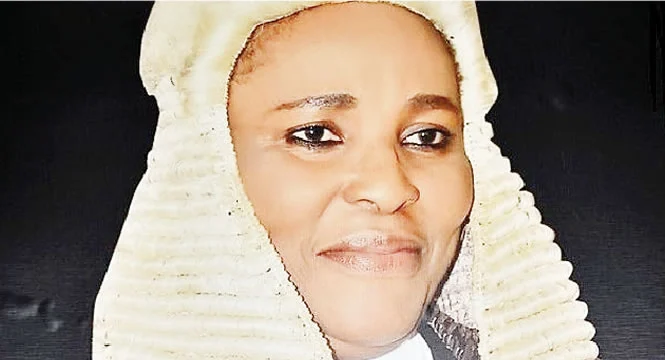
The Chief Judge of Ogun State, Justice Mosunmola Dipeolu, has called for stronger collaboration among stakeholders — including the police, lawyers, judges, relevant government agencies, and non-profit organisations — to effectively address sexual violence in the country.
Dipeolu also advocated the adoption of technology, such as the use of video link facilities in sexual violence cases, to allow witnesses — particularly children or traumatised survivors — to testify from separate rooms, thereby reducing the trauma of confronting the accused in open court.
She said the judiciary occupies a pivotal and unassailable position in the fight against sexual violence and must remain committed to ensuring that courts become fortresses for survivors, while offenders are adequately punished to serve as a deterrent to others.
The Chief Judge, who was represented by Justice Funke Odubanjo, made the call on Saturday in Abeokuta at a stakeholders’ gathering themed, “Strengthening Laws, Policies, and Institutional Coordination to Improve Justice Delivery in Sexual Violence Cases,” organised by the Headfort Foundation for Justice.
Dipeolu, who spoke on the topic, “The Weight of the Gavel, The Call for Justice: A Judicial Perspective on Dismantling Barriers and Forging a Survivor-Centred Response to Sexual Violence,” said it was incumbent on the judiciary to prioritise justice for survivors of sexual violence.
She said, “We are the guardians of the Constitution, the interpreters of our laws, and the arbiters of justice. Our role extends beyond the mere adjudication of cases. We set the tone for how society views these crimes.
“Through our conduct in the courtroom, our interpretation of evidence, our sentencing, and our management of the trial process, we either reinforce harmful stereotypes and re-traumatise survivors, or we uphold their dignity and affirm their rights.”
She noted that Section 34 of the 1999 Constitution of the Federal Republic of Nigeria guarantees the right to the dignity of the human person, which she described as the constitutional bedrock upon which the judiciary’s efforts must rest.
According to the CJ, every survivor who walks into a courtroom seeks the enforcement of this fundamental right — validation, protection, and restoration of the dignity violently stripped from them.
She stated that the Ogun State Violence Against Persons (Prohibition) Law, 2017, provides a robust framework for tackling sexual violence, as it expands the definition of sexual offences, provides for the protection of survivors, and prescribes stringent penalties for offenders.
However, Dipeolu identified delayed justice, evidential hurdles, the adversarial culture of the legal system, and a lack of effective coordination in the administration of justice as major impediments to securing justice in sexual violence cases.
To address these challenges, she suggested the adoption of technology such as video link systems for vulnerable witnesses, clearer and more protective sentencing practices, and enhanced institutional collaboration to improve justice delivery.
“In conclusion, let me state that the fight against sexual violence is not a battle the judiciary can win alone. It is a shared responsibility that falls on all of us.
“It falls on the executive to adequately fund our justice institutions and social services. It falls on the legislature to continuously review and strengthen our laws.
“It falls on the police to investigate professionally and with empathy. It falls on civil society to support survivors and hold us all accountable.
“It falls on the media to report on these issues with sensitivity and accuracy, avoiding sensationalism that can further stigmatise survivors. And it falls on us, the judiciary, to be the fair, fearless and empathetic umpires that justice demands,” she added.
The Chief Judge commended the Headfort Foundation for Justice for its commitment to the cause, noting that the organisation has reached over 500,000 women with information on accessing justice in sexual violence cases. She urged other organisations to help bridge the gap between the law and the people it is meant to serve.
In her remarks, the Executive Director of the Headfort Foundation for Justice, Mrs Oluyemi Orija, said the stakeholders’ meeting was organised to enhance access to justice and support for survivors of sexual violence.
“We are very keen on a survivor-centred approach — not just justice, but justice that protects and prioritises survivors of crime, particularly in sexual violence cases,” she said.
“At today’s event, we are also examining the existing laws in Ogun State to identify areas that need strengthening to better protect survivors’ rights and promote the speedy administration of justice in such cases.
“You have heard from stakeholders — judges, police officers, the NBA, FIDA, and the Ministry of Women Affairs — who have shared their experiences and highlighted existing gaps. Recommendations are being made on how to address these gaps so that, ultimately, we achieve a justice system that delivers more effectively for survivors of sexual violence.”
She added that justice sector actors in Ogun State and across Nigeria have the capacity and willingness to act, but require adequate government support and funding.
“Importantly, we need government support and funding because none of these goals can be achieved without proper financial backing,” she said.
Other speakers at the meeting included the Chairman of the NBA, Abeokuta branch, Chief Kayode Aderemi; Chairperson of the International Federation of Women Lawyers, Mrs Taiwo Olusesi; SP Bunmi Asogbon of the Gender Unit, Ogun State Police Command, Eleweran; and Mrs Adewusi Olajumoke, State Director of Women Empowerment Services, Ministry of Women Affairs and Social Development, among others.
In this article