
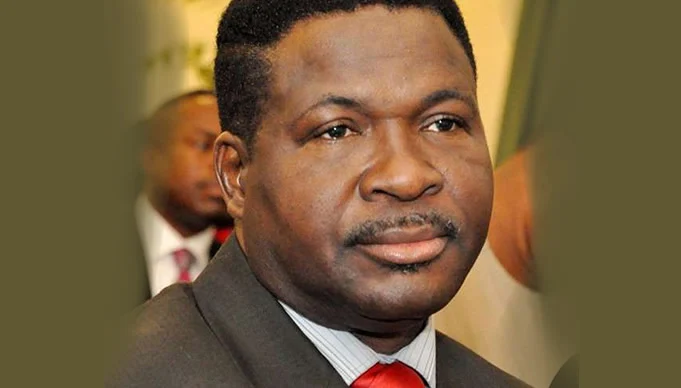
By Itsede Okhai Esq.
Every Nigerian has seen this pattern before. A powerful man dies, the veil over his private dealings is lifted, and the public demands accountability. But the dead cannot be docked. So attention turns to the living, often the lawyer who stood closest to the matter. That is the uncomfortable context in which the case against Chief Mike Ozekhome, SAN, must be examined.
The London property at the centre of this controversy did not suddenly acquire a false identity because of Ozekhome. Long before he asserted any interest, General Jeremiah Useni had already purchased the house under the name “Tali Shani.” This is not speculation; it is the finding of a UK tribunal. The false name, the concealment, and the offshore structure were all Useni’s creation. That single fact matters because criminal liability does not travel by association. In law, a person is punished for what he does, not for what another did before him.
The prosecution’s theory quietly skips this starting point and invites the public to believe that because forged or unreliable documents surfaced later, Ozekhome must be responsible for them. That leap is emotionally satisfying, but legally dangerous. Criminal law does not operate on suspicion or moral discomfort. It operates on proof beyond reasonable doubt. And here, proof is precisely what is missing.
There is, as of now, no direct evidence that Ozekhome forged any document. No forensic report has been produced linking him to the creation of a Nigerian passport. No issuing authority has testified that he applied for it. No witness has come forward to say he instructed or supervised its fabrication. Even the UK tribunal, whose findings are now being leaned on heavily, explicitly admitted that it could not determine who was behind the various forgeries. That uncertainty did not prevent the tribunal from resolving ownership, but it should trouble anyone who understands the difference between a civil finding and a criminal conviction.
The law is clear on this point. To sustain a charge of forgery or fraudulent use, the prosecution must prove not only that a document is false, but that the accused either made it, procured it, or knowingly used it as genuine. Knowledge is not presumed; it must be proven. Courts have repeatedly warned that it is unsafe to infer criminal intent merely because a document later turns out to be unreliable. Otherwise, every lawyer who files a document on a client’s instruction becomes a suspect the moment that document is challenged.
Much has also been made of the timing of Ozekhome’s claim—that it became prominent after Useni’s death. But timing, in law, is not a crime. Property disputes routinely emerge after death because that is when estates are administered and interests collide. If asserting a claim post-death were evidence of fraud, probate courts would be emptied into prison yards. What matters is not when a claim is made, but whether it is supported by valid proof. That question belongs first to civil adjudication, not to criminal punishment.
There is also an uncomfortable inconsistency in the prosecution’s narrative. On one hand, it accepts that Useni used “Tali Shani” to acquire and hold the property for decades. On the other hand, it suggests that the same Useni could not, in law or logic, use that same identity to transfer or gift the property. That position is weak. A pseudonym, once adopted and used consistently, does not vanish at the convenience of the State. If the law could recognize “Tali Shani” for purchase, it cannot selectively reject it for transfer without clear evidence of fraud at the point of transfer. And that evidence has not been shown.
What is really happening here is a quiet substitution of certainty for proof. Because forged documents exist, someone must answer. Because Useni is dead, someone else must carry the burden. Ozekhome, visible, vocal, and alive, becomes the convenient vessel for collective outrage. But criminal justice is not a tool for emotional closure. It is a disciplined process that demands precision.
There is a deeper danger in this case that should concern every legal practitioner and every citizen who may one day need one. If a lawyer can be criminally charged simply because a client’s long-running deception unravels after death, then legal representation itself becomes a risk. Lawyers would be forced to guarantee the moral purity of their clients or face prosecution by hindsight. That is not the law; it is intimidation dressed as accountability.
This case, stripped of its noise, is not about whether General Useni concealed assets. That question has already been answered. It is about whether the State can convert unresolved civil complexity into criminal certainty without doing the hard work of proof. If it can, then innocence becomes conditional, and proximity becomes guilt.
The law does not work that way. It never has.
When the true architect of a scheme is gone, the answer is not to manufacture a new culprit. Criminal law punishes acts, not atmospheres. Evidence, not narratives. Until direct proof is placed before a court, Chief Mike Ozekhome, SAN, is not a symbol, not a scapegoat, and not a substitute for the dead.
He is, in law and in fact, presumed innocent.
– Itsede Okhai (LL.M) is a legal practitioner based in Lagos, Nigeria.
itsedeokhai1@gmail.con
In this article