
By Dele Kabir Hassan
Nigeria has once again found itself under an unflattering international spotlight, not because of diplomatic missteps or economic turbulence, but because of a deeply troubling legal saga that began in a foreign court and has now returned home demanding institutional reckoning.
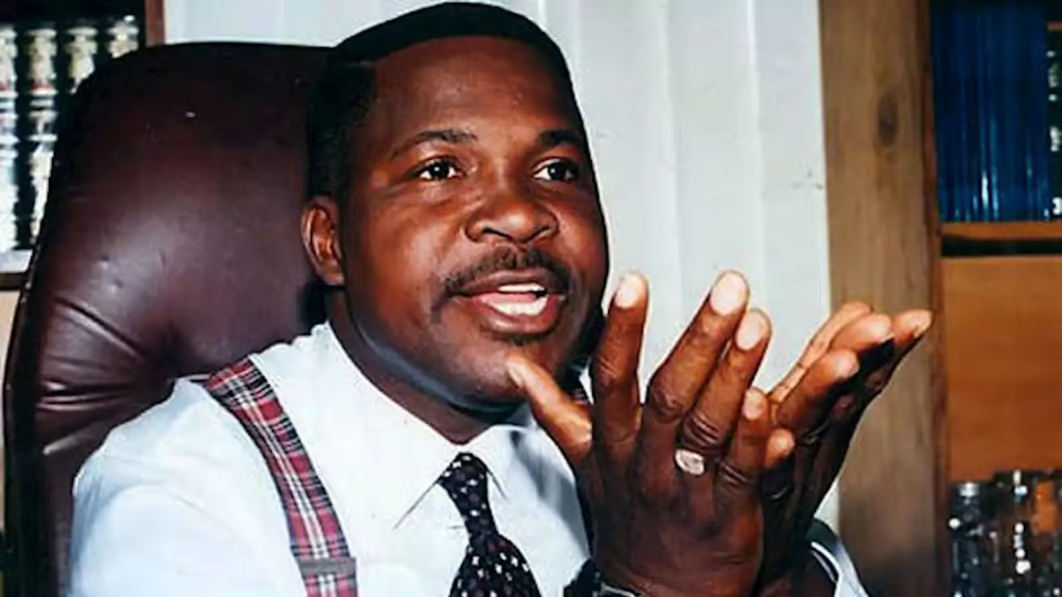
The case involving Senior Advocate of Nigeria, Chief Mike Ozekhome, arising from a disputed London property and a scathing judgment by a United Kingdom tribunal, is not merely about one man or one asset.
It is about how Nigeria responds when a foreign court lays bare conduct it describes as dishonest and rooted in fabrication, and whether the country’s institutions are prepared to follow the evidence to a logical, lawful and credible conclusion.
At the heart of the controversy is a residential property at 79 Randall Avenue, London. What might ordinarily have been a routine dispute over ownership instead evolved into a judicial exposé after the UK First-Tier Tribunal (Property Chamber) examined competing claims to the property.
Chief Ozekhome’s claim was that the house had been gifted to him in 2021 by an individual identified as Shani Tali. To support this assertion, documents and identity records were placed before the tribunal, including materials meant to establish the donor’s existence, ownership rights, and capacity to transfer the property.
The tribunal, after hearing witnesses and reviewing the documentary trail, rejected the claim in its entirety.
In language that attracted immediate attention within international legal circles, the court concluded that the supposed donor did not exist, that the identity relied upon was fictitious, and that the documents presented in support of the ownership claim were fabricated. The tribunal stated unequivocally that it did not accept that the named individual had ever been a real person, nor that such a person could have purchased the property or passed title to anyone else. It went further to describe the entire ownership narrative as one built on deception.
More damaging still was the tribunal’s reconstruction of the property’s true history.
The court found that the house had been acquired in the early 1990s by the late General Jeremiah Useni using a false identity. On that basis, it held that no lawful title ever vested in the fictional donor and that no valid gift could therefore have been made to Chief Ozekhome. His application to be registered as proprietor was cancelled, and the tribunal’s findings were placed firmly on the public record.
These were not casual remarks or speculative observations. They were detailed judicial findings reached after contested proceedings in which evidence was tested and credibility assessed. Unsurprisingly, the judgment travelled quickly beyond the confines of the property tribunal, circulating within international asset-recovery, anti-money laundering, and legal accountability communities. The prominence of the parties involved, particularly the fact that one was a Senior Advocate of Nigeria, only amplified the attention.
It was against this background that Nigeria’s Independent Corrupt Practices and Other Related Offences Commission (ICPC) stepped in. Following petitions and a review of the UK proceedings, the ICPC filed criminal charges alleging that Chief Ozekhome knowingly received the London property, created or procured forged Nigerian identity documents in the name of Shani Tali, and used those documents in pursuit of the disputed ownership claim.
The Commission has indicated that its case will rely on documentary exhibits, investigative findings, and testimony from officials of the Nigerian Immigration Service.
Chief Ozekhome, like every defendant, is entitled to the presumption of innocence, and the Nigerian courts will determine his culpability, if any. But what cannot be ignored is that this case did not originate in rumour or political vendetta.
It emerged from a foreign judicial process that examined evidence and delivered findings of fact that are now impossible to pretend do not exist.
This is what has raised the stakes. Nigeria is no longer dealing with a purely domestic allegation that can be quietly buried or allowed to wither through delay. It is dealing with a case in which a foreign court has already concluded that it was presented with forged identities and a false ownership narrative. How Nigeria responds will inevitably be read as a statement about its seriousness as a legal and institutional actor.
The reputational dimension cannot be overstated. Nigeria has been through similar moments before. The conviction of former Deputy Senate President Ike Ekweremadu in the United Kingdom over organ trafficking was a profound embarrassment, not simply because of the crime, but because it reinforced a damaging global narrative: that powerful Nigerians believe foreign systems can be manipulated without consequence, and that accountability only truly arrives when imposed from outside.
Each such episode leaves residue. It shapes how Nigerian professionals are perceived, how Nigerian passports and documents are scrutinised, and how Nigerian institutions are trusted or doubted abroad. The Ozekhome case threatens to deepen that damage if it is mishandled.
The UK tribunal’s findings already suggest a troubling level of audacity: the alleged invention of an identity, the deployment of forged documents, and the pursuit of property rights through misrepresentation. When conduct of that nature is associated with a senior member of the Bar, the implications go well beyond one courtroom.
For President Bola Tinubu’s administration, this case is an uninvited but unavoidable test. The government has pledged to strengthen institutions, combat corruption, and restore confidence in the rule of law. Those commitments are now being measured not by rhetoric but by response. International partners, foreign courts, and asset-recovery bodies are watching closely, not out of hostility, but because Nigeria’s reaction will inform future cooperation and trust.
The ICPC has taken an important first step by filing charges. That step must be allowed to run its full
course. Anything less — whether through undue delay, procedural manipulation, or quiet abandonment — would speak louder than any official statement. It would suggest that even when dishonesty is judicially exposed abroad, accountability at home remains negotiable.
This case is not about public humiliation or predetermined outcomes. It is about evidence, due process, and institutional credibility. The Nigerian judiciary does not need to echo the UK tribunal; it needs to do its own work thoroughly and transparently. But it must do that work without fear or favour, and without succumbing to the familiar temptation to let difficult cases simply fade from view.
Nigeria’s reputation is not shaped by slogans or press releases. It is shaped by what the world sees when the country is tested. Right now, Nigerians are watching. The international community is watching. The Tinubu government, the ICPC, and the courts must act with the clear understanding that this case has already crossed Nigeria’s borders, and that how it ends will say much about who we are as
a country and how seriously we take the rule of law.
Hassan is a public affairs analyst
In this article