
By PEB
AFTER succumbing to sudden deaths from myriad avoidable causes, many Nigerians still seem bent on stretching an already grim tally by committing suicide. Scooping fuel spilled from crashed tankers, a senseless, reckless gamble, has consumed so many lives. Yet, Nigerians still indulge in such folly at every turn.
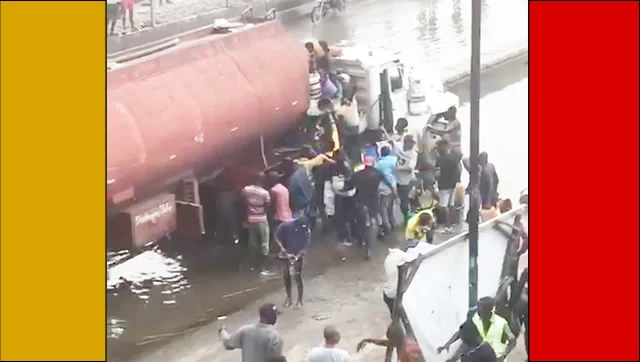
On 19 January, a tanker crashed on the Liverpool Bridge inward Mile 2, in the Apapa area of Lagos. The 33,000-litre diesel-laden tanker, operated by NIPCO Ltd, apparently lost control and overturned, spilling large volumes of diesel to the road beneath.
In a twinkle, a mass of people had busied themselves scooping the product into buckets and other containers. If this tanker had fallen off the bridge, a worse disaster would have occurred.
Luckily, emergency responders, including the National Emergency Management Agency and the Lagos State Traffic Management Authority, intervened to contain the situation. The Lagos State Emergency Management Agency deployed a crane to upright the tanker. The road was also closed to traffic to avoid escalation.
The Nigerian Police provided security and helped to control the crowd and regulate traffic. The damaged vehicle was later towed away after the remaining diesel was transferred to another tanker. The Lagos State Fire and Rescue Service later washed the spilled diesel off the road.
The Director of Operations at LASEMA, Olatunde Akinsanya, reportedly attributed the accident to excessive speeding on the bridge. The LSFRS reportedly said the accident was due to brake failure.
The state governor, Babajide Sanwo-Olu, described the action of residents who trooped to the scene to scoop fuel as reckless and dangerous. He warned residents to desist from such acts.
It is surprising that in spite of the high risk, people remain adamant about scooping fuel from crashed tankers and burst pipelines.
They ignore the danger of an ignition and consequent monumental tragedy.
Ordinarily, numerous incidents of this nature in the past should have taught people a lesson. Sadly, that is not the case.
Thousands have perished in the past three decades from explosions and fire outbreaks while scooping up fuel from fallen tankers and burst pipelines.
In October 1998, over 1,000 people were killed when a ruptured pipeline exploded in Jesse, Ethiope West Local Government Area of Delta State. The victims were attempting to scoop fuel spilled from the pipeline.
In June 2003, over 100 people died while trying to scoop fuel from a ruptured pipeline at Onicha-Amaiyi in Abia State. In Abule-Egba, Lagos, over 200 people died attempting to scoop fuel from a vandalised pipeline in December 2006.
Between January 2009 and October 2024, about 169 fuel tanker accidents reportedly led to 1,613 deaths. In July 2012, over 100 people died in Okogbe, Rivers State, while trying to scoop fuel from a crashed tanker.
A similar tragedy happened in 2019 when more than 60 persons scooping fuel died after a petrol tanker exploded in Odukpani, Cross River State. In the same 2019, over 50 people who rushed to scoop fuel from a crashed tanker died at Ahumbe in Benue State.
In 2024, the Federal Road Safety Commission estimated that over 411 Nigerians lost their lives while attempting to scoop fuel from fallen tankers.
On 1 October 2024, a fuel tanker fell and spilled its contents on the failed portions of the Oghara-Ologbo axis of the Sapele-Benin Motorway. Five of the youths who rushed to scoop fuel from the tanker died in the explosion that followed. The explosion also destroyed eight buses, two tankers, five trailers, two cars and one motorcycle.
Over 150 people died in Majiya town, Taura LGA of Jigawa State, when a tanker overturned and exploded in October 2024.
In September of the same year, at least 48 people lost their lives when a tanker collided with another vehicle, causing an explosion on the Agaie-Lapai Road in Niger State.
In January 2025, at least 98 people perished when a petrol tanker crashed and exploded near Suleja in Niger State. Dozens of others were injured. The people rushed to scoop fuel from the fallen tanker when it burst into flames.
The high level of poverty in the country is a major factor in this risky adventure. People are aware of the dangers inherent in this venture, but they are lured by the prospect of financial gain, despite the risks in a lawless atmosphere.
However, citizens must realise that financial status should not make them blind to danger. It is common sense and natural human instinct to run away from danger.
Besides, Nigeria over-relies on road transportation, with few alternatives like the railway. Yet, most of these roads are in very bad condition. This has caused accidents and will still cause more. Unfortunately, the relevant government agencies that should repair these roads appear not to be bothered most times.
No doubt, many of the trucks and tankers plying Nigerian roads are rickety and not roadworthy. Some of them do not have functional brakes, good headlights, or good tyres. Some are overloaded and carry above the 33,000-litre/30-tonne capacity. Some of the drivers are either not licensed or drive under the influence of alcohol and hard drugs.
There are FRSC officers, Vehicle Inspection Officers and the police on many of these roads. But most times, they concentrate on stopping cars to extort money. Hardly do they stop these rickety trucks and tankers to screen them.
This has to stop. Apart from deaths resulting from the scooping of fuel, the environmental impact of spilled fuel on the road is enormous. The resultant fires and fumes affect air quality, which can be harmful to health.
It is time to sanitise this sector. The law enforcement agencies need to save people from themselves. Rather than chasing tinted glass vehicles, the police and other law enforcement agents should chase and inspect rickety tankers and trucks as well as commercial buses. The Nigerian Security and Civil Defence Corps should also help to address the situation.
Tankers exceeding the 33,000-litre capacity limit must be detected and the owners sanctioned, per rules by the Federal Government.
There should be laws that regulate the movement of fuel tankers. Preferably, they should be made to move only at night when the roads are relatively freer. Owners of these tankers must be made to pay hugely for any careless accident arising from the poor condition of their vehicles.
Dangote recently bought 4,000 new fuel tankers that run on compressed natural gas and 6,000 dry cargo trucks. This should be encouraged. There should be enforcement of the quality of tankers plying the roads. The government should phase out old trucks and tankers.
There should be emergency hotlines where people can call and report incidents of fallen tankers or ruptured pipelines.
When fallen tanker incidents happen, the place should be immediately cordoned off to avert disaster.
The Nigeria Police Force, NEMA and state emergency and traffic response teams must collaborate with a view to responding promptly to prevent disaster when tankers crash.
The National Orientation Agency and other relevant government agencies should intensify enlightenment campaigns and issue warnings against scooping fuel from tankers.
The message can be amplified through traditional rulers, religious and social organisations, because many, especially in rural areas, may not have access to modern means of communication. After all the warnings and messages against these types of people, who still engage in it, should be arrested and sanctioned to serve as a deterrent.
In this article