
By Tunde Odesola
The (Om0) child (tó) is (bá) the (ma jé) father (Àsàmú) to (kékeré) the (ló ti ń jenu) man (sámú-sámú). Ehn, yes! Deal with it! The mishmash opening sentence is intentional because it is the confusion I have on offer today, not peace nor order… Not prostration or placation. My esteemed readers can’t be eating Christmas rice and chicken while I wrack my brain to produce an article, which will be digested within 20 minutes, amid mutterings of ‘uhm!’, “na wa o” and “you said it all”. No, I won’t have all that.
Dear readers, where’s my Christmas rice and chicken? At all, at all, na im bad. It’s not only your mouths that can describe the road to Òyó: Enu yín nìkan kó ni wón ń bá dé Òyó. My own mouth too can also describe the road to Òyó if I sight a plateful of chicken and jollof rice.
Even if my cheeks bulge with a mouthful of rice and my eyes ogle with foodie greed while I clutch chicken thighs in both hands, I still can describe with my mouth 100 roads leading to Òyó. Right now, I’m journeying to the palace of Aláàfin Abimbola Akeem Owpade, the Iku Baba Yeye, to celebrate Christmas with him. If you are interested, you can come along; Aláàfin has more than enough food and palm wine to go round.
Now, let’s get a bit more serious. If you run the jargony first sentence of this article through a literary sieve, you will get two intertwined proverbs: one English, the other Yoruba. The English proverb is “The child is the father of the man”, and its Yoruba counterpart is “Omo tó bá ma jé Àsàmú, kékeré ló ti ń jenu sámú-sámú”. Neither plagiarised the other. Only that the same stream of thought flowed through two different social milieux in different languages, at different eras, before congealing into wisdom. The English proverb was coined by William Wordsworth, an English poet, in his 1802 poem, “My Heart Leaps Up”. Its Yoruba equivalent, “Omo tó bá ma jé Àsàmú”, is a fruit of logic dangling on a communal tree at the village square.
Since the two proverbs mean the same thing, I’m taking both with me to the Olṕyo in Òyó. “The child is the father of the man” implies that the gamut of a person’s childhood experiences, character, and values fundamentally shape who they become as an adult, stressing that the innocent, formative years of childhood lay the groundwork for the entire adult life. The proverb has a couple of other meanings, but the meaning I deploy here suffices for this engagement. The Yoruba proverb, “Omo tó bá ma jé Àsàmú, kékeré ló ti ń jenu sámú-sámú”, means “A child that would grow to become Àsàmú (an adult), would possess from childhood, Àsàmú’s sharp oratory skill”.
Let me bore you with the story a deputy governor told me many years ago. “Tunde, I was a rascally child. There was no mischief beyond me. One day, I rummaged through my father’s alcohol cabinet, which had all sorts of choice drinks. Normally, I drink from any bottle that tickles my fancy. But, one particular day, I took a swig from a dark bottle, it was so sweet, nice and creamy. I took another swig and fell asleep, right by the cabinet.
“I jerked awake to my father’s car horn. Quickly, I locked the bar, bolted to my room, grabbed a book and sat like a saint. Ha, that was a close shave! Hot air zipped down my nostrils. That night, I slept soundly. I looked forward to another drink from the dark bottle. On subsequent occasions, I drank from the bottle. Each time I drank, I topped it up with a little water.”
“One day, my daddy had some of his fellow top civil servants visiting. He was happy to receive them. He went to his mahogany bar, opened it and brought out various drinks. Clutching ‘my’ bottle, my father proudly announced to his friends that he bought the creamy drink and some others from France. One of his friends took the ‘my’ bottle from him, noticed it was already opened, but he didn’t say anything.
As he opened and poured the drink, my heart relocated. The drink that was once chocolate had turned snow-white. When he tasted it, his face crumpled like a deflated balloon. He called my father by his first name and showed him the content in his cup, saying, ‘Lagbaja, this is not from France.’
“My father was a no-nonsense. His instrument of chastisement was an entwined six-wire whip. After seeing off his friends, he stormed back in. He called all of us to the sitting room and announced the crime. He didn’t ask who the culprit was. He just said, ‘I’ll begin with the youngest! Hey, you, come here!’
“My youngest sibling screamed, ‘Èmi kọ́ o ! It’s not me o! It’s Aunty Tamedo. I saw her when she opened your cabinet and drank your drinks! It’s not me o!!’
Unknown to him that the soul of his Irish Cream had been killed by his daughter, the deputy governor’s father lived on false hope, believing that his bar was still as warm as a furnace, not knowing that it was as cold as a refrigerator. He was living in the past, like Aláàfin Ọwọade is doing today.
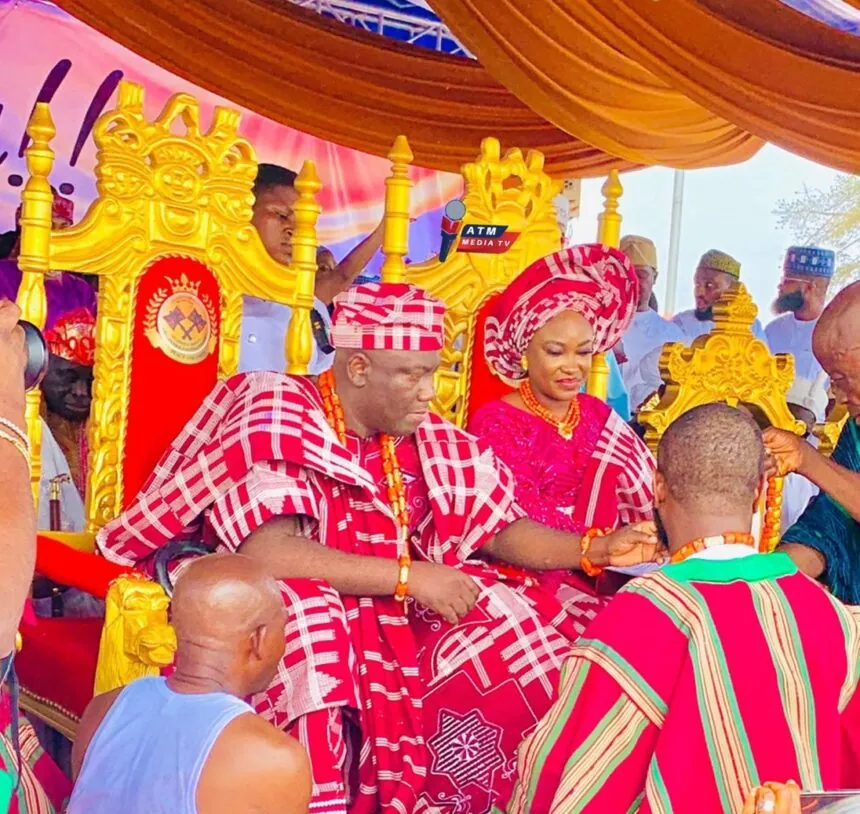
Enthroned in the first quarter of 2025, Ọwọade has yet to clock one year on the àpèrè of his forefathers. But it appears the Ọlọ́yọ has been reigning for over a decade. The gbas-gbos sound of the pestle pounding the mortar in Ọ̀yọ́ is not a dinner invitation. The sound is the drumbeat of an unnecessary war. On April 11, 2025, exactly six days after his inauguration on April 5, 2025, I wrote an article, “Letter to Alaafin Abimbola Owoade,” in honour of the new king, congratulating him and charging him to rule in peace, love and harmony. In the article, I prayed, “May the land not be angry with your majesty. May Ọ̀yọ́ live in harmony during your reign…Aláàfin, so far, your feet appear set on the path of honour, I beseech thee not to depart from it.”
Upon noticing the unmelodious bata sound emanating from Ọ̀yọ́ palace thereafter, I wrote another piece on May 9, 2025, titled “Aláàfin Ọwọade: Thy bata drum is sounding too loudly”. In the article, I called on Ọwọade to tread with caution, warning that royalty road is strewn with banana skins. Specifically, I recalled the controversial death of Chief Lookman Arounfale, the Baba Ọjà of Ọ̀yọ́tùnjì, a US community, after he was reportedly attacked in Aláàfin’s palace. However, the palace issued a statement denying involvement in the death of Arounfale.
In the article, I also recalled how the Ọ̀ràngún of Ìlá, Ọba Abdulwahab Oyedotun, and his entourage were allegedly treated shoddily during a congratulatory visit to the Aláàfin.
From day one, I mean, right on Aláàfin’s coronation day, controversy erupted over what many Yoruba sons and daughters perceived as shabby treatment of the Ooni of Ife, Ọba Adeyeye Enitan Ogunwusi, whose name was not mentioned at all during the programme. As the culturally recognised head of all Yoruba traditional rulers, the Ọọni was not given the honour to speak at the occasion. This action presupposes that the Alaafin, even before his coronation, nursed a complex against the Ọọni. My personal findings showed that when it was the turn of an oba to speak on behalf of all traditional rulers present at Ọwọade’s coronation, it was the Oloro of Oro in Kwara State, Ọba Oyatoye Titiloye, a couple-of-months-old king, who was called to speak. When it was time for the Alaafin to talk, he failed to recognise the Ọọni or kings from Osun State. I don’t think that’s a good way to treat visitors who left their ‘ile ati ona’ to come and felicitate with you.
In his eight-month reign so far, Ọwọade has visited the Aseyin of Iseyin (Oyo State), Okere of Sak (Oyo State)i, Alake of Egba (Ogun State), Sultan of Sokoto (Sokoto State), Onitede of Tede (Oyo State), Olofa of Ofa (Kwara State), Oluwo of Iwo (Osun State), Emir of Ilorin (Kwara State), and the Olowu Kuta of Owu Kuta (Osun State), on a thank you and familiarisation visit. But he has yet to visit the ancestral and cultural head of the Yoruba nation, the Ooni of Ife, Ọọni Adeyeye Ogunwusi. I suspect Aláàfin Ọwọade is saving the biggest for the last. Iku Baba Yeye is at liberty to choose who and when to visit.
Ọwọade’s attitude became a matter of particular concern for me because the heatmap of his relationship with the Ooni indicates red, while that of the Arole Oduduwa is green. At this juncture, it is good to ask the Aláàfin a pertinent question. How has the Ooni wronged you? As I said earlier, it behoves the Aláàfin to associate with whosoever he desires, but it doesn’t lie in his right to exhibit an attitude that casts the Yoruba in discourteous, arrogant and unroyal light.
I ask again, what has the Ọọni done to deserve disdain from the Aláàfin – when the Ọọni has not publicly disrespected him? Before the Aláàfin thinks I’m doing a paid job for Ogunwusi, he should grab a copy of last Friday’s PUNCH and read how acerbic I was of the Ọọni for installing Senator Oluremi, the wife of President Bola Tinubu, as Yeye Asiwaju Gbogbo Ile Oduduwa, without using the symbolic ‘akoko’ leaves. The title of that my critique is “Tinubu: Ade Ori Okin befits KWAM 1, not Awujale crown”. Aláàfin, nobody send me o; I am just in the queue of Nigerians who demand responsible leadership for our society to grow.
The long queue of Nigerians demanding decorum from their leaders was shocked a few months ago when Ọwọade announced that he was the only traditional authority that could honour anyone with a title that covers the whole of Yorubaland. Ọwọade’s announcement came after the Ọọni honoured an Ibadan businessman, Dotun Sanusi, as the Okanlomo Oodua. Hehehe. The King of Oyo also gave Ogunwusi 48 hours to rescind the title given to Sanusi or face a consequence. The Ọọni has not rescinded the title. And thunder from the Ṣango of Ọyọ has failed to strike Ogunwusi. Abi, does the Aláàfin mean 48 years?
Or was the Iku Baba Yeye ‘catching cruise’ – as the youth of today would say? When confronted with an unserious or funny matter, the youth of today would also say ‘dey play’ or ‘ọ̀rọ̀ àpárá’.
A foremost traditionalist and Araba of Osogbo, Ifayemi Elebuibon, shared his opinion on the ongoing issue, saying the Old Oyo Empire, which Ọwọade is using as a basis for his preeminent claim, was long dead and buried. He said, “Ọyọ should pay reparation to other parts of Yorubaland that they despoiled. Ọyọ wreaked havoc on fellow Yoruba towns, lording it over towns and villages, and forcing them to pay tributes. When they argue that they rescued Yorubaland, did they fight wars as much as Ibadan? Where were they when Ibadan warriors were the ones who repelled and defeated the Fulani? The Old Ọyọ empire had collapsed then. So, should Ibadan also get up and say they are superior to Ile-Ife? No. How can a child be older than his father? Did Ọranyan, who founded Ọyọ, not leave from Ile-Ife? So, what are they saying? Is supremacy fight what our kings should be engaged in now?
“Look at how many people Basorun Gaa killed. Look at how many Alaafins he killed? Is that the type of history that we should be proud of? Is that the type of history that a king should derive his present-day authority from, and try to lord it over others as if we are still in the past? The Alaafin should learn patience. Many of our traditional rulers are bringing shame to us. Was it Ifa or a royal election that made Alaafin superior? But the Ọọni derives his superiority from Ifa.”
I reminded Elebuibon that Ifa chose the new Alaafin. He said, “Yes, Ifa chooses kings, but the chosen king must also reinvent himself…”
To be continued.
In this article